Megabass X-Nanahan +2: a 7.6 cm minnow that reaches 3 m
The right lure in the wrong spot still catches nothing. CarnaFish spots the zone that works, from a single photo.
Mid-August, a reservoir, the water has warmed and the fish have pulled off the bank. On the sonar you can see them pinned to a breakline around three metres, sitting on a change of slope. Your usual jerkbaits top out at a metre and a half: they pass two metres above the fish and move nothing at all. The Megabass X-Nanahan +2 exists to fill exactly that gap — a short minnow that reaches a layer normally reserved for long-lipped crankbaits.
7.6 cm for three metres: the lip gamble
The maker's table is unambiguous on this model: 3 in, or 7.6 cm, for 1/4 oz, or 7.1 g, a listed depth of 10 ft — 3 m — and a slow-floating class. Those four figures tell the whole story. Driving a 7.6 cm body down to three metres is counter-intuitive: the shorter a bait, the faster it wants to rise, and the harder the lip has to work to keep it down.
Megabass answers with what it calls an aero-bill, a long profiled lip with a double job. In flight it cuts drag and stabilises the trajectory, which produces unusually flat casts for a bait this size. In the water it supplies the bite the bait needs to dive. The maker also states that the body is carved from a high-volume block, to obtain a visually tight silhouette with greater precision and less air resistance.
The ratio between the 7.1 g and the listed reach is worth underlining: that's a high density for such a short body, and you feel it on the cast. With a correctly matched setup you cover twenty-five to thirty metres easily, which matters a great deal when the lip needs retrieve length to take the bait all the way down to its working depth.
Two actions in one body
This is the point the maker pushes hardest, and it isn't common. On a straight retrieve, with no rod input, the X-Nanahan +2 produces a high-pitched roll: the body pivots on its axis at small amplitude and high frequency, throwing tight flickers rather than one broad flash. The moment you give it a sharp pull, the same bait switches to a completely different register: an abrupt, unpredictable lateral lurch that cuts the trajectory dead.
Most minnows only do one of the two properly. A heavy roller stays dull on the twitch; a strong darter has a poor straight-retrieve swim. Being able to alternate within a single cast — fifteen steady handle turns, then two sharp pulls, then a pause — lets you test two behaviours without changing lures, which is valuable when you don't yet know what the fish want.
The slow rise, and why it matters at three metres
The Class column reads Slow-Floating. That isn't a detail: on the pause the bait doesn't hang, it rises, but very slowly. Two concrete consequences follow.
The first is positive: at three metres over cluttered bottom, a slow floater frees itself. You feel the lip touch a branch, you give a second of slack, the bait climbs a few centimetres and comes clear. A suspending bait stays stuck. That's the difference between fishing a stump calmly and working around it.
The second is a constraint on cadence: you cannot hold long pauses without losing your depth. Beyond three or four seconds of stillness the bait has already left the layer you wanted to work, and it takes several handle turns to get back. Pauses must therefore be short and frequent, not long and rare.
To genuinely hold three metres, drop the rod towards the water the instant the bait lands and give ten to fifteen fast turns. The lip pulls the bait down during that phase; only then do you switch to the slow cadence. Start gently and you'll fish at two metres while believing you're at three.
Working it without breaking it
The base cadence
Fifteen steady turns to get down, then a twitch-twitch-pause sequence repeated all the way back to the boat or the bank. Pulls come from the wrist, rod tip low, over about thirty centimetres of travel — not arm swings. An overlong twitch throws the bait off its axis and kills the descent, exactly what you want to avoid with this model.
Drifting in current
The maker's notes also point to river use, where the bait holds its depth against the flow. Cast slightly upstream, reel just enough to keep contact, and let the current roll the body. The high-pitched roll is enough on its own; twitches only serve to reawaken a following fish.
Not sure what to tie on?
Photograph your spot: CarnaFish reads the scene, cross-checks the conditions and gives you the zone, the lure and the retrieve. Free on iOS and Android.
Two signatures behind a small bait
The maker credits the X-Nanahan concept to two people meeting: Shinjin Sato, one of Japan's foremost jerkbait anglers, and Yuki Ito, the creator of the Megabass Vision 110. You find in this small model the same logic of a dense body and a tight silhouette seen on the brand's larger jerkbaits, transposed to a short format.
What the maker doesn't say
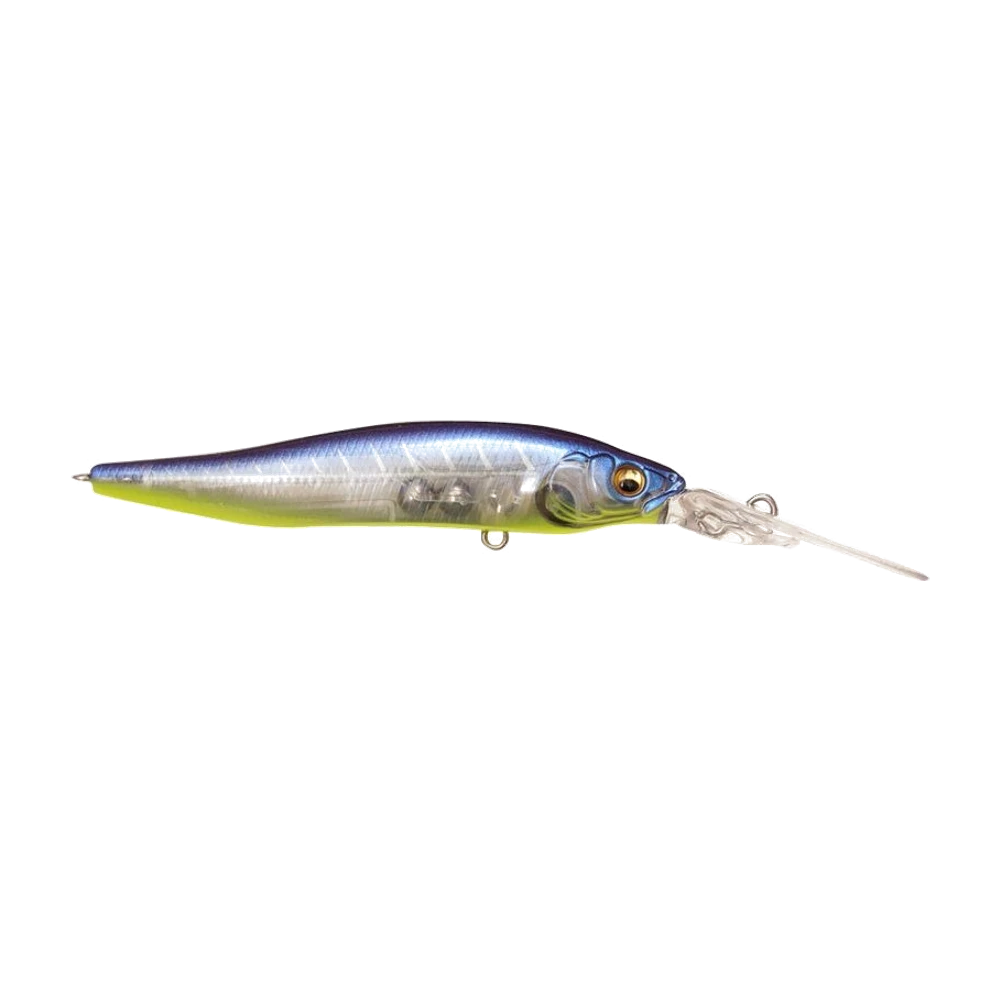
The X-Nanahan +2 spec table carries no column for hooks: no gauge is published. In the catalog shot the bait appears bare, with one belly hanger and one tail hanger — that's what the image shows, not a specification. If you do swap trebles, remember that a slow floater is a delicate balance: a few tenths of a gram more and it becomes a suspending bait, which costs you the self-freeing behaviour described above.
Colour by water clarity
- Lightly stained water: the finish in the photo, midnight blue back and chartreuse belly, which pairs a discreet topside seen from above with a readable underside seen from below.
- Clear water: a translucent silver finish, relying on the roll and the reflection rather than on colour.
- Low light or heavy water: a dark silhouette, easier to read at three metres down than a pale colour that dissolves into the ambient blue.
A depth-layer tool, not a Swiss army knife
The X-Nanahan +2 is not the first bait to tie on at an unknown spot. It complements a Megabass X-70 BFS Jerkbait holding the top half-metre, and a Megabass Vision 95 for everything in between. Its real value shows up on the day you know the fish are at three metres and the bigger models no longer interest them.
Of course you still have to read the breakline before casting. That's what CarnaFish makes easier: a photo of the spot, and the app suggests the zone, the working depth and the lure type that suit the day. To cover the basics on this species, our beginner's guide to bass fishing runs through tackle and typical lies.
Key takeaways
- A short 7.6 cm minnow at 7.1 g rated to 3 m: an unusual depth for this size class.
- Slow-floating class: the bait rises gently on the pause, which frees it from snags but rules out long stops.
- Two registers in one body, a tight roll on the straight retrieve and a sharp lurch on the twitch.
- The maker publishes no hook gauge: if you change trebles, match the original weight to keep the listed buoyancy.
FAQ
Does the X-Nanahan +2 really reach three metres?
The maker lists 10 ft, or 3 m. That figure assumes a long cast, a rod held low to the water and a dozen fast turns at the start of the retrieve. With a thick leader or a slow retrieve from the off, you will stay well above it.
What's the difference between slow-floating and suspending?
A suspending bait hangs on the pause, a slow floater drifts upward. Over cluttered bottom, that rise frees the lip from a branch with no input from you. In return, a long pause costs you your working depth.
Can you catch perch on this lure?
Yes. Seven point six centimetres matches a prey size European perch accept readily, and the ability to work at three metres suits schools that have pulled off the bank in summer. The tight roll on a slow straight retrieve often beats the twitch on this species.
Casting or spinning rod?
Either works. At 7.1 g a medium-light casting rod stays comfortable and precise; a 7-21 g spinning setup gains distance, which helps reach the listed depth on a long cast.
Which leader should I use?
A metre of 0.22-0.25 mm fluorocarbon behind thin braid. Heavier fluorocarbon floats more and pulls the bait's nose upward, which costs depth directly.
How does it differ from a Vision 110?
In size and in job. The Megabass Vision 110 is an 11 cm bait that works higher in the column and covers water; the X-Nanahan +2 is a short format built to go down and work one precise layer. Both come from the same workshop but do different jobs.
The full bass lure guideSeason-by-season strategy: which family of lure, when, and why.Go from theory to fish
CarnaFish reads your spot from a photo and gives you the game plan: zone, lure, retrieve. Free on iOS and Android.