Megabass Kanata: the 16 cm jerkbait that rises head-first on the pause
Not sure this lure fits YOUR spot today? CarnaFish tells you in 10 seconds, from a photo.
There are days when everything you throw gets ignored and the only thing that changes anything is going distinctly bigger. Not louder, not brighter: bigger. When fish are locked onto fifteen-centimetre prey, a ten-centimetre minnow becomes invisible to them. The Megabass Kanata is built for those days, and it resembles no other jerkbait at this size.
Sixteen centimetres for one ounce
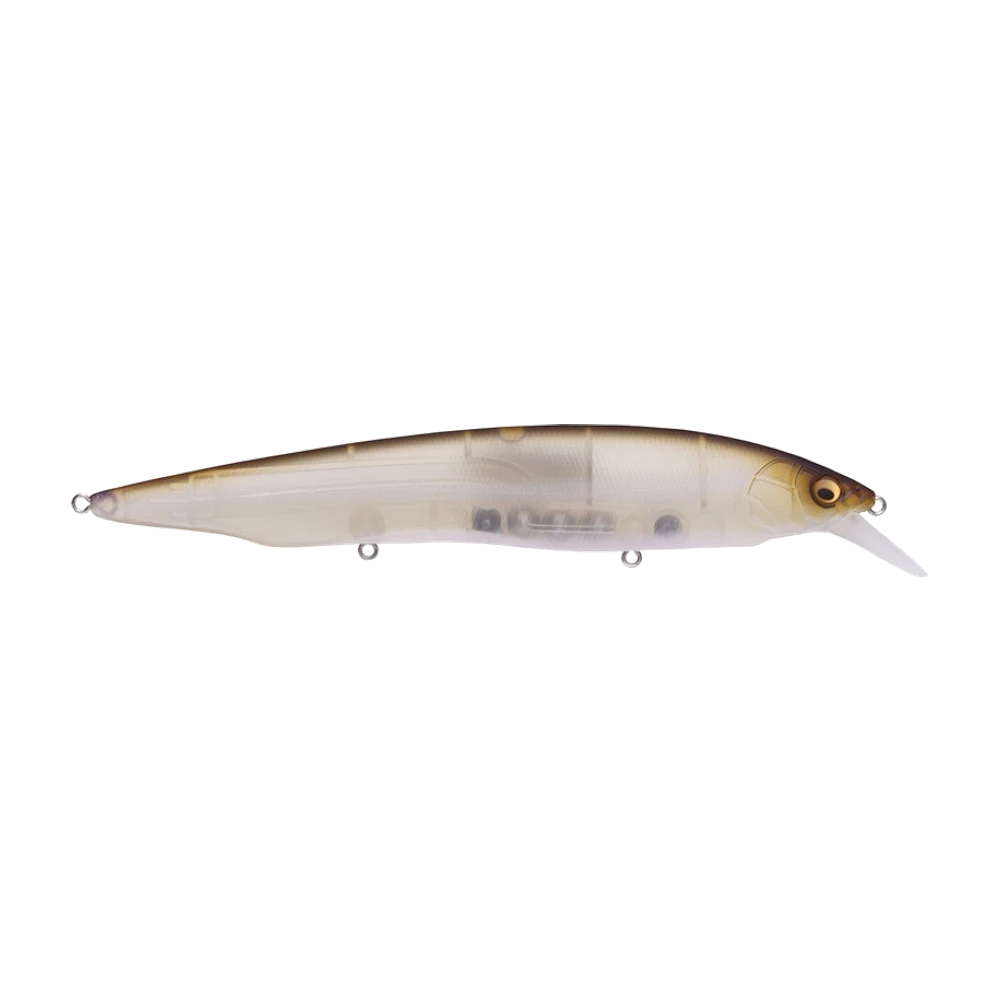
The spec table gives 6-1/3 in, roughly 16.1 cm, for 1 oz, roughly 28.4 g, and lists the bait as slow-floating: it floats, but slowly, which means it rises unhurriedly on the pause. That's a buoyancy class in its own right, not to be confused with a suspending bait that holds its depth, nor with a standard floater that pops straight back up.
That 28 g for 16 cm ratio is fairly light for the size, and deliberately so. A 16 cm hard bait often weighs 35 to 45 g: the Kanata stays under 30 g because its body is hollow, streamlined and built to offer little resistance. We'll come back to why that changes everything by the end of a fishing day.
One absence worth flagging, because it matters: Megabass publishes no running depth for this model. The description talks about a bait you can burn over grass beds and work as a traditional jerkbait, which places it in the sub-surface layer, but no figure is given. If you need a precise depth over a breakline, count your handle turns and work off the sonar rather than trusting a stated value that doesn't exist.
Flat sides, and what they do with light
The Kanata's body is built with finely tuned flat sides, and that is this bait's signature. A flat side reflects light like a mirror: instead of scattering the flash in all directions as a round body would, it throws a clean, directional flash every time the bait tips.
The effect peaks in two situations. On a fast retrieve over a grass bed, where the bait generates a continuous strobe that a fish holding in the vegetation picks up from a distance. And on classic jerking, where each rod snap produces an isolated flash — the kind of signal that triggers a reflex strike rather than a considered approach.
The trade-off is worth knowing: a flat side is also more affected by crosswind during the cast and less stable than a round body in heavy current. In fast river water it needs a firmer retrieve to stop it lying over.
A lot of water moved, little ground covered
This is the Kanata's most interesting trait, and Megabass describes it explicitly: on a sharp rod snap the bait kicks into a lateral dart with huge water displacement but travels less than an Ito Vision 110 for the same pull.
Translate that into fishing. A jerkbait that travels a long way on each twitch leaves the spot in three or four snaps. A jerkbait that moves a lot of water while travelling little stays in the productive zone for ten twitches, sending out a pressure wave and a flash each time. On a precise spot — a weed edge, a bridge pile, the corner of a dock — that's an enormous difference.
Count your rod snaps rather than your handle turns. On a marked spot, ten twitches on the same patch beat three twitches that carry you across it. That's the exact opposite of how most people fish a big jerkbait.
The head-first rise
Another behaviour the maker states: on the pause, the Kanata doesn't rise flat, it lifts its head and climbs. That's the posture of a wounded fish heading for the surface, and it's a classic trigger on a fish that follows without committing.
In practice, lengthen your pauses. Two sharp twitches, then three to five seconds of complete stillness, rod motionless, and let the bait take that angle. The take very often comes during that slow rise, at a moment when you have no tension in the line: keep the bow just tight enough to feel, without pulling.
Working it, and fatigue
Megabass stresses a point rarely raised: the Kanata's streamlined body offers little resistance to the water, which lets you retrieve it fast and work it hard without overloading your wrist and forearm.
That is not a comfort detail. A big jerkbait means rod work for six hours. If every snap costs twice the effort, you slow down without noticing by the middle of the day, and you stop working the bait properly long before you stop fishing. A bait you can keep working at the same rhythm all afternoon catches more than a better bait over ten casts.
The cast gets the same care: an aerodynamic form and three oscillating tungsten balancers that shift rearward as the bait flies. On a 16 cm bait, that's the difference between casting a lure and throwing one.
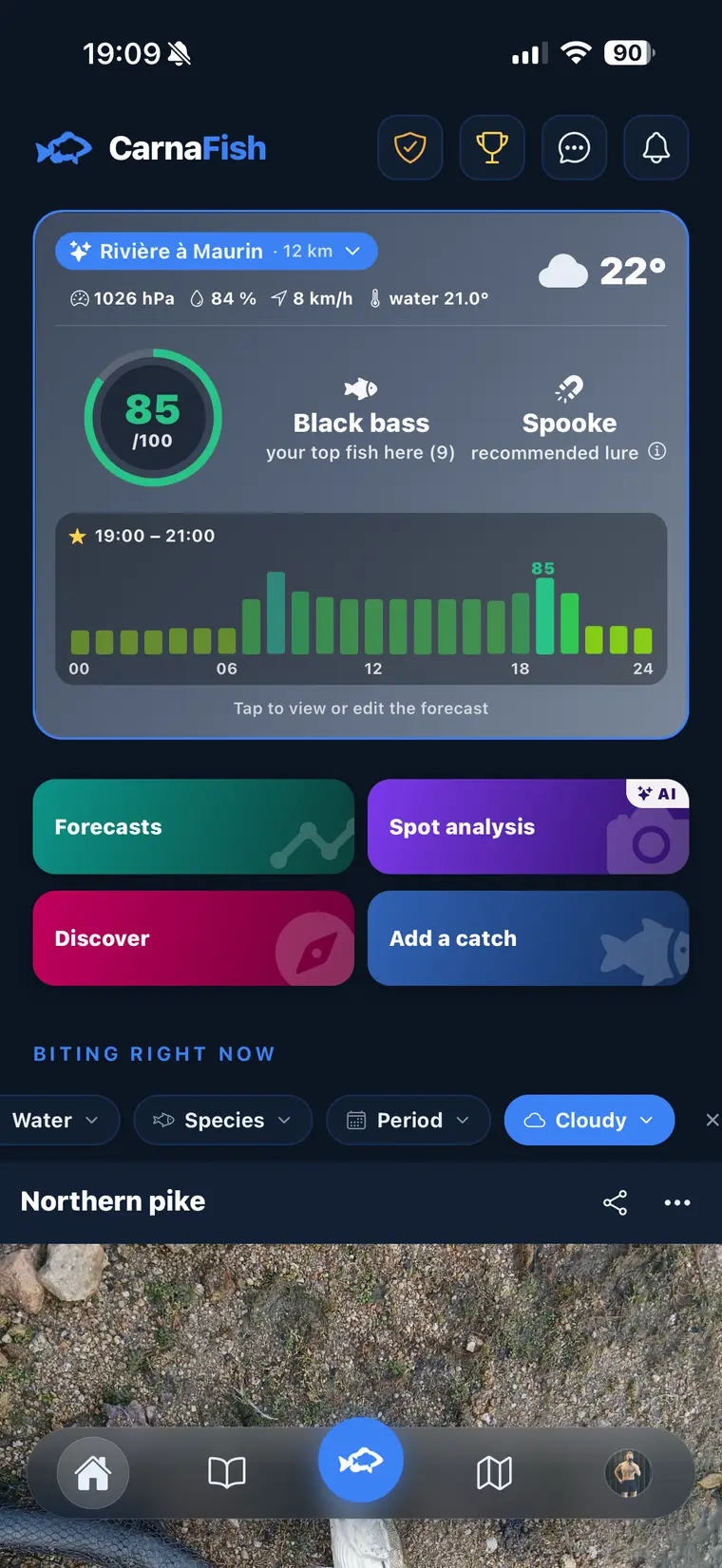
Not sure what to tie on?
Photograph your spot: CarnaFish reads the scene, cross-checks the conditions and gives you the zone, the lure and the retrieve. Free on iOS and Android.
Colour by water clarity
- Clear water: the translucent pearl with an olive back from the photo. Partial transparency avoids presenting too hard a silhouette to a wary fish while letting the flat sides do their reflecting.
- Stained water: a well-contrasted opaque finish, ayu or a strongly marked baitfish pattern, so the silhouette exists once light no longer passes through.
- Low light or the end of the day: a black back. With 16 cm of lure, the outline alone is enough to be noticed, and contrast beats colour.
Where it sits in the box
The Kanata is a big-fish, big-water bait rather than an all-rounder. On a standard spot a Megabass Vision 110 stays more versatile and easier to place — it is in fact the reference Megabass cites to explain the Kanata's behaviour. For a finer, snappier jerk, a Megabass X-80 Trick Darter or a Duo Realis Jerkbait 120SP cover the range below. And if you want a minnow that works on its own on a straight retrieve rather than on the rod, a Rapala Husky Jerk answers a different logic.
Pulling out a 16 cm bait at the right moment is mostly a question of reading the spot and the season. CarnaFish exists for that: a photo of the spot, and the app suggests the zone, the water layer and the lure size that fit conditions. To work out when this format becomes relevant, our guide to predator fishing through the seasons supplies the reference points that are usually missing.
Key takeaways
- 16.1 cm for 28.4 g in a slow-floating class: it floats, but slowly, and rises head-first on the pause.
- It moves a lot of water while travelling little, so it stays on the spot where a standard jerkbait crosses it.
- The flat sides throw a clean directional flash, especially on a fast retrieve over grass beds.
- Megabass publishes no running depth for this model: count handle turns rather than hunting for a figure.
FAQ
Does the Kanata float or sink?
The maker classes it as slow-floating: it floats, but rises slowly on the pause. It is neither a suspending bait, which holds its depth, nor a standard floater, which comes straight back up. That slowness is exactly what makes long pauses effective with it.
How deep does it run?
Megabass does not publish that figure for the Kanata, and no technical source supplies it. The description places it in the sub-surface layer, usable over grass beds and as a classic jerkbait, but no number is available. Count your handle turns to reproduce a depth that has produced.
Why does it travel less than another jerkbait?
That's a design choice, and Megabass compares it explicitly to the Ito Vision 110: for an equal pull, the Kanata moves far more water but covers less distance. The point is to stay longer on a precise spot instead of crossing it.
Is it suitable for pike?
Yes, that's one of the good uses of this format in Europe. Sixteen centimetres and 28 g match a pike keyed on large prey well. Just fit a leader that can take the teeth — the bait ships without a wire trace.
Is it tiring to work?
Less so than a conventional big jerkbait, and that is an argument the maker itself puts forward. The streamlined body offers little resistance, which lets you hold a sustained rhythm for hours without your wrist giving out before the end of the day.
How does it differ from a Vision 110?
The Megabass Vision 110 is distinctly smaller and more versatile; the Kanata targets a fish locked onto large prey. For the same pull, the Kanata displaces more water and covers less ground, which makes it a spot bait rather than a search bait.
The full bass lure guideSeason-by-season strategy: which family of lure, when, and why.Go from theory to fish
CarnaFish reads your spot from a photo and gives you the game plan: zone, lure, retrieve. Free on iOS and Android.