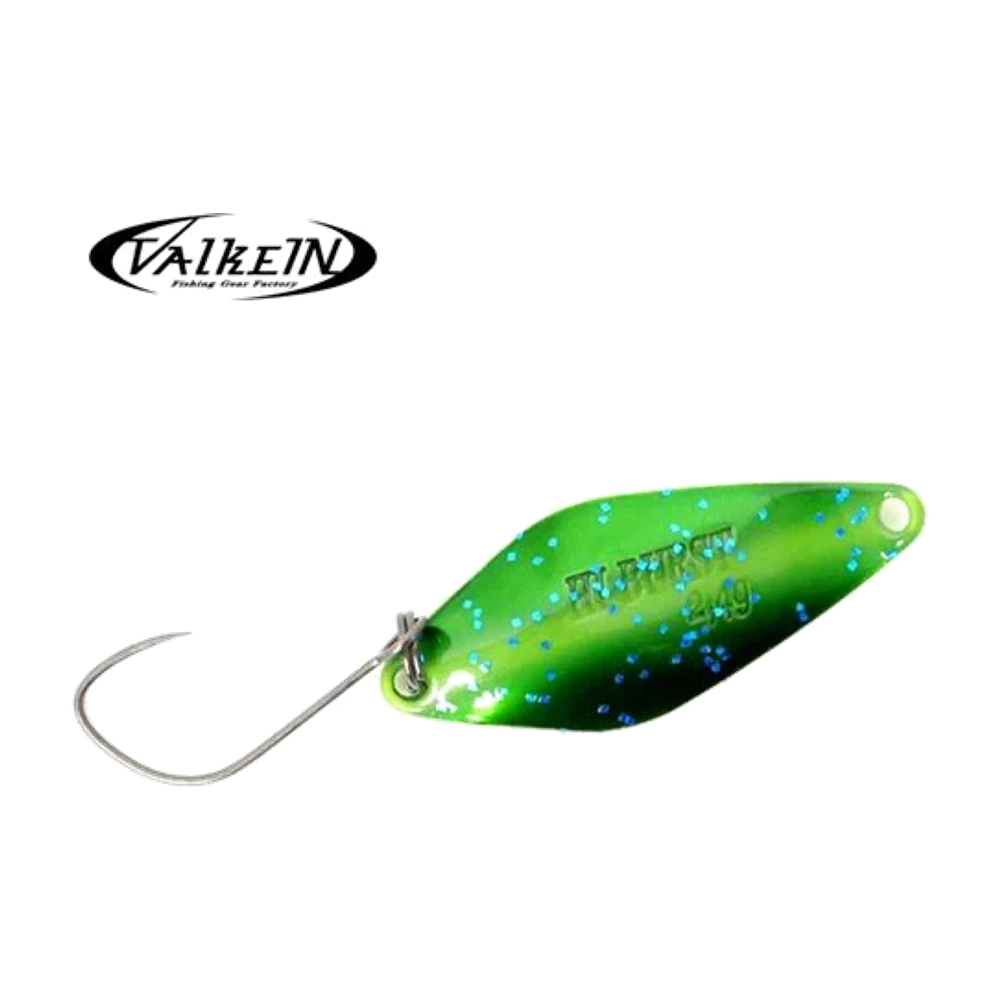
Valkein Highburst: the area spoon that holds up to speed
This lure shines under specific conditions. CarnaFish tells you in 10 seconds if today is one of them.
Area fishing has an unwritten rule: fish slowly. It is right most of the time, and it ends up becoming dogma. The result is that you regularly see anglers crawling a spoon back in front of a shoal of freshly stocked trout — active, aggressive fish that follow the spoon to their feet without ever taking it.
On a fish that is actively hunting, slowness stops being an advantage. It gives the fish all the time it needs to examine the lure and refuse it. What you need at that moment is the opposite: a presentation that leaves no time to think.
The problem is that most micro spoons cannot handle acceleration. Past a certain threshold they break away, spin like a propeller and put twist into the line. The general principles of the discipline are covered on the Forest Miu page; what makes the Highburst useful is precisely that it escapes that limit.
Holding its axis when you speed up
A wobbling spoon that breaks away always does the same thing: it leaves its axis, starts spinning like a propeller, and transmits twist to the line. In area fishing with 0.12 mm nylon, a few minutes of that is enough to make the line unusable.
The Highburst is pressed to push that threshold further back. Two features contribute:
A narrow profile. Less surface offered sideways, so less purchase for water pressure at speed. It oscillates in a tight corridor instead of swinging wide.
A high-frequency vibration. Where a wide-wobbling spoon rolls slowly from one flank to the other, this one vibrates fast and short. The signal is closer to a fleeing fry than to a prey item dragging itself along — and that is exactly what a hunting trout is trying to intercept.
The practical consequence: you get a much wider usable speed range. You can fish it slowly like any area spoon, but you can also go up a notch, or two, without the lure falling apart. It is an extra card in the box, not a replacement.
The retrieve: the burst that provokes
- Cast and let it sink one to three seconds depending on the layer you want.
- Start at medium speed, noticeably faster than your usual area retrieve — around one and a half handle turns per second.
- Every six to eight turns, accelerate hard for two turns, then return to cruising speed.
- Never come to a complete stop. On active fish, a stop kills the momentum and gives them time to inspect.
- Accelerate clearly over the last three metres, right at your feet. That is where a good share of the followers make up their minds.
| Mood of the fish | Speed | Sequence |
|---|---|---|
| Freshly stocked trout, active | Brisk | Fast straight retrieve + bursts |
| Fish following without taking | Medium | Two-turn bursts |
| Activity dropping off | Slow | Classic straight retrieve, expect to change lure |
On the water: when a trout follows your spoon to the bank without biting, never stop the lure — it is the reflex most anglers have and it is the surest way to lose the fish. Accelerate instead over the last metre, and lift the rod slightly to send the spoon up towards the surface. Prey that runs faster gets attacked; prey that stops becomes suspicious.
When in the session to use it
The Highburst is an activity-window spoon. It exists to squeeze everything out of the phases when fish are moving, and it does not pretend to do the rest.
- The first minutes after a stocking, when the trout are grouped and aggressive. A fast retrieve lets you make far more casts, so far more fish during the window.
- Isolated feeding spells, when you see rises or swirls in one area: it lets you get there fast and provoke.
- Restarting a session that has died. After an hour without a bite at slow speed, switching abruptly to fast sometimes wakes up a whole zone.
- Windy days, where its relative density and narrow profile cast further and straighter than flat spoons.
Where it does not fit: on durably lethargic fish, late on a hot afternoon, glued to the bottom. Its fast range is useless then, and its reduced amplitude gets noticed less than a wide, slow wobble. It is also out of place on a tiny pond where the retrieve is ten metres long: you have no room to build a sequence.

Not sure what to tie on?
Photograph your spot: CarnaFish reads the scene, cross-checks the conditions and gives you the zone, the lure and the retrieve. Free on iOS and Android.
Colours and finishes
Two families work particularly well with this kind of retrieve.
The brights and fluos — orange, chartreuse, pink — on fresh fish, in the half hour after a stocking. Combined with a brisk speed, they play purely on reflex.
The silvers and holographics in clear water and bright weather. At speed, a reflective finish produces an almost continuous flash that pulls fish from a distance — exactly the context where high frequency becomes a visual asset.
Dark, matt tones, very effective late in a session at a crawl, lose a lot at speed: the flash disappears without anything replacing it.
Highburst or a high-layer spoon
The Forest Pal and the Highburst overlap on the same slot — the stocking, the high fish — and yet they do not play the same card.
The Pal stays near the surface thanks to a slow sink rate and is fished very slowly: it relies on a prolonged presentation in the feeding layer. It is the finesse choice, for fish that are high but not necessarily aggressive.
The Highburst bets on reaction. It crosses the same zone faster, provokes instead of convincing, and lets you make twice as many casts in a short window. On a genuinely active shoal it produces more; on high but wary fish, the Pal takes the lead again.
Our guide to river trout fishing covers the running-water side, where speed management follows other rules. And if you are unsure what rhythm to start with when you reach the bank of a stocked pond, CarnaFish analyses a photo of the spot and answers.
Key takeaways
- Its narrow profile pushes the break-away threshold back: you can accelerate without putting twist in the line.
- High-frequency vibration, closer to a fleeing fry than to prey dragging itself along.
- A two-turn burst every six to eight turns, never a complete stop.
- On a follower, accelerate instead of stopping: prey that stops becomes suspicious.
- An activity-window spoon: useless on trout that are durably lethargic and glued to the bottom.
FAQ
Do you really need to fish fast in area fishing?
Not all the time, but fishing slowly as a matter of course loses fish during active phases. On freshly stocked or hunting trout, a brisk retrieve triggers reflex attacks that a crawl never produces.
Why does my spoon spin when I speed up?
Because it has passed its break-away threshold: it leaves its axis and spins like a propeller. A narrow profile like the Highburst's pushes that threshold back, which lets you use a much wider speed range.
What should you do when a trout follows without biting?
Accelerate instead of stopping, and lift the rod slightly to send the lure up towards the surface. A lure that stops dead becomes suspicious immediately, whereas prey running faster often triggers the attack.
When in the session should you tie it on?
In the first minutes after a stocking, over visible feeding activity, or to restart a dead session after a long spell without a bite at slow speed. It is an activity-window spoon.
Which colours should you favour?
Brights and fluos on fresh fish in the half hour after a stocking, and silver or holographic finishes in clear water and bright weather. Dark, matt tones lose a lot of their effectiveness at speed.
How does it differ from a high-layer spoon?
A slow-sinking spoon relies on a slow, prolonged presentation in the feeding layer. The Highburst crosses the same zone faster and plays on reflex: it produces more on an active shoal, less on wary fish.
The full trout lure guideSeason-by-season strategy: which family of lure, when, and why.Go from theory to fish
CarnaFish reads your spot from a photo and gives you the game plan: zone, lure, retrieve. Free on iOS and Android.