O.S.P Blitz Max DR: getting down to 4 m without a 40 m cast
Rather not fish it blind? Photograph your spot — CarnaFish cross-checks the conditions and points you the right way.
Deep crankbaits have a structural flaw nobody talks about: they need room. A big American deep crank gets down to four or five metres, yes — but only after twenty or twenty-five metres of retrieve. If you fish from the bank, on a gravel pit where the drop-off is fifteen metres from your feet, you spend the cast getting the lure down, you touch the useful zone for five metres, then you climb back up. In other words you fish the right depth for a quarter of your retrieve.
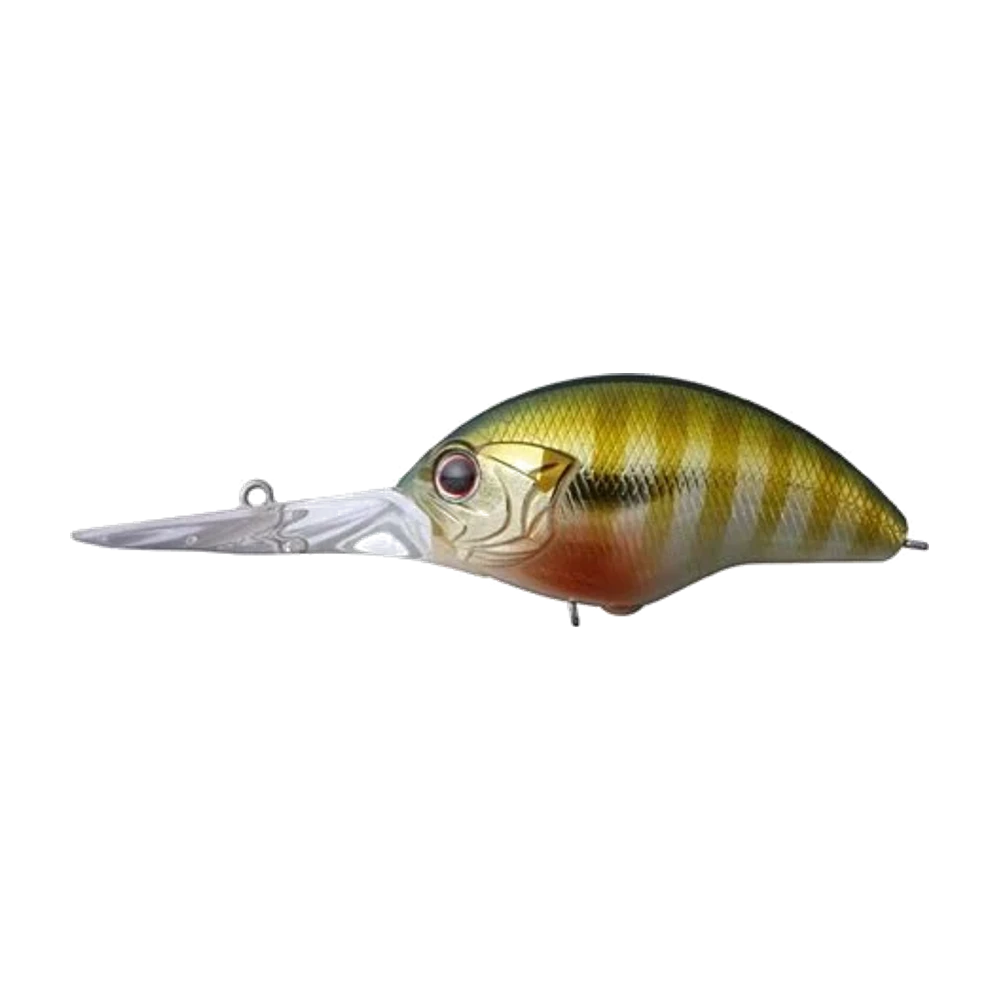
The Blitz Max DR answers that with an unusual compromise: a compact body of around 6 cm paired with a big lip and a heavy ballast load for that size. The lure is short and heavy, so it noses down straight away and holds its line. The upshot is that it reaches its three-to-four-metre zone in a handful of metres of retrieve, not in twenty.
This is not a lure that goes deeper than the big deep cranks. It is a lure that goes down faster, and for an angler on the bank or on a small water, that is usually what matters most.
Short body, big lip: an unusual balance
A classic deep crankbait is elongated so it stays stable under the pull of its big lip. The Blitz Max DR does the opposite and keeps a stubby body. That has precise consequences.
- The angle of attack is steeper from the off. The ratio between lip length and body length is very favourable: the diving torque is high relative to the mass to be shifted, so the nose dips immediately.
- The action is tight and fast, not wide and rolling. A short body oscillates at high frequency. That is a different signal: closer to a small fish swimming fast than to a coarse fish undulating along.
- The pull on the retrieve is real but manageable. A big lip on a long body pulls enormously; here the frontal area stays modest, so you can fish for an hour without wearing yourself out, which is no small thing on a lure you cast a hundred times.
- It deflects well. On contact with a rock, the short body kicks sharply to the side then realigns quickly. That is the movement that triggers.
The lure stays buoyant: on the stop it rises, more slowly than a shallow crankbait but enough to free itself from cover if you give it slack.
The retrieve: three modes depending on activity
The basic sequence, on a drop-off or a steep bank:
- Cast past the drop-off, onto the flat, and wind fast for the first five metres to send the lure down quickly.
- Switch to a steady medium speed as soon as you feel the first contact with the bottom.
- Keep the contact as you come down the slope. You should feel sharp knocks, not a continuous scrape.
- On every marked knock, stop for one to two seconds. The lure floats up a few tens of centimetres. Most bites come in that window.
- Restart sharply to make it dive again, then go back to medium speed.
- Carry on to the bank, including the last few metres where the slope comes back up.
The three modes to know:
- Active fish, water above 18 °C: a continuous, fairly fast retrieve with no pauses. You are looking for a reaction.
- Moderate fish, 12 to 18 °C: the sequence above, contact and short pauses.
- Apathetic fish, below 12 °C: very slow dragging, the lure almost permanently in contact, pauses of three to five seconds. The crankbait then becomes a probing lure more than a reaction lure.
On the water: with a deep crank, the rod matters as much as the lure. With a stiff carbon blank you will pull the hooks on half your fish — a bass hooked at four metres on a lure carrying two trebles pulls in every direction, and you have no line stretch to compensate. A parabolic rod, or a composite blank, genuinely transforms your landing rate. This is not a detail, it is the parameter that changes the most.
Line, rod and real depth
| Parameter | Choice | Effect |
|---|---|---|
| 0.25 mm fluorocarbon | Recommended | Maximum depth, good sensitivity |
| 0.30 mm fluorocarbon | Compromise | 20 to 30 cm less depth, more security near cover |
| 0.30 mm nylon | Avoid | Floats and costs 40 to 50 cm |
| Parabolic rod 2.00 to 2.10 m | Recommended | Absorbs head shakes, fewer lost fish |
| Stiff fast action rod | Avoid | Trebles frequently pulled out |
| Low rod position, tip toward the water | Recommended | Gains 20 to 30 cm and improves contact |
The stated three to four metres is realistic with fine fluorocarbon and a decent cast. In practice, on a short cast from the bank, count on three metres to three and a half — which is still far more than an equivalent crankbait would reach over the same distance.

Not sure what to tie on?
Photograph your spot: CarnaFish reads the scene, cross-checks the conditions and gives you the zone, the lure and the retrieve. Free on iOS and Android.
Where it excels, where it is the wrong call
It excels on drop-offs close to the bank: gravel pits, reservoirs with steep banks, scoured canal margins, dam walls. It also excels on isolated humps in the middle of a hole, which you can cross entirely in contact on a single cast. Finally, it is very good in early autumn, when the bass hold on the drop between the flat where they spent the summer and the hole where they will winter.
It is the wrong call in three situations. Over a bottom choked with dense sunken wood: its big lip protects it from rocks but not from branches, and a lure with two trebles at four metres is expensive to lose. Over a uniform flat of less than two metres: it just ploughs pointlessly and you snag. And in very dirty water: its tight high-frequency action displaces less water than a wide action, so it is harder to locate; a wide-amplitude crankbait will be the better call.
Blitz Max DR or a big American deep crank
That is the comparison that matters. The Strike King 5XD gets down to the same depth range, with a much bulkier body and a wider action. It covers more water, it sends a stronger signal, and it keeps the advantage from a boat on a long drift where retrieve distance is not a problem. Our page on the 5XD covers the whole principle of contact cranking, no need to repeat it here.
The Blitz Max DR takes the lead in three specific cases: fishing from the bank, where the useful distance is short; wary or medium-sized fish, where the bulk of a big American crank is too much; and clear water, where the tight action goes down better than a wide wobble. If you only need two to three metres, look at the Strike King 3XD instead, easier to wind and less prone to snagging.
Our beginner's guide to bass fishing places the period when the drop-off becomes the number one spot. And if you are unsure which crankbait depth to reach for on an unfamiliar bank, CarnaFish analyses a photo of the spot and answers.
Key takeaways
- Short body and big lip: the lure reaches three to four metres within a few metres of retrieve.
- It is a crankbait for bank fishing and small waters, not for long drifts.
- Tight high-frequency action: an asset in clear water, a handicap in dirty water.
- Contact, a one to two second stop while it floats up, then a sharp restart.
- A parabolic rod is essential unless you want to lose half your fish.
FAQ
How deep does the Blitz Max DR really go?
Three to four metres with fine fluorocarbon and a decent cast. On a short cast from the bank, count on three metres to three and a half, which is still well beyond what a classic crankbait would reach over the same distance.
Why does it go down faster than a big deep crankbait?
Because its body is short and heavy for its size, and its lip is large relative to that body. The diving torque is high compared with the mass to be shifted, so the nose dips from the first turns of the handle.
What rod do you need for a deep crankbait?
A parabolic rod or a composite blank, 2.00 to 2.10 m. A stiff blank loses a lot of fish, because fluorocarbon offers no stretch and a bass hooked at four metres pulls violently in every direction.
Should you fish fluorocarbon or nylon?
Fluorocarbon, 0.25 to 0.30 mm. Nylon floats and costs you forty to fifty centimetres of depth, which is enough to make you miss contact with the bottom — and contact is what produces bites in cranking.
Can you use it over sunken wood?
Hardly. The big lip protects well against rocks and gravel, but not against thin branches that jam between the trebles. Over dense wood, a squarebill crankbait or a Texas-rigged soft plastic will be far better suited.
What should you do when the water is dirty?
Change the type of action. Its tight high-frequency vibration is hard to locate in dirty water. A wide-action crankbait or a lipless, which displace far more water, will be more effective in those conditions.
The full bass lure guideSeason-by-season strategy: which family of lure, when, and why.Go from theory to fish
CarnaFish reads your spot from a photo and gives you the game plan: zone, lure, retrieve. Free on iOS and Android.