River2Sea Tactical DD Crankbait: diving down to 5.5 metres
Before tying this one on, it helps to know if the spot actually calls for it. CarnaFish reads the scene from a photo.
Fishing a deep crankbait is not casting and reeling. It is sending a lure twenty-five or thirty metres out, driving it down on the strength of its bill, then ploughing a flat or a drop-off while the rod soaks up the load. The Tactical DD from River2Sea comes out of exactly that kind of fishing: it was designed by Matt Allen and Tim Little, the two anglers behind TacticalBassin, who wanted a crank that would get deep and keep catching once the water turns cold.
The bill does the work, and it is mounted differently
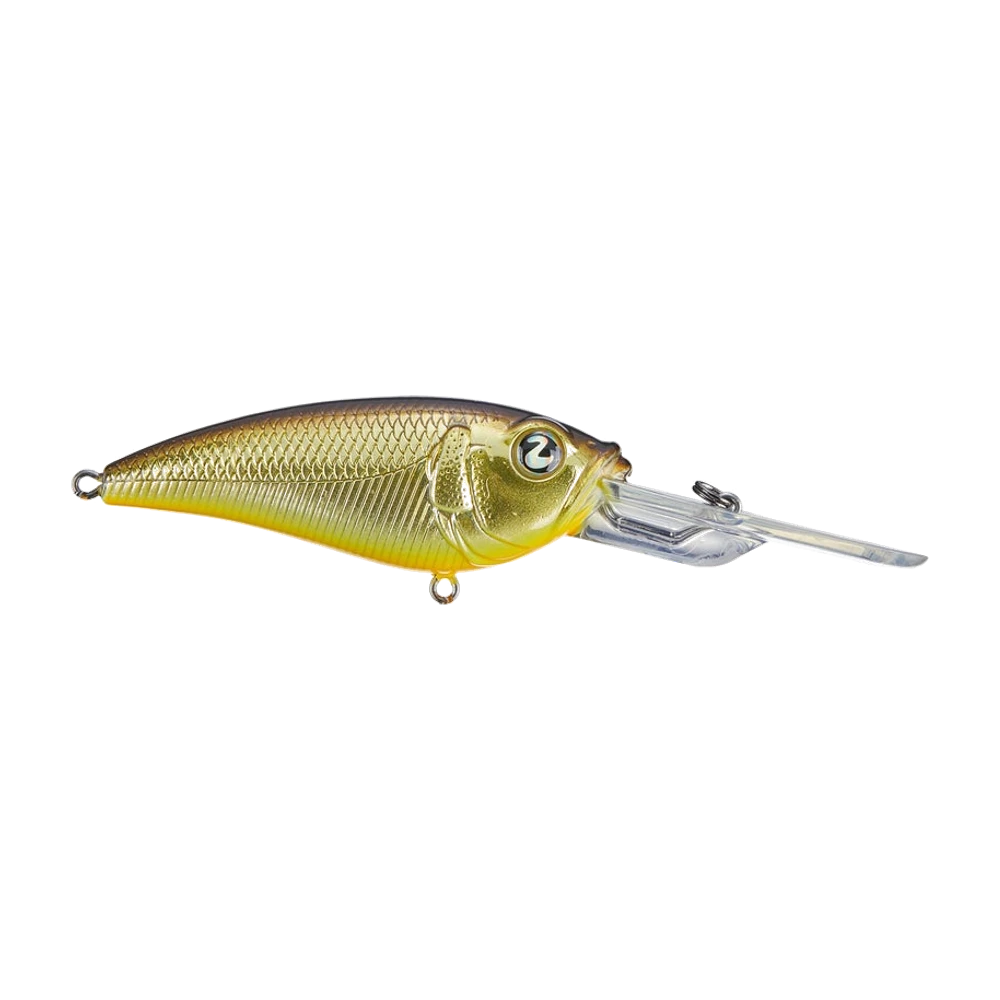
The first thing you notice in the photo: the line tie is not on the nose of the lure but fixed to the bill itself, roughly halfway along it, by a split ring. That is not a styling choice. Moving the pull point onto the bill lengthens the lever arm and forces the lure to dive harder in the first few metres of the retrieve, so the crank reaches its depth sooner and holds it longer on a given cast.
The bill itself is long, flat and translucent, with a moulded rib along its underside visible in the photo. River2Sea also claims a distinctive head shape, built to maximise the surface the lure presents to the water and therefore its dive depth. The maker lists a working range of 0 to 18 ft, about 5.5 m, which puts it squarely among deep divers rather than bank-edge cranks.
Floating, and that is a technical fact
The spec table rates the Tactical DD as floating. That is anything but trivia on a lure meant to work in contact with the bottom: a floating crank rises the moment you stop reeling, which lets you lift it off a stump or a rock by simply giving slack, instead of motoring over to free it. The maker also stresses a fast rise, presenting it as a trigger in its own right.
That behaviour dictates how you fish it. Reel until you feel the bill tap, give half a second of slack, the lure rises a few centimetres while rolling over, then carries on. That break — contact, float, restart — is far more productive than a continuous retrieve, and it is also what keeps you out of snags.
On a deep diver, the real depth depends as much on your line as on the lure. A 0.25 mm fluorocarbon runs deeper than a 0.35, and a long cast runs deeper than a short one. If you are not touching the bottom you aimed at, drop the diameter before you change lures.
A crank that claims cold water
The designers put forward a tight action rather than a wide wobble, and year-round use including the lowest temperatures. That is a designer's claim, to be taken as such, but it is consistent with the mechanics: a tight-action crank keeps a readable signal even at very low speed, where a wide-action crank needs to be pushed to come alive. And in cold water, a sluggish fish does not chase a fast lure.
In practice that means a deliberately dragging retrieve in winter, with long pauses, and a firmer retrieve in summer when fish are active. The rattle, which the maker describes as strong, works the same way: it gives a sound reference to a fish that cannot see much five metres down in stained water. For a comparison, the Strike King 10XD runs far deeper but demands boat-grade tackle, while the Norman DD22 covers roughly the same band with a wider wobble.
The tackle is not optional
The rod
A cranking rod, long and parabolic, 2.10 to 2.30 m, medium-heavy power but slow action. This is not about comfort: a fast rod tears the treble out of a fish that hits twenty metres away, because nothing cushions it. A rod that bends through its whole length keeps contact during the run. With a 21.3 g lure and a big bill, retrieve resistance is constant, and a rod that is too stiff will cook your wrist within the hour.
The reel and the line
A low-geared baitcaster around 5.4:1 stops you reeling too fast without noticing and gives you the torque to pull the bill. On the line side, fluorocarbon is the norm: it sinks, so it helps the lure reach depth, and it handles abrasion on rock well. A 0.25 to 0.30 mm covers most situations.
The classic mistake
Cinching your knot hard onto the line tie. On this lure, the split ring fixed to the bill already provides freedom of movement, but a knot crushed against it can still restrict the swim. Use a loop knot or a small round snap. The second common mistake: reeling faster to get deeper. Past a certain point that is simply false — beyond the optimum speed, the lure climbs instead of diving.
Not sure what to tie on?
Photograph your spot: CarnaFish reads the scene, cross-checks the conditions and gives you the zone, the lure and the retrieve. Free on iOS and Android.
Hooks
The maker's table carries a Hook column reading River2Sea short shank size 2. Read it carefully: that number is a hook size, not a hook count. The count comes from the description — two short-shank trebles in a black nickel finish. Short shanks are no detail on a deep-bodied crank: they stop the trebles tangling with each other or slapping the flanks of the lure on every wobble.
In the photo on this page the lure is shown without trebles fitted: all you can see are two bare split rings, one under the belly and one at the tail. If you replace the factory trebles, keep the same size: a heavier treble lowers buoyancy and can turn this floater into a suspender, which removes the very rise on the pause the technique relies on.
Colours by water clarity
- Clear water: a dark back with scaled gold flanks like the one in the photo, which reproduces the open-water baitfish register.
- Stained water: chartreuse with a blue back, the timeless deep-crank classic, visible at five metres when the light no longer reaches.
- Cold early-season water: a red craw, matching what fish look for while they root along hard bottoms before the spawn.
A deep diver is only worth tying on if you know where the drop-off, the flat or the rock pile you want to plough actually is: cast at random over twenty metres of featureless bottom, it does nothing. That is exactly what CarnaFish makes easier — a photo of the spot, and the AI suggests the zone, the depth and the kind of presentation that match the conditions. And since this lure claims twelve months of use, our season-by-season predator fishing guide helps you decide when to go down and when to come back up. For a far lighter take on the same family, the Rapala Shad Rap remains the benchmark slow crank.
What to remember
- 7.6 cm for 21.3 g, floating, a stated 0 to 5.5 m range: this is a deep diver, not a bank-edge crank.
- The line tie is mounted on the bill, which makes the lure dive earlier in the retrieve.
- Buoyancy serves to clear obstacles and to trigger: contact, slack, restart.
- The size 2 in the table is a treble size, not a count: the lure carries two, both short shank.
FAQ
How deep does the Tactical DD really run?
The maker lists a 0 to 18 ft range, about 5.5 m. That figure assumes a long cast and a thin line: with heavy fluorocarbon or a short cast you will easily lose a metre of achieved depth.
Is it a floating or a sinking lure?
Floating, as the spec table states. It rises as soon as you stop reeling, which lets you free it from an obstacle by giving slack and draws strikes on the way up.
How many hooks does it carry?
Two short-shank trebles in a black nickel finish. The short shank #2 entry in the table refers to the size of those trebles, not to how many there are. In the photo on this page the lure is shown without its trebles.
Can it be fished in winter?
That is one of its designers' main arguments: they present it as effective down into the coldest water. Its tight action stays readable at very low speed, which matters when fish stop chasing. Slow right down and lengthen the pauses.
What rod does this crankbait need?
A parabolic cranking rod of 2.10 to 2.30 m, medium-heavy power, slow action. With 21.3 g and a big bill, a fast rod tires your wrist and pulls trebles on long-distance strikes.
Does it suit zander in Europe?
Yes, on the flats and drop-offs where zander sit between three and five metres. Its tight action and its ability to work slowly suit that fish well, provided you keep contact with the bottom. For a finer approach to the same spot, a Megabass Deep Six is a good alternative.
The full bass lure guideSeason-by-season strategy: which family of lure, when, and why.Go from theory to fish
CarnaFish reads your spot from a photo and gives you the game plan: zone, lure, retrieve. Free on iOS and Android.