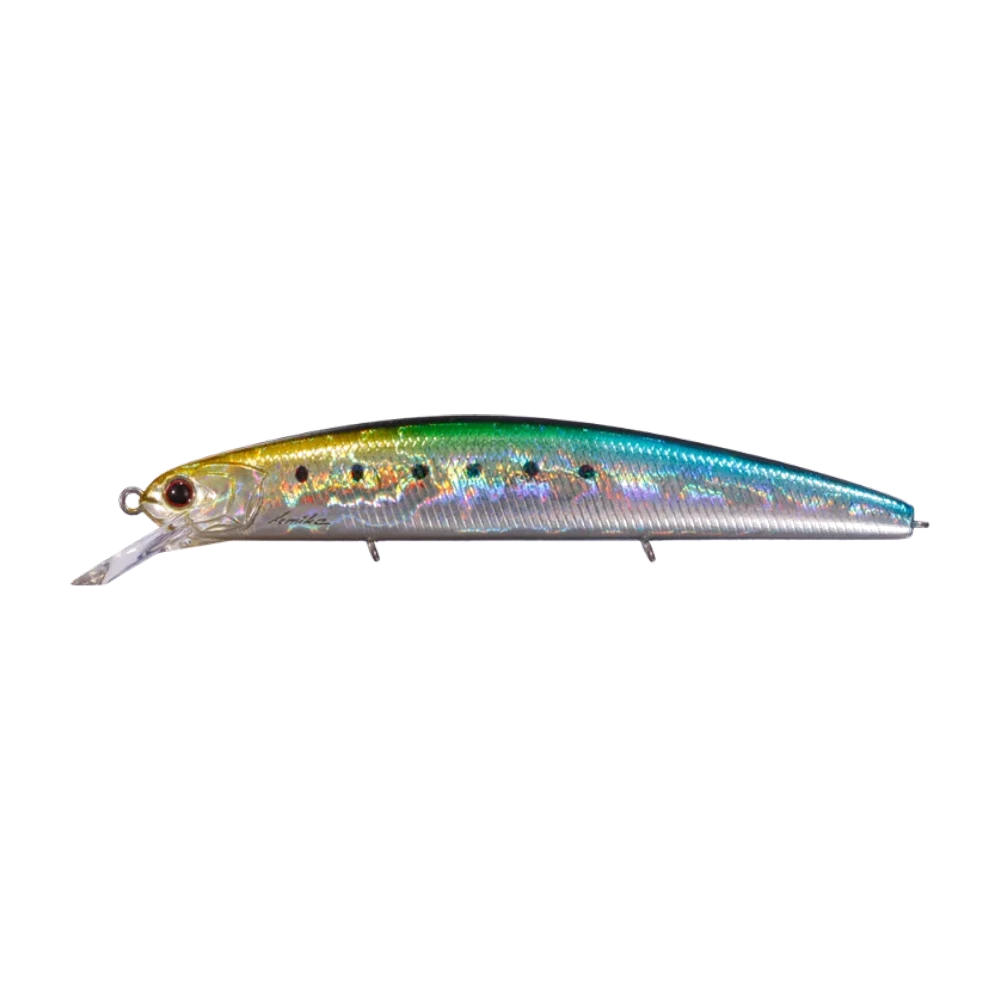
O.S.P Varuna: the jerkbait for the middle layer
Rather not fish it blind? Photograph your spot — CarnaFish cross-checks the conditions and points you the right way.
When a fish refuses your jerkbait, you have three levers: size, rhythm, and water layer. The first two are the ones you adjust instinctively — you drop a size, you lengthen the pause. The third is the one people forget most often, even though it is nearly always the one that decides.
A bass holding a metre twenty under the surface will not come up to thirty centimetres to take a lure drifting flat, and it will not drop to two metres either to fetch a big motionless jerkbait. It waits for something to pass at its level, no higher and no lower, at a rhythm matching its activity.
The Varuna is precisely the tool for that intermediate band. In the O.S.P range it occupies a very identifiable place: between a lure that never leaves the surface and a lure that drops toward two metres and freezes.
Exactly where it sits in the range
The three models are not size variants of the same lure. They cover three different layers and three different rhythms.
| Model | Working layer | Dominant rhythm | Target fish |
|---|---|---|---|
| Bent Minnow | 0 to 30 cm | Motionless drift, isolated twitches | Fish looking up, warm water, pressured fish |
| Varuna | 1 to 1.5 m | Three jerks, 1 to 4 s pause | Active to moderately active fish |
| Rudra | 1.5 to 2 m | Two jerks, 5 to 15 s pause | Inactive fish, cold water, big format |
In practice, the Varuna wins in two situations the other two handle badly.
When the surface has stopped producing but the water is not cold yet. Typically early and late season: the fish no longer comes up to hit the surface, but it still chases. The Bent Minnow stays too high, the Rudra is too slow and too big.
When you are fishing 1.5 to 2.5 m of water in total. The Rudra skims or hits the bottom there, which breaks its rhythm. The Varuna passes just above cover, with a margin of thirty to fifty centimetres that allows a rhythmic retrieve without snagging.
Its intermediate size — 11 cm, around 14 g — goes with that logic: enough volume to interest a pike or a big bass, little enough not to be refused by an average fish in clear water.
A tight, fast sideways dart
The difference in feel compared with a big jerkbait is immediate. The Varuna does not set off in long sweeping hooks; it produces short, very sharp darts, with an almost instant return to line.
That signature has a direct consequence on the fishing: you can link three impulses close together without the lure leaving the target zone. On a precise spot — the tip of a fallen tree, the corner of a jetty, the point of a weed bed — you get three successive signals within the same square metre, where a wide-amplitude lure would already be three metres further on.
It is also what makes it more tiring to work properly: the stroke has to be short and sharp, wrist only, with slack re-forming between each impulse. Pulling with the arm produces a soft dart and the lure just carries on straight.
The retrieve: the sequence of three
- Cast past the spot and wind three or four turns to bring the lure down to its layer.
- Three short sharp jerks, rod tip pointed at the water, half a turn of the handle between each to take up the slack.
- Pause. One second in temperate water, three to four seconds in cool water. No more: beyond that you may as well pick up a Rudra.
- Repeat the sequence all the way to the bank, keeping exactly the same count. Consistency is what lets you identify the sequence that catches.
- On a visible follow, break the rhythm: one very long jerk, then a dead stop. The abrupt change of signature triggers more often than an acceleration.
On the water: count your jerks out loud for the first ten casts of the session. Everyone believes they fish in regular sequences and nobody does. When a bite comes, you should be able to say "that was on the second jerk after the pause" — otherwise you cannot reproduce what worked, and you will spend the day searching.
Settings that move the water layer
On a jerkbait, the stated depth is a starting point. Four parameters move it by several tens of centimetres:
- Line diameter. A 0.20 mm fluorocarbon takes the lure twenty to thirty centimetres deeper than a 0.30 mm. That is your fastest adjustment.
- Rod angle. Tip in the water during the retrieve: you easily gain thirty centimetres. Tip high: you come back up by the same amount.
- Cast length. A short cast never reaches maximum depth. On a precise spot, always cast five metres past it.
- The hooks. As on any jerkbait tuned to the edge, a heavier treble makes the lure sink during the pause. Stick with the stock size.
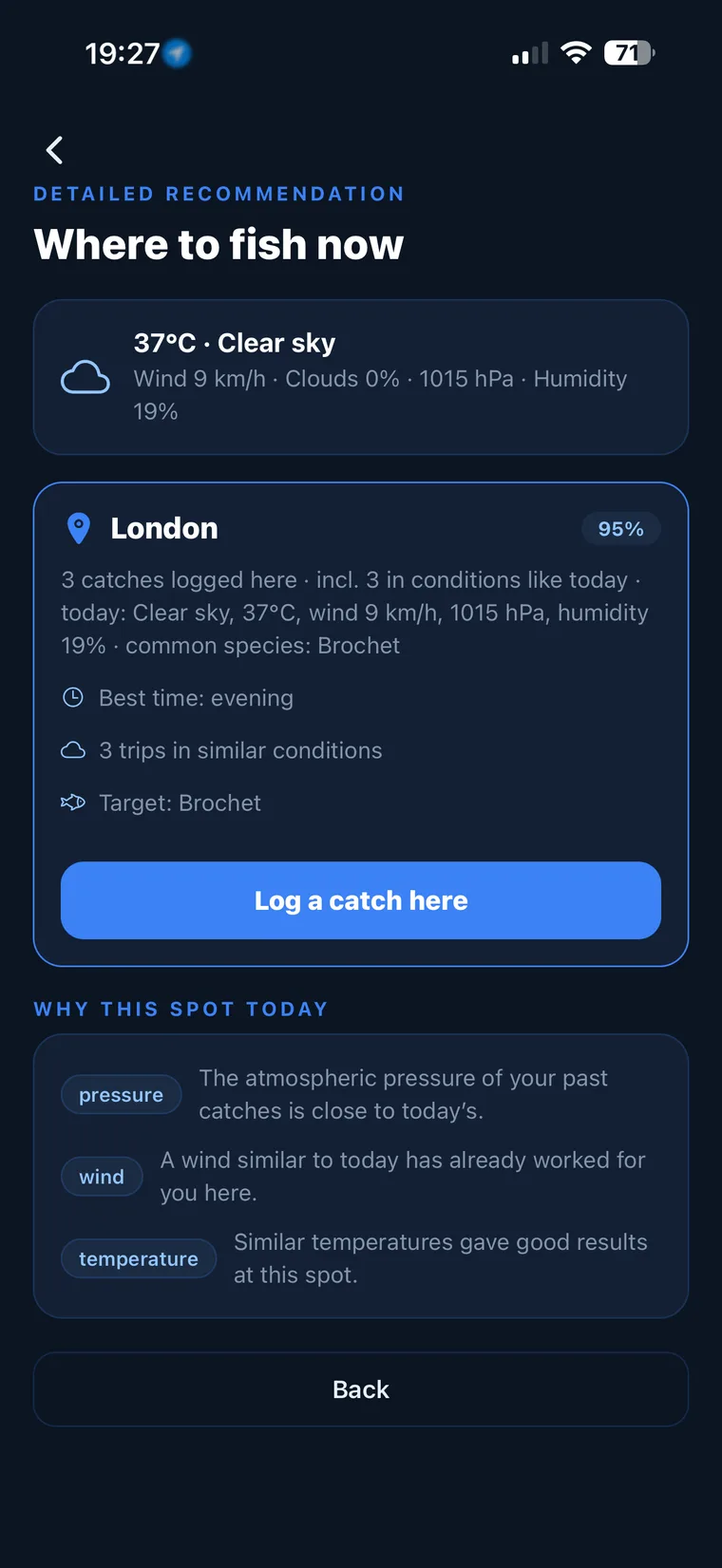
Not sure what to tie on?
Photograph your spot: CarnaFish reads the scene, cross-checks the conditions and gives you the zone, the lure and the retrieve. Free on iOS and Android.
Where it excels, where it is the wrong tool
Its windows:
- Spring and autumn, water between 10 and 18 °C, when the fish still chases but no longer comes to the surface.
- Water depths of 1.5 to 3 m: flat edges, weed just under the surface, fallen trees, gravel pit margins.
- Clear to slightly stained water, where the flash of the fast darts shows.
- Precise spots to work repeatedly, thanks to the sequence of three jerks within a square metre.
Its limits:
- Very cold water under 8 °C: the rhythm it needs is too sustained, the fish no longer reacts. Move up a size with long pauses.
- Fish rising at the surface: you are fishing underneath them. That is the Bent Minnow's moment.
- Very dirty water: it plays on speed and flash, two signals that disappear when visibility drops below forty centimetres.
- More than 2 m of useful depth: its lip will not take it there, whatever you do.
Varuna, Rudra or Bent Minnow: how to decide on the bank
The right method is not to pick a favourite model but to read the water layer through three questions.
Is the fish marking the surface? If there are rises, swirls, coarse fish scattering: Bent Minnow, and do not go deeper.
Is it cold and is the fish sitting still? Below 8-10 °C, on a drop-off, with no visible activity: Rudra and endless pauses.
Neither? That is the most frequent situation over a season, and it is the Varuna's. The fish is somewhere between one and two metres, it chases but it does not come up, and it wants a sustained rhythm rather than prolonged stillness.
Our beginner's guide to bass fishing explains how to read that activity before you even cast. And if you are unsure which water layer to aim for when you reach the bank, CarnaFish analyses a photo of the spot and answers.
Key takeaways
- A working layer of 1 to 1.5 m: between the Bent Minnow's 30 cm and the Rudra's 2 m.
- An intermediate rhythm: three short jerks, a pause of only one to four seconds.
- Tight, fast darts, which allow three signals within the same square metre.
- Line diameter and rod angle move the layer by thirty centimetres easily.
- A poor choice below 8 °C, on surface rises and in very dirty water.
FAQ
What is the difference between the Varuna and the Rudra?
The Rudra is bigger, gets down toward 1.5 to 2 m and is fished with pauses of five to fifteen seconds on inactive fish. The Varuna works between 1 and 1.5 m with a more sustained rhythm, suited to a fish that still chases.
How deep does the Varuna swim?
Between 1 and 1.5 m with standard fluorocarbon. Finer line and a rod tip pointed at the water gain it twenty to thirty centimetres; a short cast does not give it time to reach its maximum layer.
How long should the pause be?
One second in temperate water, three to four seconds in cool water. If you need pauses longer than five seconds, you have left its domain: that is the sign that a bigger, deeper jerkbait will suit better.
Can you use it for pike?
Yes, its 11 cm and sustained rhythm suit margin pike well in spring and autumn. Fit a supple bite leader, in thick fluorocarbon or titanium, that does not choke the sideways dart.
Should you change the stock hooks?
No, except when they wear out. This kind of jerkbait is tuned to the finest edge of neutral buoyancy: heavier trebles make it sink during the pause and remove precisely the behaviour you are after.
When should you prefer a topwater?
As soon as you see rises, swirls or bait jumping. In that case the fish is looking up and a lure working at a metre passes underneath it unseen — that is the moment for a floating minnow or a walking bait.
The full bass lure guideSeason-by-season strategy: which family of lure, when, and why.Go from theory to fish
CarnaFish reads your spot from a photo and gives you the game plan: zone, lure, retrieve. Free on iOS and Android.