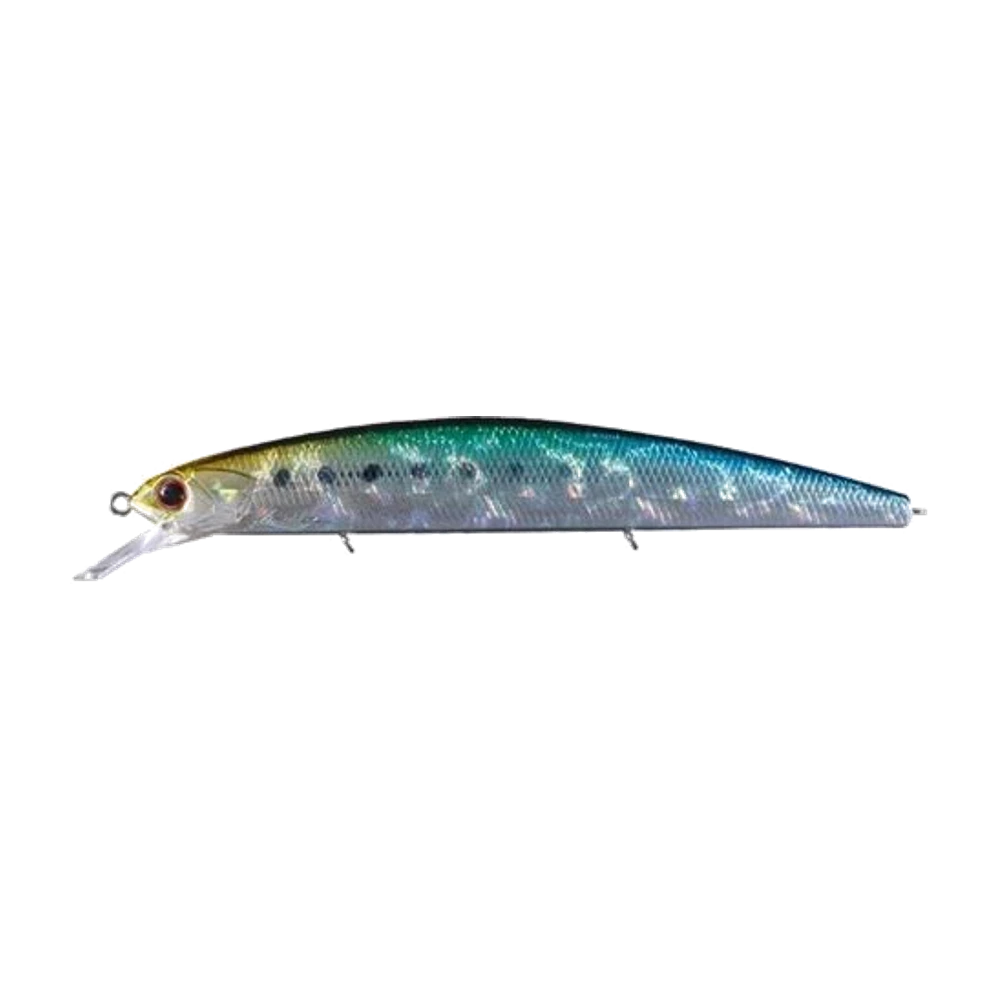
O.S.P Rudra: the big jerkbait that holds a ten-second pause
One lure, endless conditions. CarnaFish reads your spot from a photo so you are not just guessing.
In cold water, the problem is not finding the fish. They are there, often grouped, often visible on the sounder, often exactly where you expected them. The problem is that they do not want to move. A bass or a pike at eight degrees chases nothing: it waits for a vulnerable prey to enter a radius of a few tens of centimetres and stay long enough to be worth the energy.
A lure that crosses that radius in one second will never be attacked, however good it is. A lure that stays in it for ten seconds has every chance. That is the whole logic of the suspending jerkbait in winter, and it is an exercise in mental endurance as much as in technique.
The Rudra is the large-format tool for that approach. Thirteen centimetres, around twenty grams, a lip that takes it towards two metres, and above all a balance that freezes it dead in its layer the moment you stop doing anything. It does not rise, it does not sink, it waits with you.
What 13 centimetres buys you
Going from a 10 cm jerkbait to a 13 cm model is not just a step up in size. Three things change.
The depth reached. The longer body allows a bigger lip without destabilising the action. The Rudra gets down properly to a metre and a half or two metres, where a 10 cm jerkbait often tops out at a metre. In winter that difference is decisive: the fish are rarely in the first fifty centimetres.
The sideways dart. For a given impulse, a longer body describes a wider arc. The Rudra kicks hard to the side then stops dead, producing a very marked change of axis. For an apathetic fish, it is that abrupt turn that acts as the trigger, not the speed.
The selectivity. A thirteen-centimetre lure filters out a large share of the smaller fish. In cold water, where every bite counts, that filtering works in your favour: fewer bites, but bites worth the trip.
The price is paid in fatigue. Twenty-one grams jerked for two hours is no small thing, and it demands the right setup.
The retrieve: two jerks, then silence
This is the hard part, because it consists mainly of doing nothing.
- Cast and wind three to five turns quickly, to bring the lure to its working depth. That diving phase is technical, not a fishing phase.
- Two sharp jerks, rod tip pointed at the water, 30 to 50 cm of travel, taking up the slack between them.
- Stop everything. Rod still, line slightly slack. Count.
- Five to ten seconds depending on temperature. Above twelve degrees, three to five is enough. Below eight, aim for ten, even fifteen.
- Start again with two jerks, and repeat all the way to the bank.
A full cast can take a minute and a half. Over a session that adds up to very few casts — and that is normal. You are not searching, you are working a zone you identified in advance.
On the water: during the pause, keep the line slightly slack rather than tight. A tight line pulls imperceptibly on the lure and makes it drift towards you, which is enough to take it out of the window where the fish had spotted it. The Rudra only stays genuinely still if you give it the chance — and it is in that slack that you will see the bite peel off sideways.
Setting your pauses by temperature
| Water temperature | Pause length | Number of jerks |
|---|---|---|
| Under 8 °C | 10 to 15 seconds | 1 to 2, very sharp |
| 8 to 12 °C | 5 to 10 seconds | 2 |
| 12 to 16 °C | 3 to 5 seconds | 2 to 3 |
| Over 16 °C | 1 to 2 seconds | 3 to 4, linked |
Above sixteen degrees the Rudra remains usable but loses its relative advantage: at those temperatures the fish chase, and faster lures cover more ground for the same result. Its window is cold water and the shoulder seasons.
The tackle follows the size of the lure. An MH rod of 2.00 to 2.20 m, moderate-fast action: enough backbone to load twenty-one grams, enough give not to pull the hooks on a long-distance hookset. Fluorocarbon of 0.25 to 0.35 mm tied direct, or braid with a one-metre fluoro leader if you are fishing at range. For pike, add a supple wire leader: on a thirteen-centimetre lure taken sideways, fluoro is not enough.
One detail that matters: fluorocarbon sinks. Used direct, it makes the lure tilt down slightly during the long pauses, which can turn a suspending lure into a very slow sinker. On ten-second pauses, that is noticeable. If you want strict stillness, drop a diameter or shorten your pauses.
Not sure what to tie on?
Photograph your spot: CarnaFish reads the scene, cross-checks the conditions and gives you the zone, the lure and the retrieve. Free on iOS and Android.
Where to use it, and where it has no business
Its best situations are fairly specific:
- Cold water, November to April, on grouped, located fish.
- Drop-offs and margins at two or three metres, where its swimming layer matches the position of the fish exactly.
- Clear to slightly stained water, where the motionless silhouette is visible long enough.
- Following fish: on a spot where you see follows without a strike, the Rudra's long pause often converts.
It is the wrong choice elsewhere. In summer on active fish, it is too slow to be productive. Beyond three metres, it does not get down. In weed or dense branches, its trebles and long motionless pauses make it a snag magnet. And when searching a large area, its rhythm means you cover far too little ground per hour.
Rudra or a 10 cm jerkbait
The comparison with a Megabass Vision 110 says a lot: at 11 cm, that one stays higher in the column, takes less effort to work and suits a wider spread of fish. It is the jerkbait you take everywhere, and over a day of varied searching it will catch more fish.
The Rudra is a deliberate choice for a precise situation: when you know the fish are at two metres, that they are big, and that they will not move. It goes deeper, it darts harder, it filters for size — and it asks you to accept twenty casts an hour instead of sixty.
In a different register again, a Megabass X-80 Trick Darter sinks slowly instead of suspending, which suits it better to wind and to educated fish. Our guides to getting started in bass fishing and to choosing a pike lure place the jerkbait within a seasonal strategy. And if you are unsure how long a pause to hold on a given spot, CarnaFish analyses a photo of the spot and answers.
Key takeaways
- 13 cm and a long lip: it genuinely reaches 1.5 to 2 m, where a 10 cm model tops out.
- Two sharp jerks, then five to fifteen seconds of stillness depending on temperature.
- Keep the line slightly slack during the pause, or the lure drifts.
- Thick fluorocarbon makes the lure tilt down on very long pauses.
- Out of place in summer on active fish, beyond three metres and in vegetation.
FAQ
How long should you pause with the Rudra?
Five to ten seconds between 8 and 12 °C, up to ten or fifteen seconds below 8 °C, and only one to two seconds above 16 °C. The colder the water, the longer the pause has to be to let the fish make up its mind.
How deep does it go?
Between about 1.5 and 2 m, after three to five fast turns of the handle to bring it to its layer. Its lip, larger than that of a 10 cm jerkbait, is what lets it reach that depth without losing stability.
What rod should you use with a 21 g jerkbait?
An MH rod of 2.00 to 2.20 m with a moderate-fast action. You need enough power in reserve to load the lure and deliver clean jerks, but enough give to avoid pulling the hooks on a long-distance hookset.
Do you need a wire leader for pike?
Yes. A thirteen-centimetre lure is often taken sideways, and the teeth reach well beyond the front hook. Choose supple wire or titanium, kept short, so it limits the impact on the sideways darts.
Why does my Rudra sink during the pauses?
Usually because of the fluorocarbon, which sinks and pulls the lure down slightly on long pauses. Drop a diameter, shorten your pauses, or switch to braid with a shorter fluoro leader.
Is it effective in summer?
It works, but it loses its advantage. In warm water the fish chase, long pauses no longer do much, and faster lures cover more ground for an at least equivalent result.
The full bass lure guideSeason-by-season strategy: which family of lure, when, and why.Go from theory to fish
CarnaFish reads your spot from a photo and gives you the game plan: zone, lure, retrieve. Free on iOS and Android.