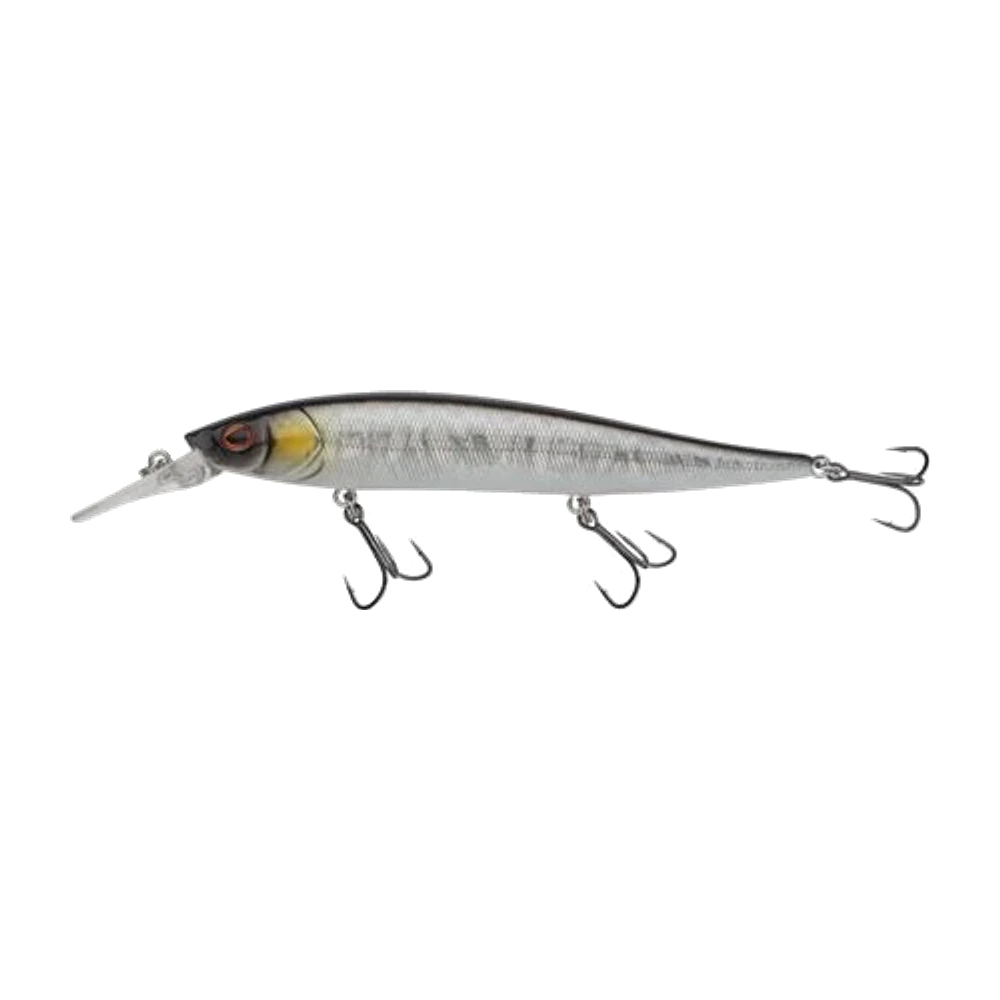
Berkley Stunna: tuning the buoyancy so the pause really works
The right lure in the wrong spot still catches nothing. CarnaFish spots the zone that works, from a single photo.
A suspending jerkbait is judged on the one thing nobody looks at: what it does when it is doing nothing. You give two twitches, you stop, and for the next few seconds the lure is supposed to stay perfectly still, horizontal, at the depth it reached.
In practice, almost no jerkbait is genuinely neutral. It rises slowly, or it noses down, or it drifts. And because water density changes with temperature, a lure perfectly tuned in September becomes distinctly buoyant in February — exactly when you need ten-second pauses.
The Stunna is built to sit as close to neutral as possible, and above all to stay adjustable. That is what decides how many fish you catch with it.
What happens during the stop
You need to understand the mechanism before talking about tuning. When you stop the lure:
The fish's lateral line registers a void. The signal that drew it in disappears at once. In a predator, that abrupt break triggers a move closer — the same reflex as in front of an injured fish that stalls.
The lure has to stay in its field of view. If it rises, it leaves the layer of water the fish is holding in. If it sinks, it passes below it. Either way the fish resets its position and the attack does not happen.
The hooks keep moving. Even on a motionless lure, the trebles swing for a few seconds and produce a micro-signal. It is the only thing alive at that moment.
Hence the rule: the colder the water and the slower the fish, the longer the pause has to be, and the more precise the neutral buoyancy has to be.
Tuning the buoyancy by season
You tune with small adhesive lead strips, placed under the belly or on the lip, or by changing treble size. Always test in the margins before fishing, on calm water, watching what the lure does at rest.
| Water temperature | Target behaviour | Pause | Typical adjustment |
|---|---|---|---|
| 18 °C and above | Very slow rise | 2 to 4 s | None, stock hooks |
| 12 to 17 °C | Truly neutral | 4 to 8 s | A small weight under the belly if needed |
| 8 to 12 °C | Neutral to very slow sinking | 8 to 15 s | Trebles one size up |
| Below 8 °C | Deliberately slow sinking | 10 to 20 s | Weight on the lip + heavier trebles |
Line diameter counts as much as the weighting. A 0.30 mm fluorocarbon pulls the lure down and makes it run some twenty centimetres deeper than a 0.22 mm. For pike, a titanium leader shifts the balance again — test your complete setup, not the lure on its own.
The retrieve, in three variants
Temperate water variant, active bass.
- Two sharp wrist twitches, rod tip down, which make the lure dart to each side.
- One turn of the handle to take up the slack.
- A three-second pause.
- Repeat all the way in, without changing the rhythm as long as it produces.
Cold water variant, fish sitting tight.
- One wide twitch, then take up the slack.
- A ten to fifteen second pause, rod still, watching the line rather than the lure.
- One tiny twitch, barely a quiver.
- Another long pause. Over fifteen metres of retrieve, you sometimes give only six twitches.
Pike variant, searching. Three wide, fast twitches, then four seconds of stop. Pike accept a brisker rhythm than bass in cold water, and the length of the lure does the rest.
On the water: during long pauses, do not watch the lure, watch the point where your line enters the water. A pike or a bass that engulfs a motionless jerkbait does not pull — it moves forward thirty centimetres and the line goes slack without a sound. If you are waiting for a knock, you will never set the hook.
Not sure what to tie on?
Photograph your spot: CarnaFish reads the scene, cross-checks the conditions and gives you the zone, the lure and the retrieve. Free on iOS and Android.
Where it makes the difference
- Drop-off edges in late autumn, when fish are holding between one and three metres and refuse to come up.
- Clear winter water, where visibility lets a fish spot the lure from a distance and come to it slowly.
- Sparse weed areas: the jerkbait passes above and fish leave the cover to intercept it.
- Post-front days, blue sky and high pressure, when nothing fast produces.
It becomes unsuitable:
- In heavily coloured water or in flood, where the fish does not see it early enough to react during the pause.
- Beyond three metres deep, outside its running range — you then have to drop down to soft plastics.
- In dense branches or compact weed, where two exposed trebles make the fishing unmanageable.
- When there is a strong crosswind: the line bows, you lose contact, and the pause is no longer under control.
Stunna or classic Japanese jerkbait
A Megabass Vision 110 remains the benchmark for very pronounced side darts and clear water: it darts wide and is fished at a fast rhythm. The Stunna aims more at stability at the stop, which makes it easier to read in cold water and on endless pauses.
The DUO Realis Jerkbait 120SP is its closest neighbour in size and covers the same spots well; some jerkbaits make the opposite choice and nose down during the pause, which works nicely when the fish is pinned underneath the lure. And in a shorter format, the Lucky Craft Pointer 78 applies the same logic to perch and small spots.
Our guide to choosing a pike lure places the jerkbait against the other families through the seasons. And if you are torn between a jerkbait and a soft plastic when you arrive at a spot, CarnaFish analyses a photo of the spot and answers.
Key takeaways
- Everything happens during the stop: the lure must stay horizontal, in the fish's layer of water.
- Re-tune the buoyancy every season — a lure that is neutral in September rises in February.
- Line diameter changes the running depth by some twenty centimetres.
- Watch the line during pauses, not the lure: the bite is silent.
- Unusable in coloured water, in dense cover or beyond three metres.
FAQ
How do you know if your jerkbait is really suspending?
Test it in the margins, in calm water at the day's temperature. Give two twitches, stop, and watch for ten seconds: the lure should stay at the same depth, horizontal. If it rises or noses down, it needs adjusting.
How long should the pauses be?
Two to four seconds in temperate water, eight to fifteen seconds below 12 °C. The practical rule: the colder the water, the longer you stretch it, up to the point where the pause feels uncomfortably long — that is usually the right one.
How do you weight a jerkbait for cold water?
With small adhesive lead strips stuck under the belly or on the lip, or by fitting trebles one size up. Add in very small amounts and retest after each addition: a few tenths of a gram are enough to tip a lure from floating to sinking.
Is the Stunna suitable for pike?
Yes, in the larger sizes and with a suitable leader. Pike accept a brisker rhythm than bass in cold water: three wide twitches followed by four seconds of stop cover weed edges and drop-offs well.
Do you need a wire leader for pike?
A titanium leader or 0.60 mm fluorocarbon is the reasonable minimum as soon as pike are about. Titanium slightly changes the lure's balance, so retest the buoyancy with the complete setup rather than with the lure on its own.
Why do I miss my bites on the pause?
Because a bite on a motionless lure almost never registers as a knock. The fish simply moves forward and the line goes slack. Watch where the line enters the water, and set the hook as soon as it moves abnormally, without waiting to feel the weight.
The full bass lure guideSeason-by-season strategy: which family of lure, when, and why.Go from theory to fish
CarnaFish reads your spot from a photo and gives you the game plan: zone, lure, retrieve. Free on iOS and Android.