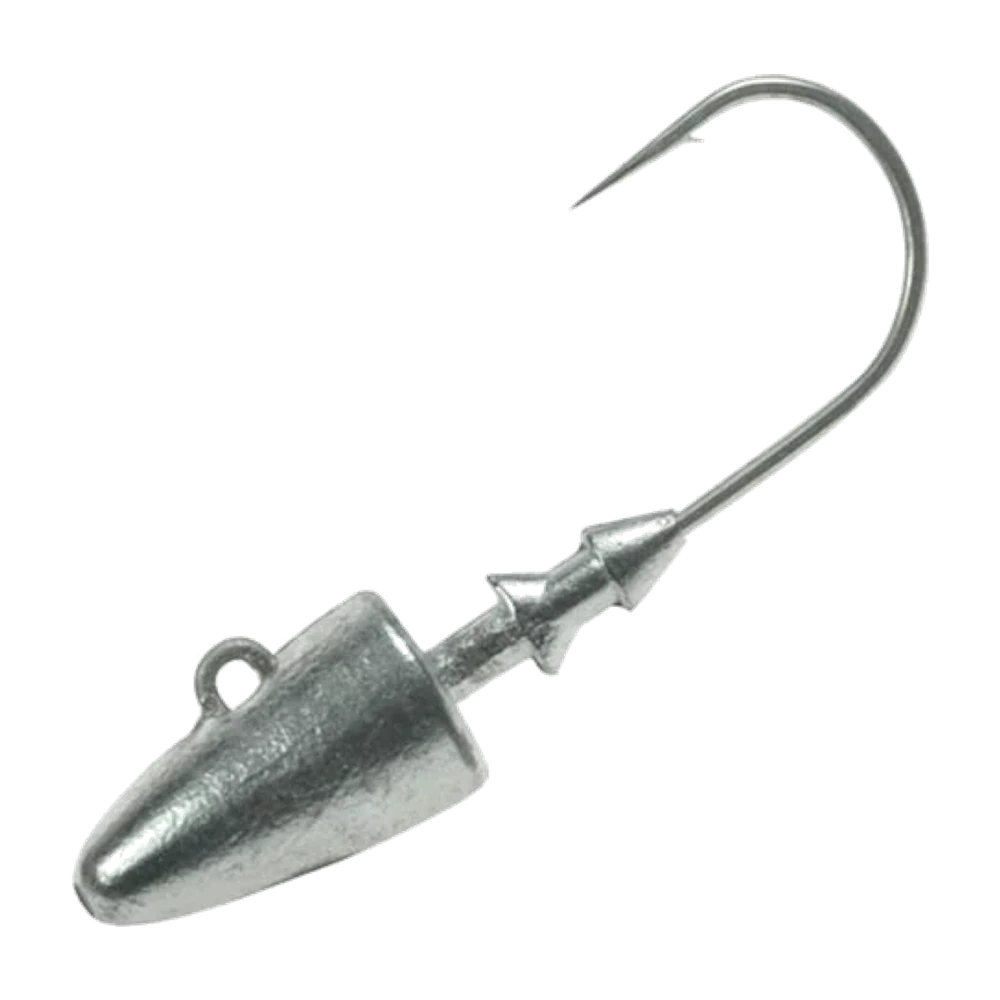
Owner Cultiva Jig Head: you are buying the hook, not the lead
Rather not fish it blind? Photograph your spot — CarnaFish cross-checks the conditions and points you the right way.
A late autumn drift, fifteen metres of water, a zander that takes the shad mid-fall. You feel a weight, you tighten, you strike. And nothing. The lure comes back with two tooth marks on its flank.
That scenario repeats itself three or four times in a session, and the first reflex is to blame the lure, the colour or the weight. In reality, the culprit is almost always elsewhere: between your rod and the fish there are thirty metres of braid that stretch, a layer of plastic to get through, and a hook point that may have lost its bite forty minutes ago.
Choosing a jig head is therefore largely about its hook. Weight and head shape are covered on our simple jig head rig page; here we are looking at the ironmongery.
What actually happens on the hookset
Fishing vertically at three metres, any decent hook sticks. The problem appears the moment you add distance or depth.
Three obstacles stack up:
- Braid stretch. Even good braid stretches by a few per cent. Over forty metres, part of your hookset stroke goes into that elasticity before it ever reaches the hook.
- The thickness of the lure. The point has to clear the plastic in the back of the shad before it attacks the mouth.
- A zander's mouth. It is bony, hard, and offers few soft areas. A blunt point skids off it without catching anything.
The result: at range, it is not the force of your stroke that sticks the fish, it is the fineness of the point and the wire diameter. A chemically sharpened point penetrates with a fraction of the energy a decently mechanical point needs.
Three things to look at before the price
The out-of-the-box sharpness. That is what built Owner's reputation in this segment. A very fine point goes through with little effort — so it converts soft bites you would otherwise have lost.
The wire diameter. A permanent compromise: the finer the wire, the better it sticks and the more it risks opening on a big fish or in cover. For drifting for zander, a medium wire is the right setting. For finesse perch, a fine wire. For a 15 cm shad worked through branches where pike are possible, a heavy wire is a must.
The eye angle. It determines the attitude of the lure in the water and the way the point presents itself on the hookset. A 60-degree eye tips the head downward and suits bottom work well; a 90-degree eye gives a more horizontal action, better suited to a straight retrieve.
On the water: keep a miniature sharpening stone in your box and touch up your points every half hour when you are scraping stone. One pass on each face is enough. It is the habit that changes the most over a day's soft plastic fishing, and it is the least practised.
The keeper and a straight rig
The other point on which a jig head is judged is its ability to keep the lure perfectly in line. A crooked shad spins, twists the line, and rotates instead of swimming. You are then fishing with a dead lure without knowing it.
Serious heads use a keeper with multiple barbs or a spiral, plus a collar that clamps the nose of the lure against the lead.
To rig it straight, the method is always the same:
- Lay the lure alongside the hook and note by eye where the point has to come out.
- Thread it on in line, turning gently, without forcing, right up to the collar.
- Bring the point out exactly at your mark, in the middle of the back.
- Look at the rig head-on: the lure should be straight, neither arched nor twisted.
- Test it for three seconds at your feet before casting: if it spins, do it again.
Choosing the weight and the size
| Depth / current | Weight | Hook size | Lure |
|---|---|---|---|
| 2 to 4 m, calm water, perch | 3 to 7 g | 1 to 2/0 | 7 to 10 cm |
| 4 to 8 m, zander from the bank | 7 to 12 g | 2/0 to 3/0 | 10 to 12 cm |
| 8 to 15 m, boat drift | 12 to 18 g | 3/0 to 4/0 | 12 to 15 cm |
| Strong current, big river | 18 to 21 g and up | 4/0 to 5/0, heavy wire | 12 to 15 cm |
The universal reference stays the same: your lure should touch bottom between two and five seconds after the cast or the release. Any longer and you no longer control anything; any shorter and you are going down too fast.
Not sure what to tie on?
Photograph your spot: CarnaFish reads the scene, cross-checks the conditions and gives you the zone, the lure and the retrieve. Free on iOS and Android.
The retrieve for zander
- Cast and let it sink on a controlled line, following it with the rod tip. Count the drop.
- On contact with the bottom, pick up the slack and wait two seconds, rod at ten o'clock.
- One short pull of twenty to thirty centimetres, rod tip up.
- Give it back and follow the fall without ever letting the line go completely slack. The bite almost always comes here.
- Repeat three or four times, then wind two turns to move to a new patch.
Strike as soon as you sense anything odd: a weight, a fall that stops, a line peeling off sideways. With zander, odd is usually all you are going to get.
Owner Cultiva or a generic jig head
From the bank, in three metres of water, with a short hookset: the gap is small and a cheap jig head does the job. That is the truth, and it may as well be said.
The gap widens in three specific situations — and they are the ones where you lose the best fish. Deep, beyond eight metres, where hookset energy dissipates. At long range, beyond thirty metres. And on soft bites from inactive fish, in cold water, when the zander simply mouths the lure without moving off.
If you are rigging big shads and pike are possible, add a stinger rig: it is the logical complement, and it solves the problem of short takes from behind. Our beginner's guide to lure fishing for zander covers the associated retrieve rhythms.
And if you are unsure what weight to rig when you reach a spot, CarnaFish analyses a photo of the spot and answers.
Key takeaways
- At range and at depth, it is the fineness of the point that sticks the fish, not the force of your stroke.
- Fine wire for perch, medium wire for zander on the drift, heavy wire as soon as pike are possible.
- The eye angle sets the attitude: 60 degrees for bottom work, 90 for a straight retrieve.
- A crooked lure spins and stops fishing. Check it head-on before every cast.
- Resharpen your points every thirty minutes when you are fishing over stone.
FAQ
Why do I miss so many zander bites?
Usually because the point no longer has enough bite to get through a bony mouth after thirty metres of braid and a thickness of plastic. Check the sharpness against your fingernail and resharpen or replace.
What hook size for a 12 cm shad?
A 3/0 suits in most cases. The reference: the point should come out in the middle of the lure's back and leave a clear gap, without the plastic filling the bend.
What is the eye angle for?
It determines the attitude of the lure and the orientation of the point. A 60-degree angle tips the head downward, useful for bottom lifts; 90 degrees gives a more horizontal action on a straight retrieve.
How do you stop the lure spinning?
By threading it perfectly in line right up to the collar and bringing the point out in the middle of the back. If the lure is arched or offset to one side, it will spin whatever the weight.
Should you repaint the head or choose a coloured one?
In clear water, a bare or dark lead head goes unnoticed and causes no problem. In coloured water or at depth, a fluo head adds a visual reference point that can help focus the attack toward the front.
What weight for fishing at 10 metres?
Between 12 and 18 g with a 12 to 15 cm lure, with no marked current. You check the control with a stopwatch: the lure should touch bottom in two to five seconds.
The full zander lure guideSeason-by-season strategy: which family of lure, when, and why.Go from theory to fish
CarnaFish reads your spot from a photo and gives you the game plan: zone, lure, retrieve. Free on iOS and Android.