Rapala PXR Mavrik 110: the suspending jerkbait that stops nose down
Before tying this one on, it helps to know if the spot actually calls for it. CarnaFish reads the scene from a photo.
February, seven degree water, a two metre flat bordered by a drop-off. The fish are there, the sonar shows them, but nothing moves. The only thing that still triggers in those conditions is a lure that hangs motionless under the fish's nose long enough to annoy it. That is exactly the job of a suspending jerkbait, and the Mavrik 110 has one feature worth pausing on: it does not simply suspend, it suspends nose down.
A head-down suspend, and what it changes
The manufacturer rates this lure suspending and states that on the pause it settles in a head down position. That comes from the size chart, the Class column, not from inference: you can build on it.
That attitude is not a cosmetic detail. A jerkbait that stays horizontal on the pause shows the fish a flat flank and a neutral silhouette. A jerkbait that tips nose down shows the posture of a baitfish in trouble, sliding towards the bottom — an image predators read instantly as an easy meal. In cold water, where a predator weighs energy spent against calories gained, that posture is often the difference between a follow and a bite.
In practice it also tells you what rhythm to adopt. A lure that noses down at rest works with long pauses: two, three, sometimes five seconds. You lose nothing by waiting, because the bait stays in the water column and keeps telling a story.
Weight transfer: further, and straighter
Rapala states an internal weight transfer system that lets the lure cut through the air for longer casts. The principle is well known but remains decisive on an 11 cm jerkbait, whose thin profile and large side area normally make it a poor projectile.
On the cast, the moving weight slides to the back of the body. The lure then flies tail first, stabilised, instead of tumbling. On entry the weight returns to the front, where it has to be for the bait to take its swimming attitude. The gain is measured in metres, and whether you fish banks from a boat or from the shore, those metres decide how many spots you can reach without getting close.
What the size chart actually says
The manufacturer chart has five columns, and they have to be read to the end: length, weight, depth, class, hook size. For this model that gives a length of about 11.1 cm — the 110 in the name does correspond to millimetres, the inch fraction in the source being a rounded conversion — a weight of about 14.2 g, a running depth of 1.5 to 1.8 m, the suspending class, and a stated hook size of number 5.
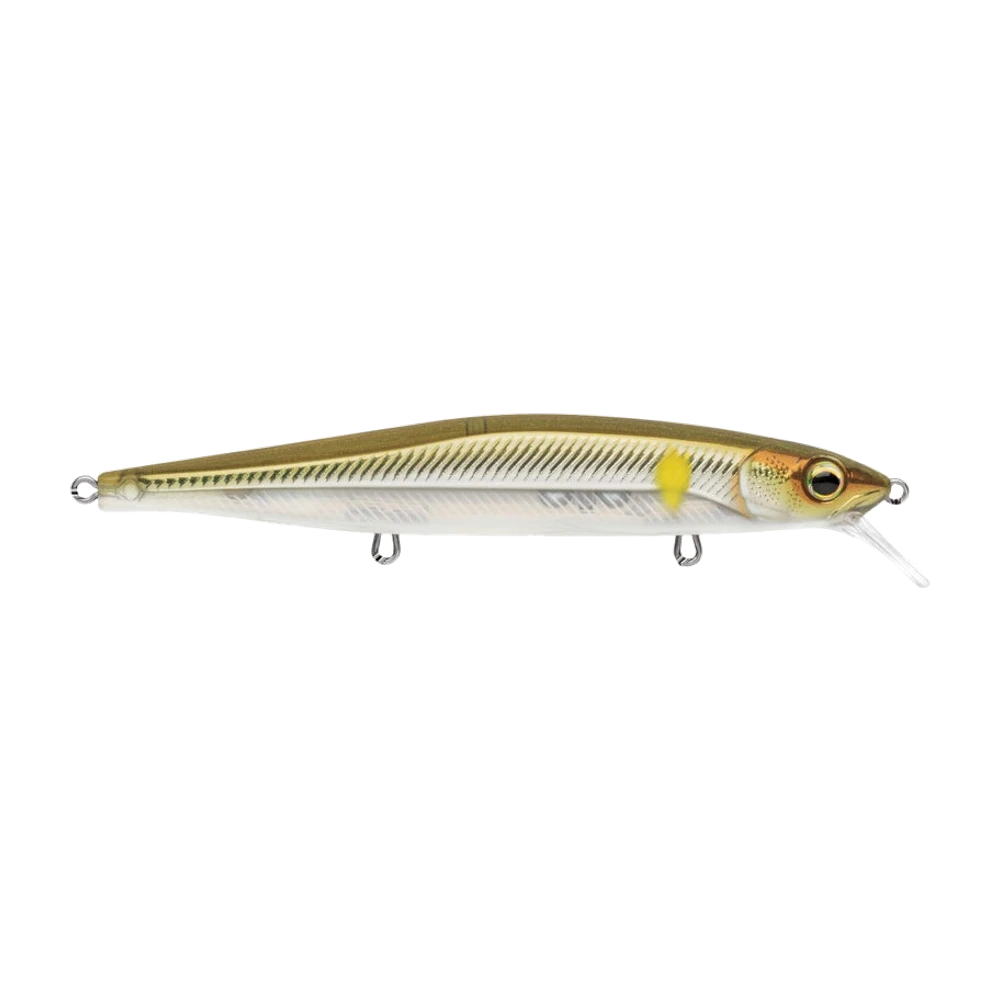
That number 5 is a treble gauge, not a dimension of the lure and not a hook count. The description separately states that the bait is armed with three VMC RedLine trebles. In the product photo the three hook hangers are clearly visible, but no treble is fitted: an observation from a product photo, not a statement about what comes in the box.
The 1.5 to 1.8 m depth puts the Mavrik in the same band as a Rapala Husky Jerk and above the deep search jerkbaits. That is the most useful layer over flats and along drop-off edges, where cold water fish sit.
Rigging
Fluorocarbon in 25 to 30 hundredths, for discretion in clear water and because its density helps hold the lure at depth through long pauses. Thin braid with a metre of fluorocarbon leader also works, and transmits twitches better on long casts.
A round clip beats a knot tied straight to the eye, so the nose is not restrained. On a pike water, add heavy fluorocarbon or soft titanium: an 11 cm jerkbait regularly attracts pike, and the head-down pause gives them confidence.
For the rod, count on 2 m to 2.1 m in medium power with a fast action. You need a tip that snaps to transmit the twitch, and a butt that cushions the hookset on three trebles.
Not sure what to tie on?
Photograph your spot: CarnaFish reads the scene, cross-checks the conditions and gives you the zone, the lure and the retrieve. Free on iOS and Android.
The retrieve: it is the pause that catches, not the twitch
The manufacturer describes a hard-cutting action on each twitch, produced by the body shape, the weight balance and the profile of the bill. Translation: the lure darts firmly to the side, changes direction, and flashes.
The basic sequence has three beats: two sharp wrist twitches with the rod tip low, then a pause. Count the pause, and lengthen it as long as you are not getting bites. In ten degree water, three seconds. In six degree water, eight to ten seconds is not absurd. The bite almost always comes as you restart after the pause: the fish, sitting under the motionless bait, reacts to the first movement.
Always keep a little slack in the line between twitches. Pull on a tight line and the lure runs straight ahead instead of cutting sideways, and you lose the lateral flash that makes this jerkbait worth fishing.
The classic mistake
Fishing the Mavrik like a minnow, on a straight retrieve. The lure is not built for it: without a twitch, the short bill generates nothing more than a very ordinary swimming action, and its main argument — the nose-down stop — is useless if you never stop. If you want to cover water on a straight retrieve, pick a crankbait.
The other mistake is shortening the pauses out of impatience when nothing bites. The opposite is what works: in cold water, the pause is the lure.
Colors by water
- Clear water: the hatched green gold back and pearl white flanks of the lure in the photo, which plays on reflection rather than colour.
- Overcast sky or lightly stained water: a dark, strongly contrasting back that keeps a readable silhouette as the light drops.
- Coloured water: a chartreuse base or an orange belly, the one case where realism has to be traded for visibility.
A suspending jerkbait is only worth something if you put it in the right layer, and that is exactly what CarnaFish makes easier: one photo of the spot, and the AI suggests the zone, the likely depth and the type of lure suited to the day. To build the method around zander, our guide to getting started with zander on lures covers the lure families worth knowing.
What to remember
- Rated suspending by the manufacturer, with a stated head-down stop: the posture of a struggling baitfish, which allows long pauses.
- About 11 cm for 14.2 g, running 1.5 to 1.8 m, armed with three size 5 VMC RedLine trebles.
- The internal weight transfer turns a thin profile into a stable projectile: that is casting distance gained.
- The bite comes on the restart after the pause, not during the twitch: lengthen the pauses as the water cools.
FAQ
Does the Mavrik 110 really stay motionless on the pause?
The manufacturer rates it suspending and states a head-down stop. In practice, line density and water temperature shift that behaviour slightly: heavy fluorocarbon will pull it down slowly, braid will let it rise.
How long should the pause be?
Two to three seconds in temperate water, up to eight or ten seconds in very cold water. The rule is simple: lengthen the pause while you are getting no bites, and shorten it as soon as fish hit during the twitch.
How deep does it run?
Between 1.5 and 1.8 m according to the manufacturer, on fine line with a standard retrieve. That is the useful layer over flats and drop-off edges in cold water, the same band as a Rapala Shadow Rap.
What does the stated hook size mean?
It is a treble gauge, number 5, given in the last column of the size chart. It is neither a dimension of the lure nor a hook count: the description separately states that the bait carries three trebles.
Can it be fished on a straight retrieve?
That is not what it is for. The short bill is made to cut sideways under the impulse of a twitch, not to generate an interesting action on its own. On a pure straight retrieve, a crankbait does the job better.
Do I need a wire leader?
Only where pike are present, which is common on the flats where this lure works best. Heavy fluorocarbon or soft titanium is enough in most cases, and stays more discreet than steel cable in clear water.
The full bass lure guideSeason-by-season strategy: which family of lure, when, and why.Go from theory to fish
CarnaFish reads your spot from a photo and gives you the game plan: zone, lure, retrieve. Free on iOS and Android.