6th Sense Vega Hush Frog: the compact frog built to skip under docks
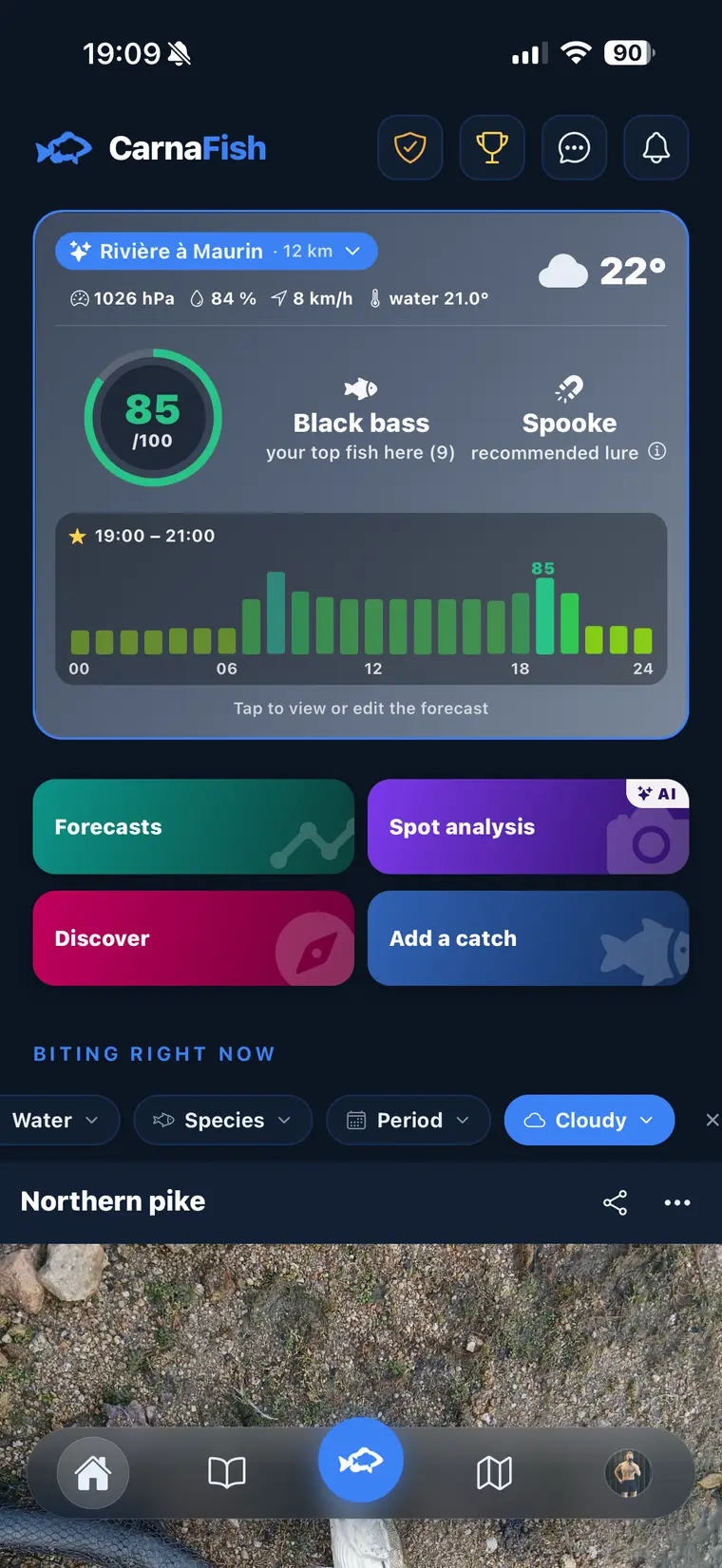
One lure, endless conditions. CarnaFish reads your spot from a photo so you are not just guessing.
There is one place most topwater anglers give up on without even trying: the thirty centimetres of shaded water under a floating dock, or the inside of a laydown whose branches touch the surface. A full-size frog gets in there badly — it bounces high, hits the wood and comes back. That is exactly the ground 6th Sense is aiming at with the Hush: a shorter frog, flatter across the top, built to skip flat and slip through cover where bulk becomes a handicap.
A size that changes what the lure is
The Hush measures 5.9 cm / 2-1/3 in and weighs 14.2 g / 1/2 oz. That is half a centimetre and almost five grams less than the 6th Sense Vega Hollow Body Frog it descends from, and it is not a cosmetic variation. A 14 g frog still casts properly on a heavy casting rod, but it enters the water far more quietly, and above all it shows a silhouette that bass which have seen ten frogs over a season have not yet learned.
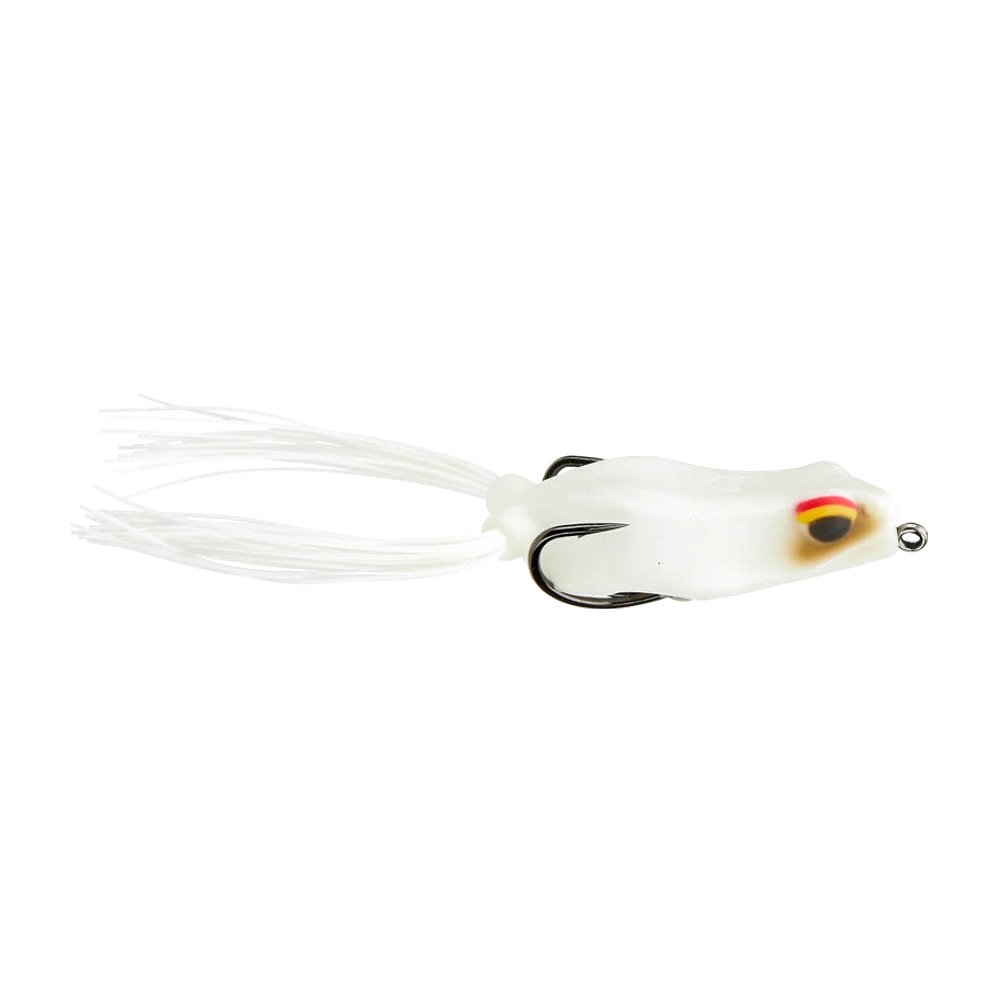
The body is clearly slimmer than the category average. Seen in profile in the photo, it has almost no belly: it is a spindle, not a stylised frog. That slimness has a direct effect on how it travels through cover. In a tangle of branches, a wide frog stops at every fork; the Hush slides through and carries on. In a pad field it goes between the gaps instead of climbing onto the leaves, which changes the rhythm: fewer hang-ups, more water genuinely covered per cast.
The cupped back and the belly plug
Two construction details are worth stopping on, because each answers a concrete problem.
The back of the Hush is moulded with a recess, a channel that takes the double hook points exactly. You can see it clearly in the photo: the points do not stand proud, they sit in the body. The benefit is not only weedlessness — every frog does that — but hookset consistency. Points that always start from the same place, on the same axis, come out of the hollow body the same way every time. On a frog where the points float freely against the back, the angle varies from one set to the next, and that is one of the causes of fish lost for no obvious reason.
The belly is closed with a plug designed to limit water intake. That is the historic weak point of the hollow body: after twenty bites and a few trips through wood, a conventional frog fills, gains weight, loses its buoyancy and stops walking. From then on you empty it on every cast. The plug does not make the lure watertight for life, but it clearly spaces out the emptying, and over a full day spent in laydowns that is a difference you feel.
Get into the habit of squeezing the body between two fingers every ten or fifteen minutes. If a drop comes out, empty it straight away: a frog that has taken half a cubic centimetre of water already walks differently, and you will spend twenty minutes wondering why it no longer zigzags.
Skipping, the job it was built for
The belly of the Hush is keeled, meaning it presents an edge rather than a flat surface. That feels counter-intuitive when you think about skipping — you imagine you need a flat — but it is precisely that edge that lets the bait bounce while holding its axis instead of spinning off after the first impact.
How to send a frog under an obstacle
The motion is sidearm, rod almost parallel to the water, and the cast has to be flat: you aim at a point two or three metres short of the obstacle, not at the obstacle itself. The lure touches, bounces two or three times and finishes its run in the shade. Back the brake on your casting reel off slightly: too tight and the lure stops on the first bounce, too loose and you get a backlash every attempt.
Then leave the bait dead still for three to five seconds before the first move. A bass sitting under a dock watched the lure arrive; it often comes up before you have moved at all.
The classic mistake
Trying to walk the Hush with the amplitude of a big frog. The compact format calls for shorter, sharper rod-tip strokes with less slack taken up between each. Pull too hard and the lure runs straight instead of zigzagging, and you lose the whole point of walking it on the spot above a precise piece of cover.
Not sure what to tie on?
Photograph your spot: CarnaFish reads the scene, cross-checks the conditions and gives you the zone, the lure and the retrieve. Free on iOS and Android.
Where it beats a standard frog
Over a dense, uniform weed mat the Hush brings nothing decisive: a heavier SPRO Bronzeye Frog casts further and slides better across a wide field of leaves. Its ground is hard, cluttered cover — docks, submerged branches, stumps, well-defined reed edges — and waters where the fish have been heavily pressured.
It is also a good call when the average size of fish is modest. A 14 g frog's double hook is still large for a 35 cm bass, but clearly less so than a full-size frog's hardware. If you want to go smaller again, a Gunki Micro Frog covers the size below.
In Europe pike regularly attack frogs along weedy margins in summer. Be clear that the Hush's reduced size does nothing to improve hook penetration in a bony jaw: the drop-off rate stays high, and this is an opportunistic use, not a purpose.
Colours by light
- Overcast sky, milky or lightly stained water: the solid white of the photo, skirt included. On grey water, a white shape moving across the surface is the most readable signal there is.
- Clear water, high sun: a green or olive back with a pale belly, which matches the natural outline of a frog seen from below.
- Into the light, dawn and dusk: solid black. The fish sees only a cut-out against the sky, and black is the only shade that makes it truly sharp.
Knowing whether the day's margin calls for a compact frog, a full-size frog or another topwater register altogether is the kind of reading CarnaFish takes on: a photo of the spot, and the AI suggests a zone, a depth and a lure type suited to conditions. To build the groundwork, our guide to getting started with bass fishing covers the spots and the tackle.
What to remember
- 5.9 cm for 14.2 g: a reduced size that exists to get through hard cover, not to fish further out.
- A cupped back that seats the double hook points, for a more consistent hookset from fish to fish.
- A belly plug that clearly spaces out the emptying, the classic failing of the hollow body.
- A tighter walk than a standard frog: short rod-tip strokes, never forced amplitude.
FAQ
What size is the Vega Hush Frog exactly?
6th Sense gives 2-1/3 in, or 5.9 cm, for 1/2 oz, or 14.2 g. That is compact next to most American frogs, which sit around 6.5 to 7 cm for 18 to 21 g.
How does it differ from the standard Vega Frog?
The Vega Hollow Body Frog is 7 cm for 18.9 g and has a cupped mouth that throws water. The Hush gives up that spray in favour of a slimmer body, quieter on impact and far better at getting through wood and skipping under cover.
Why does my frog stop walking after an hour?
In the vast majority of cases it has taken on water. Squeeze the body between two fingers: if water comes out, empty it completely before carrying on. The Hush's belly plug limits the problem but does not remove it.
Do I need a special rod to skip a frog?
A heavy casting rod with a reasonably fast action is enough, but the motion matters more than the gear: sidearm cast, rod almost horizontal, and a reel brake set firm without being locked. Practise in open water before aiming at a dock.
Is the Hush Frog suitable for pike?
In Europe pike readily attack a frog along weedy margins in summer, but the double hook penetrates a bony jaw poorly and many fish drop off. It is a secondary use, and worth treating as one.
Can you fish it in open water like a stickbait?
Yes, along a clear margin or over a hump, with short rod-tip strokes. Its walk is tighter than a full-size frog's: it covers less width on each zigzag, which makes it more precise over a small piece of cover but less efficient for covering water fast.
The full bass lure guideSeason-by-season strategy: which family of lure, when, and why.Go from theory to fish
CarnaFish reads your spot from a photo and gives you the game plan: zone, lure, retrieve. Free on iOS and Android.