Rapala Crush City Mooch Minnow: the soft minnow that stays up
One lure, endless conditions. CarnaFish reads your spot from a photo so you are not just guessing.
Some days the sonar tells you everything: fish sitting half a metre off the bottom, motionless, not lifting an inch for anything that passes above them. You drop a standard shad down to their level on a drop shot, and the moment you stop moving it folds limply towards the weight. The Mooch Minnow is built for exactly that moment — a small soft minnow that stays up above the sinker, upright on its keel, still looking like a live baitfish while you do nothing at all.
A fluke with a swimmer's tail grafted on
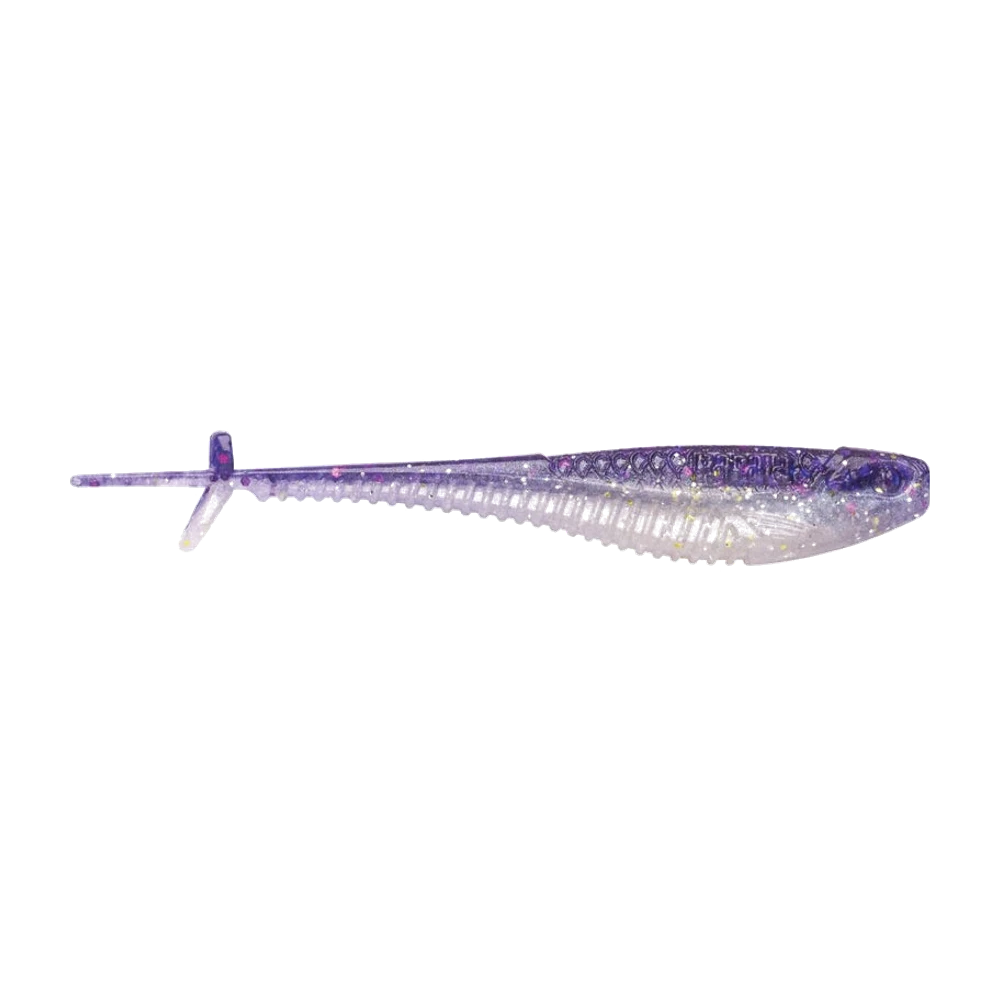
Rapala describes the Mooch Minnow as a cross between a minnow-style fluke and a swimbait: the slim silhouette and flat body of the first, the swimming behaviour of the second. In the hand that is exactly what you get — a lance-shaped body, flattened on the sides, that looks neither like a paddle tail shad nor like a straight worm.
The detail worth stopping on is at the back. The tail is not a paddle: it is a thin flat stem, long, almost thread-like, carrying two thirds of the way down a small cross-shaped fin — a short vertical tab standing above and a longer one hanging below. Nothing like the round paddle of a classic shad pushing water. That tail simply does not have the surface area to produce a hard kick: it quivers, it undulates, it trails behind the body like a living appendage. That is an observation from a product photo, not a manufacturer specification, but it explains directly why this lure asks for a different retrieve than a paddle tail.
The rest of the moulding is clean: raised scales along the back, a pectoral fin moulded at the gill line, and a belly deeply ribbed with transverse ridges. Just behind the head, on the dorsal line, there is a clear step in the mould — the intended exit point for the hook.
The three sizes, and what each is for
The manufacturer lists three lengths: roughly 6.4 cm, 8.9 cm and 11.4 cm. Be careful with the size chart published by retailers: the numbers sitting next to the lengths are pack counts (eight, six and five pieces), not weights. The weight of the bare lure is simply not published, which is a gap when you want to match a jig head to the gram. In that case, start from the weight of the head and adjust by feel rather than trusting an invented figure.
In practice the 6.4 cm is a pure drop shot size, the one you send down when nothing else gets looked at. The 8.9 cm is the broadest compromise: still finesse, but with a silhouette a good bass takes seriously. The 11.4 cm moves into another category, that of an adult baitfish, better on a jig head to cover water than on a static presentation.
What a floating TPE changes
Rapala states that the body is poured from a TPE designed to let the bait float and hover in the water column, with a subtle upright swimming action. That is not a harmless marketing line: it is the technical fact that drives every rig choice.
A soft plastic that floats will not collapse onto the line on a drop shot. It stays perpendicular to the leader, tail slightly raised, and holds that posture as long as the weight does not move. So you can leave the rig dead still for thirty seconds above a fish you have marked, and the lure keeps working on its own with every tremble of the slack line. On a light jig head the same property shows up differently: the rear of the bait lifts while the head rests on the bottom, and the long thread tail stands up in the current. That is the classic Ned rig posture, but with a baitfish silhouette instead of a stick.
The second benefit of TPE is durability: the material takes more fish than soft plastisol before tearing at the hook. Rapala adds that its injection process places flake, salt and scent where they are useful rather than through the whole mass.
Do not try to make that tail kick. It is not built for it. If you speed up until you can feel the lure loading the rod, you are already too fast: this one is fished blind, trusting the rig rather than the vibration coming back through the blank.
Three retrieves, three situations
The shaken drop shot
This is where the Mooch Minnow gives the most. Single hook nose-hooked or lightly Texas-rigged, 5 to 10 g flat sinker, twenty to forty centimetres of leader. The retrieve comes down to one thing: shaking the rod tip without moving the weight. The belly ribs and the thread tail carry every micro-movement, and the lure trembles on the spot without travelling. If nothing happens within ten seconds, move the sinker twenty centimetres and start again.
The light jig head
A 2 to 5 g round or mushroom head is enough. The point is not to sink fast but to keep the bait readable: drop it, let the body settle, then two short pulls followed by a long pause. The bite comes during the pause, as the lure recovers its attitude. Past 7 g the head crushes the floating behaviour altogether and it makes more sense to rig a paddle tail such as the Rapala CrushCity Freeloader.
Dragging on the bottom
Less talked about, deadly on hard bottom. You wind back at a crawl with no animation at all, letting the head scrape the substrate: the body follows flat, the thin tail sweeping behind. It works best in cold water, when fish refuse anything that rises or accelerates.
Not sure what to tie on?
Photograph your spot: CarnaFish reads the scene, cross-checks the conditions and gives you the zone, the lure and the retrieve. Free on iOS and Android.
Where and when to use it
The Mooch Minnow is first of all a bass lure, and that is the use the manufacturer puts forward. In Europe it also earns its place on perch, in 6.4 cm, as soon as the shoals hold deep and refuse sharply worked lures: dam edges, gravel pit holes, bridge pilings.
It is not a search lure. If you have two hundred metres of bank to cover before finding fish, take something else and come back once the zone is identified. It is built to work a spot over, not to find one.
Colors by water clarity
- Clear water: the translucent flake finishes, like the purple with a pearl belly in the photo, which throw light back without ever turning opaque.
- Weed or lightly stained water: green pumpkin, the safe bet of American soft plastics, which disappears against green and brown bottoms.
- Coloured water or low light: pearl white or chartreuse, to give the fish a visual reference once visibility drops below a metre.
Picking the right rig means nothing if the zone is wrong, and that is exactly what CarnaFish is for: one photo of the spot, and the AI suggests the area to work, the likely depth and the type of presentation that fits the day. For the rest of the method, our guide to getting started with bass fishing covers the tackle and how to read a spot.
What to remember
- The floating TPE keeps the lure upright and suspended at rest: that is the whole value of the drop shot rig.
- The thread tail quivers, it does not kick — working it fast is the most common mistake with this bait.
- The figures next to the lengths in retailer charts are pack counts, not weights: the bare lure weight is not published.
- 6.4 cm for pure finesse, 8.9 cm as the compromise, 11.4 cm to imitate an adult baitfish on a jig head.
FAQ
Does the Mooch Minnow really float?
Yes, the manufacturer states a TPE that lets the bait float and hover in the water column. Rigged bare on a single hook, it stays horizontal above a drop shot weight instead of folding onto the line.
Which size should I start with?
The 8.9 cm covers the most situations: discreet enough for a finesse presentation, bulky enough to interest an adult bass. Save the 6.4 cm for genuinely difficult fish.
What jig head weight should I use?
Between 2 and 5 g in the vast majority of cases. The manufacturer does not publish the weight of the bare lure, so you calibrate by hand, starting with the lightest head that still reaches the bottom.
Can it be rigged Texas weedless?
Yes, and it is recommended around cover. The moulding has a step behind the head that makes a clean hook point exit easy. Use a fine-wire Texas hook so you do not crush the body.
Is it a good lure for perch?
In the small size, yes, especially on shoals holding deep that refuse sharp animation. For faster perch fishing, a dedicated stick such as the Z-Man TRD Ned Rig or a compact shad stays more efficient.
How does it differ from a classic fluke?
A Zoom Super Fluke is mostly fished darting just under the surface with sharp rod strokes. The Mooch Minnow aims at the opposite: a slow presentation near the bottom, where the buoyancy of the body does the work for you.
The full bass lure guideSeason-by-season strategy: which family of lure, when, and why.Go from theory to fish
CarnaFish reads your spot from a photo and gives you the game plan: zone, lure, retrieve. Free on iOS and Android.