Roboworm Fat Straight Tail: the worm that holds a Texas rig
Not sure this lure fits YOUR spot today? CarnaFish tells you in 10 seconds, from a photo.
There is one failure every straight-worm angler knows: by the third or fourth fish, the hook has finished tearing through the nose of the bait and the worm slides down the shank on every cast. You push it back up, you re-pin it lower, then you bin it. The Fat Straight Tail is Roboworm's answer to that exact problem — an ordinary straight worm, but with a deliberately thickened head section.
A thickening with a mechanical job
Roboworm states plainly why that head is fatter: the hook holds more securely when the bait is Texas-rigged, and the plastic resists tearing better when bites come in runs. That is not marketing finesse, it is geometry. A hook passes through a thickness of plastic; the greater that thickness around the puncture, the more force it takes to rip it out.
The brand goes as far as presenting this model as the fix for anglers who gave up trying to Texas-rig the standard Straight Tail in the range. That is a commercial claim and should be read as one, but it describes the difference between the two honestly: the Roboworm Straight Tail stays thinner and suits drop shot or a light shaky head better, while the Fat takes over as soon as the hook has to take a load.
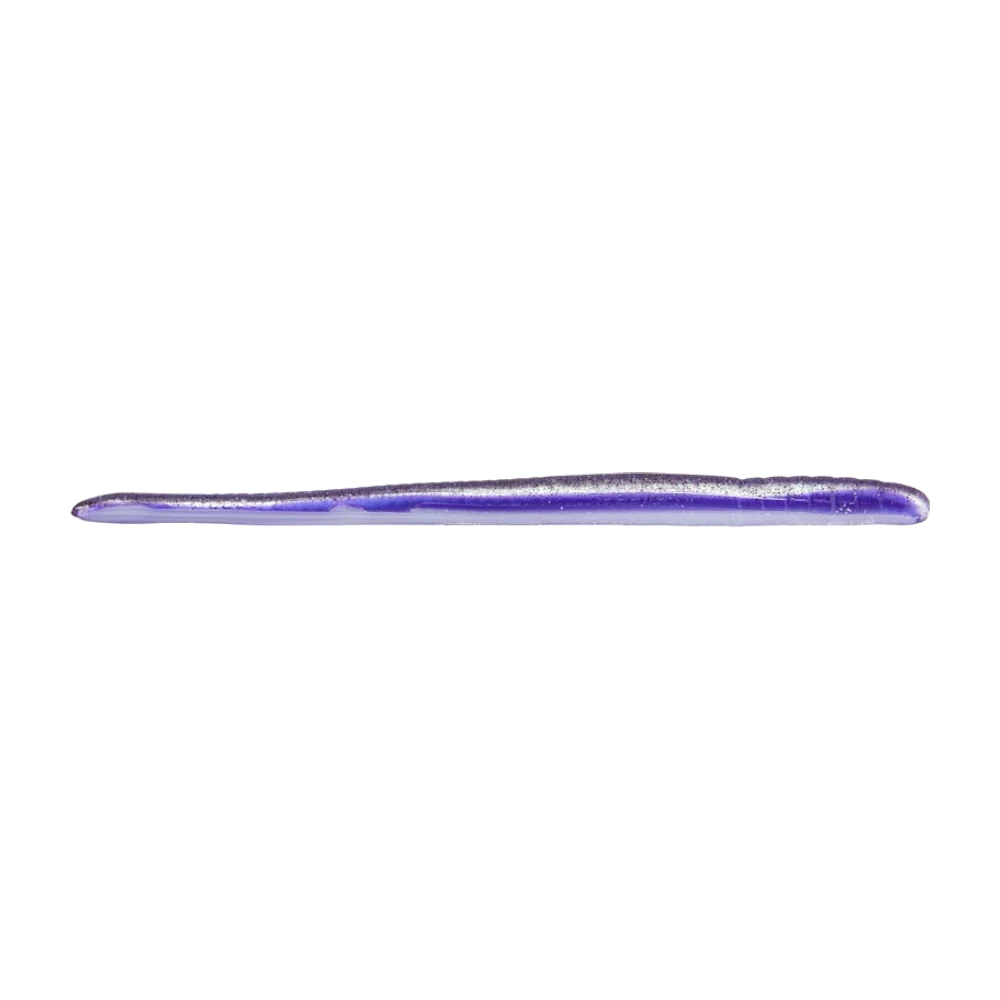
In the photo on this page, the difference in section between the rounded head and the tapered tail is obvious to the eye. The laminate reads clearly too: a translucent purple band loaded with silver flake along the back, an opaque purple core, and a distinctly paler belly. Those are observations from a product photo, not specifications, but they give a faithful idea of the finish.
Salt, and what it actually does
Every Fat Worm carries what Roboworm calls its Salt Release System: the plastic gives off a burst of salt as the fish bites. The brand's argument is that the fish holds on longer, which buys you time to set the hook.
What can be said without stretching it: a salted bait does not pull a fish in from further away, it only changes what happens after the bite. On a slow Texas presentation, where a fish picks the worm up and moves off gently, that extra second before it spits is the difference between a hookset and a chewed lure. On a fast sight-fishing presentation it changes nothing. Salt also makes the plastic heavier, so this kind of worm sinks — slowly, but it sinks.
Never set the hook on first contact with a Texas-rigged worm. Let the line come tight on its own for a second, rod low, then sweep sideways. The salt buys you that delay: use it instead of wasting it on a reflex hookset.
Two lengths, and one absence worth flagging
The maker's table lists two versions: four and a half inches, or 11.4 cm, and six inches, or 15.2 cm. Read the header of that table carefully: the two columns are length and quantity, not length and weight. Both versions come eight to a pack, and no weight is published by Roboworm. If you need the exact mass to size a sinker, you will have to weigh one yourself; better to know that than to buy on an invented figure.
The 11.4 cm is the baseline size, the one that covers most situations and works equally well on Texas and drop shot. The 15.2 cm selects upward: fewer bites, bigger fish on average, and a silhouette that keeps its value in stained water where volume counts more than detail.
Not sure what to tie on?
Photograph your spot: CarnaFish reads the scene, cross-checks the conditions and gives you the zone, the lure and the retrieve. Free on iOS and Android.
The three rigs that matter
Texas weedless
This is the use the worm was thickened for. A wide gap hook in 2/0 or 3/0 for the 11.4 cm, 3/0 or 4/0 for the 15.2 cm, point tucked just under the skin of the back. A bullet weight of 3.5 to 7 g depending on depth and wind, running free on the line or pegged, depending on whether you want the weight to separate from the bait on the fall. Drag slowly along the bottom, pause for two or three seconds, and accept that you will feel almost nothing: most bites show up as nothing more than unusual weight.
Drop shot
Nose-hooked on a fine wire hook, the Fat holds a constant height above the sinker. The thickened head helps here too, because that is the most stressed point when you shake the rod tip. This rig works particularly well on perch in Europe, along a harbour wall or a rip-rap bank.
Wacky
Hooked through the middle, the worm folds into a V and both ends quiver on every micro-input. The straight, even body of the Fat suits that presentation well, provided you use an O-ring: without one the plastic tears on the second or third fish, even on a reinforced model.
The classic mistake
Rigging this worm on a hook that is too small in the name of finesse. The thickened head is worth nothing if the hook point does not pass through it properly: you end up with a rig that restricts the worm without gaining any hold. Pick a hook whose shank matches the length of the thick section, and check that the bait sits perfectly straight once rigged — a kinked worm spins and twists your leader.
Colours by water clarity
- Clear water: the silver-flake purple laminate from the photo, a register that has worked on wary bass in bright light for decades.
- Lightly stained water: green pumpkin, the do-everything soft-plastic colour, believable on hard bottom and in vegetation alike.
- Dark water or low light: solid black, which is not after colour but after a clean silhouette.
A straight worm never makes up for the wrong choice of zone: this is slow fishing, and twenty minutes in the wrong place is twenty minutes gone. That is exactly what CarnaFish makes easier — a photo of the spot, and the AI suggests the zone, the depth and the kind of presentation that fit the day. For tackle and typical lies, our beginner's guide to bass fishing is a good starting point. And if you want to compare this profile with other straight worms, the Zoom Trick Worm and the Yamamoto Senko 5 cover two very different takes on the same family.
What to remember
- The thickened head does one job: holding the hook on a Texas rig and delaying tear-out when bites come in runs.
- The maker's table gives length and quantity, not weight: 11.4 cm and 15.2 cm, eight per pack in both cases.
- The Salt Release System works after the bite, not before: it buys a second to set the hook, it does not attract from further away.
- On a wacky rig an O-ring is still essential despite the reinforced head.
FAQ
How does it differ from the standard Roboworm Straight Tail?
The head section, clearly thicker on the Fat. Roboworm presents this model as aimed at anglers who could not get the standard Roboworm Straight Tail to Texas-rig well: the Fat holds the hook better and resists tearing longer.
How much does this worm weigh?
Roboworm does not publish a weight. The maker's table has only two columns, length and pack quantity. If you need a precise mass to choose a sinker, weigh one yourself rather than relying on an estimate.
How many baits are in a pack?
Eight, for both lengths. That is the figure given by the Quantity column of the table, for the 11.4 cm as well as the 15.2 cm.
What hook size for a Texas rig?
A wide gap hook in 2/0 or 3/0 for the 11.4 cm, 3/0 or 4/0 for the 15.2 cm. Choose the shank to match the length of the thickened section, otherwise you lose the benefit of the reinforcement.
Does this worm suit perch in Europe?
Yes, especially the 11.4 cm on a drop shot, along rip-rap or a dock wall. The straight profile and the very discreet undulation suit a wary perch well. On a heavy Texas rig, bass remains the logical target.
Does salt attract fish from further away?
No. The salt released on the bite acts on the fish's behaviour once the bait is in its mouth: it holds on longer, which buys time to set the hook. Attraction from a distance comes from silhouette, speed and noise, not taste.
The full bass lure guideSeason-by-season strategy: which family of lure, when, and why.Go from theory to fish
CarnaFish reads your spot from a photo and gives you the game plan: zone, lure, retrieve. Free on iOS and Android.