Rapala Crush City Janitor Worm: the finesse worm that quivers on its own
One lure, endless conditions. CarnaFish reads your spot from a photo so you are not just guessing.
There are days when you know exactly where the fish are, when you can even see them on the sounder, and nothing goes. No clear refusals, no follows: nothing at all. That is what Americans call the finicky bite, and it is precisely the ground of the finesse worm — a bait that does not try to provoke, but tries never to look wrong.
A tapered tail that works on the smallest input
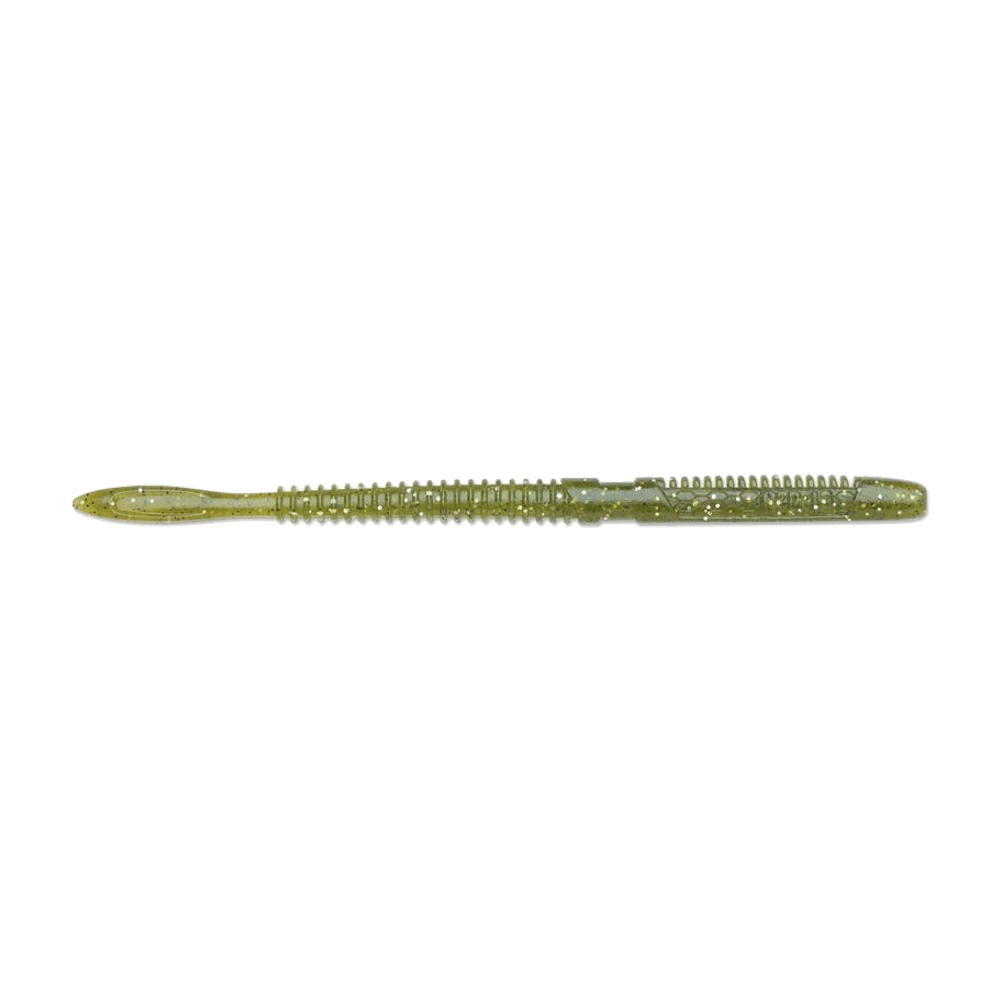
The Janitor Worm is a straight worm with nothing sticking out, and all its action lives in the tapered tail: it thins out progressively, then flattens into a lance point over the last few centimetres. Rapala advertises a lively quiver triggered by the slightest movement, and that is indeed how a tail of this geometry behaves — the finer and flatter the tip, the less force it takes to set it vibrating.
In practice that means you do not have to work it. Boat drift, a little tension on the line from the wind, or simply the fall of the bait is enough to get the tip going. That is exactly what you want when the fish refuses anything that moves too much.
The body itself is ribbed along almost its whole length, clearly visible in the photo. The ribs add surface area and a little water resistance, which slows the descent and amplifies the folding movement of the bait when it is hooked through the middle.
The slot for the ring, which is not a trivial detail
A third of the way down the body, a smooth recessed section interrupts the ribbing. It is clearly visible in the photo, and it is no accident of moulding: Rapala designed it to seat a VMC Crossover Ring, and explicitly states that this slot extends the life of the bait when wacky or neko rigging.
The problem it solves is real and familiar to anyone who fishes wacky: a hook pushed straight through a soft worm eventually tears the plastic, and a bait costing a couple of euros sometimes does not survive three fish. The ring transfers the load onto a rubber band, and the worm can last a whole day.
The slot brings a second, quieter benefit: the ring does not slide. On a smooth worm, the ring migrates towards the centre or the head over successive casts and changes the balance of the bait without you noticing. Here it stays where the maker intended, cast after cast.
The specs, and an adjective worth discussing
The maker's table is a single line, with a header to be read in full: Length Quantity.
| Published length | Equivalent | Pack |
|---|---|---|
| 6 in | 15.2 cm | pack of 8 |
No weight is published, and there is no class column: nothing says whether the plastic sinks, floats or stays neutral. The description mentions salt in the mix, which usually makes a soft plastic heavier, but that is not a density figure and no fall rate can be deduced from it.
There is also an interesting gap between the number and the wording. Rapala describes the Janitor Worm as a small finesse worm, while 15.2 cm is not small in absolute terms. The adjective is relative to the American market, where 8 to 10 in worms are common: on that scale, 6 in really is a downsized format. Seen from Europe, it is a medium-sized bait that has to be fished like a finesse bait, not a miniature one.
Wacky or neko: two unrelated ways to fish
Wacky, the ring goes on the middle of the body and the hook passes under it. The worm folds into a V and sinks with both ends fluttering. That is a surface-to-mid-depth presentation, along banks, laydowns and docks. No weight, a very slow fall, and total attention on the line: the bite is almost always a sideways drift, never a thump.
Neko, the ring goes towards the head — where Rapala has placed the slot — and a nail sinker is pushed into the thick end. The worm goes down head first and stands up on the bottom, tail pointing upwards. You work it with small tip twitches without moving it, and the tapered tail vibrates constantly above the substrate. That is the rig for deep, slow fishing, the one that works after a cold front.
The classic mistake
Overweighting the neko rig. A 1.8 g nail sinker is enough down to 4 m, and plenty of anglers jump straight to 3.5 g out of a reflex to get down fast. The result: the worm lies over instead of standing up, and the tail only vibrates in fits and starts. If you really have to reach 7 or 8 m, accept the sink time rather than adding weight.
A habit that changes everything on the wacky rig: after the splashdown, touch nothing for ten full seconds. Count them. Almost every bite on this rig comes during the free fall, and the reflex of giving a little twitch just to check cuts off precisely the phase that produces the bite.
On tackle, a size 1 or 1/0 finesse single hook, 8 to 10 lb class braid and a 16 to 20 lb class fluorocarbon leader are enough. For European perch, the Janitor Worm works but it selects: a 15 cm worm rules out the small ones from the start and leaves only the fish able to engulf it.
Not sure what to tie on?
Photograph your spot: CarnaFish reads the scene, cross-checks the conditions and gives you the zone, the lure and the retrieve. Free on iOS and Android.
Colours by water clarity
- Clear water: the translucent olive green with gold flake from the photo, with its lighter core showing through. It is the universal finesse shade, the one that looks like nothing in particular and therefore like nothing false.
- Stained water or low light: a solid dark tone, purple or black. On a bait this slim, it is the silhouette that carries, not the shade.
- Heavily fished, very clear water: a milky or translucent natural with no flake. Less signal, fewer reasons to refuse.
Where this worm really belongs
The Janitor Worm is not a search bait and does not pretend to be. It is the bait you tie on when everything else has failed, on a spot you have already identified, and that you fish slowly, accepting that you will only cover a few square metres.
If these rigs are new to you, our neko rig setup page and wacky rig setup page cover the rigging step by step, ring included. And against a Jackall Flick Shake Worm, the difference is clear: the Flick Shake has a bent body that gives it a swimming action of its own even without input, while the Janitor Worm is straight and bets everything on the vibration of its tip. The first moves more, the second is more discreet — and on genuinely wary fish, the discreet one usually wins.
Identifying the spot that deserves this kind of slow fishing is the real difficulty: CarnaFish reads a photo of the swim and suggests the zones to work first. And to go further into reading a perch spot and choosing slow presentations, our guide to perch fishing with lures lays out the useful markers.
Key points
- All the action comes from the tapered tail, which vibrates with no input from the angler: the right animation is often to do nothing.
- The smooth slot a third of the way down is made for a VMC Crossover Ring, which extends the life of the bait and keeps it from sliding.
- One size only, 15.2 cm, in packs of eight. No weight and no buoyancy class published.
- On the neko rig, stay with the lightest possible nail sinker: too heavy and the worm lies over instead of standing up.
FAQ
Does the Janitor Worm float?
Rapala does not say. The table has no class column and the description gives no density. Salt is mentioned in the mix, which usually makes plastic heavier, but that is not a published figure: if the resting posture matters, test the bait yourself.
Do you have to use a Crossover Ring?
No, but the slot is made for it and it is the only way to get the bait life Rapala advertises. Without a ring, a hook pushed through the plastic eventually tears it after a few fish.
What is the difference between wacky and neko with this worm?
Wacky, the ring is in the middle, there is no weight and the worm folds into a V during a very slow fall: that is bank fishing. Neko, the ring sits towards the head, a nail sinker goes into the thick end and the worm stands up on the bottom: that is deep, slow fishing.
What nail sinker weight for the neko rig?
Start at 1.8 g down to 4 m and only go past 2.5 g if wind or current force you to. Too heavy a sinker lays the worm flat on the bottom and kills the tail vibration, which is the whole point of the bait.
Is a 15 cm worm not too big for finesse?
Rapala calls it a small finesse worm, which makes sense on the scale of the American market where 8 to 10 in worms are common. In Europe, treat it as a medium format fished with a finesse technique, and accept that it selects fish.
How many baits per pack?
Eight. The second column of the maker's table really is a quantity and not a weight, which the header makes clear if you read it in full.
The full bass lure guideSeason-by-season strategy: which family of lure, when, and why.Go from theory to fish
CarnaFish reads your spot from a photo and gives you the game plan: zone, lure, retrieve. Free on iOS and Android.