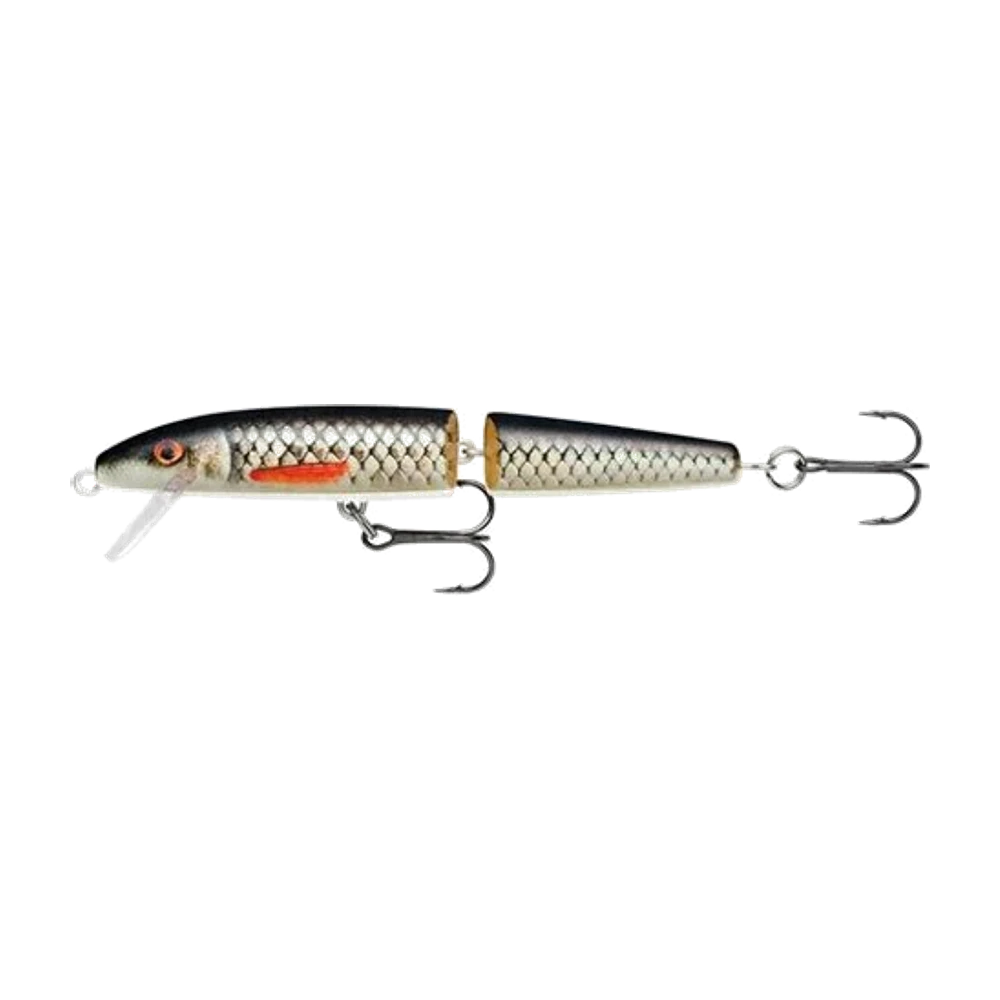
Rapala Jointed: the minnow that still swims when everything is too slow
This lure shines under specific conditions. CarnaFish tells you in 10 seconds if today is one of them.
November, water at 8 °C, pike pinned to the bottom of a gravel pit. You know you have to slow down. The problem is that when you do, your minnow stops swimming: below a certain speed the lip no longer gets enough bite, the body flattens out, and the lure crosses the zone like a piece of driftwood.
Every lure has a floor speed below which it stops working. On a slim, rigid minnow that limit sits fairly high — often higher than the pace an apathetic pike is willing to move at. That is precisely the gap most cold-water sessions fall into.
The Rapala Jointed lowers that limit. By cutting the body in two, it lets the rear section kick even when the front is barely moving. The lure keeps producing movement where a one-piece model is already dead.
Why a joint lowers the floor speed
On a rigid minnow, all the movement comes from the lip: it deflects the flow, the body oscillates around its axis, and the amplitude depends directly on the speed of the water hitting it. Slow down, and the whole thing switches off at once.
On a jointed model, the lip still starts the movement, but it no longer imposes it on a single mass. The rear section, free to move, follows with a delay and overreacts: it carries on after the front has started coming back. The result is that at very low speed you still get a visible tail kick while the front of the lure is barely doing anything.
Two secondary signals come with it:
- A more pronounced roll. The offset between the two sections tips the lure further onto its flanks, which increases the reflective surface on show.
- A dull knock produced by the hinge on every reversal. It is not a rattle, it is not a sound chamber: it is a contact noise, low and irregular, very different from the clicking of a rattling lure.
Then there is the material. Balsa is very light for its volume, which gives the lure a lively buoyancy: on the stop it floats up firmly, and it goes back into its swim at the slightest pull. That is a direct advantage for a stop-and-go retrieve, but it is also what makes it vulnerable to wind on the cast.
The retrieve: straight first, jerks afterwards
The baseline is simple, and deliberately as slow as possible.
- Cast and let the lure settle for two seconds on the surface, long enough for the rings to go.
- Start winding very slowly, until you feel the lip bite. Look for the minimum rhythm at which you can still feel the kick in the rod tip: that is your working speed.
- Hold that rhythm for five to ten metres, adding nothing. That is already a complete retrieve.
- Pause for two to three seconds. The lure floats up a few tens of centimetres, rocking onto its flanks.
- Restart sharply, with a quick half turn of the handle. The restart of a jointed lure produces a marked sideways kick that triggers a lot of bites.
- Repeat to the bank, adjusting the length of the straight phases to how responsive the fish are that day.
In rivers there is a variant worth the detour: cast upstream and let the lure come down with the current, keeping only the line tight. The current alone is enough to work the sections, and you present a lure that drifts while swimming, something fish are rarely shown.
On the water: do not use a right-angled snap or a tight knot straight onto the nose ring. On a jointed balsa lure, the front needs freedom to pivot, and a rigid connection removes part of the rear kick — exactly what you picked this lure for. A loop knot or a small round snap gives you the full action back.
Sizes, depths and uses
| Size | Indicative weight | Depth on a straight retrieve | Typical use |
|---|---|---|---|
| 5 to 7 cm | 4 to 5 g | 0.9 to 1.5 m | Small rivers, margin pike, very clear water |
| 9 cm | 7 to 8 g | 1.2 to 1.8 m | The all-round size from bank and boat |
| 11 cm | 9 to 10 g | 1.5 to 2.1 m | Medium to good-sized pike, gravel pits |
| 13 cm | 16 to 18 g | 1.8 to 2.4 m | Big fish, searching, slow trolling |
Depth depends heavily on speed: at a very slow pace, expect to swim in the upper part of the range shown. If you need to get deeper, do not force it — this is a mid-layer lure, not a deep diver.
Balsa has one practical consequence worth knowing: two examples of the same reference can swim slightly differently. If yours pulls to one side, correct it by bending the tow ring very slightly in the opposite direction to the drift, a quarter of a millimetre at a time.
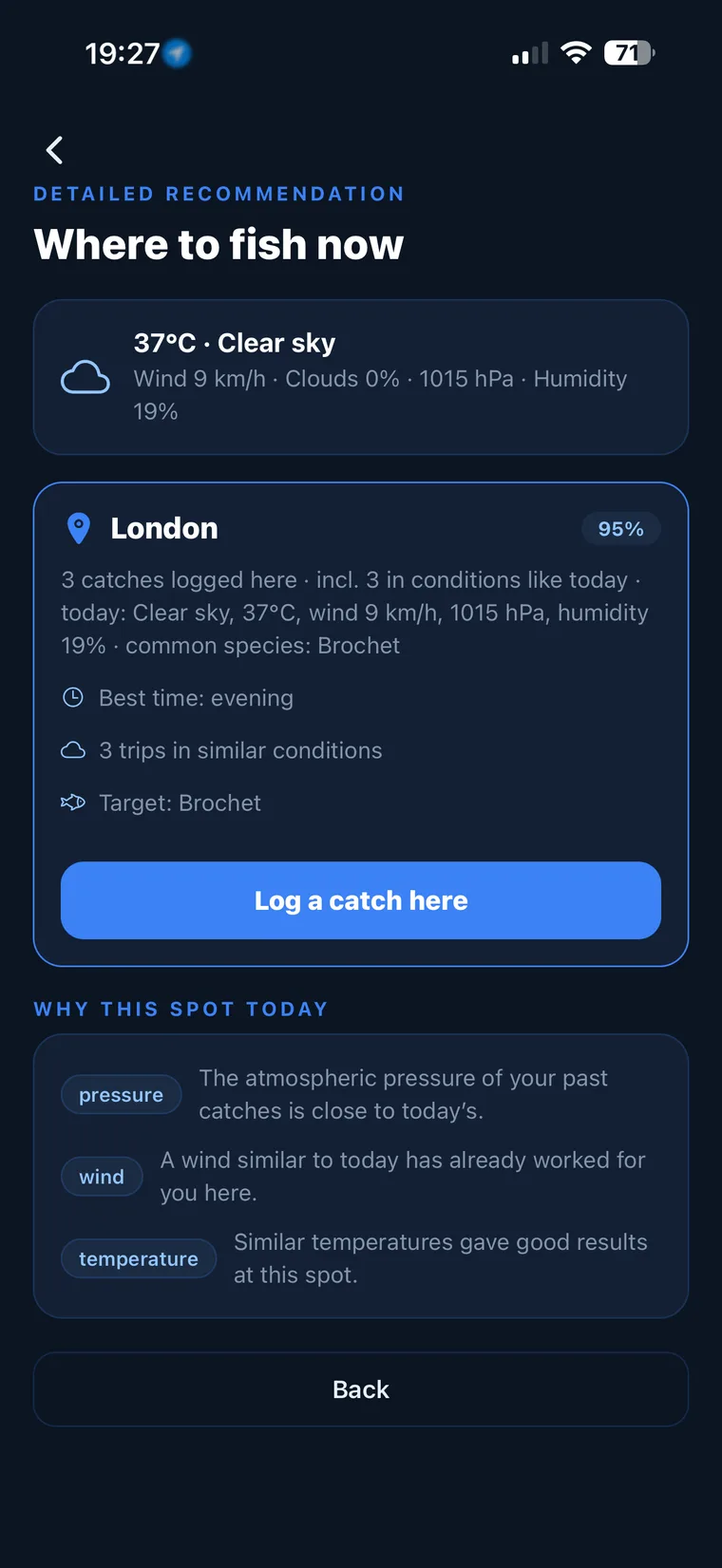
Not sure what to tie on?
Photograph your spot: CarnaFish reads the scene, cross-checks the conditions and gives you the zone, the lure and the retrieve. Free on iOS and Android.
Where it excels, and where it is the wrong choice
Its window is that of enforced slowness:
- Cold water, from late autumn to early spring, on pike that refuse to move fast.
- The edges of dead weed beds and shallow drop-offs, between 1 and 2 m, where you need to stay a long time in the same layer.
- Rivers with moderate current, on a controlled drift or a very slow retrieve.
- Slow trolling behind a boat, where its wide swim holds perfectly at low speeds.
It is the wrong pick in three cases, though. In a strong wind, its lightness for its volume ruins casts and makes it flutter in flight. In dense cover, the hinge and the two trebles multiply snags and tangles. And on active fish you need to find fast over a large area, a denser, faster lure covers ground far better.
One last honest point: balsa marks. Pike teeth leave scars, water eventually gets in once the paint is broken, and a waterlogged lure loses its lively buoyancy. Dry it out, and touch up deep cuts with varnish.
Jointed or one-piece minnow
The Rapala Original Floater F11 shares the same balsa and the same family, but its rigid body gives a tighter, more regular swim. It is better whenever you want a clean trajectory, a slightly faster retrieve, or a discreet presentation in very clear water. The Jointed takes the lead in exactly the opposite conditions: when the speed has to drop so low that a rigid body switches off, and when you want more disorder in the swim.
The Rapala CountDown answers a different question again: depth. It sinks, so it lets you pick your layer precisely by counting. The Jointed floats and rises on the stop — a drawback for holding the bottom, and a major asset for getting back into its swim after every pause.
Our guide to choosing a pike lure sets these three approaches against each other by season. And if you are unsure what speed to adopt when you arrive at a margin in cold water, CarnaFish analyses a photo of the spot and answers.
Key takeaways
- The joint lowers the floor speed: the lure still swims where a rigid minnow stops working.
- Signals specific to this model: an offset rear kick, a pronounced roll, a dull knock from the hinge.
- Very slow straight retrieve, a two to three second stop, a sharp restart: it is the restart that triggers.
- A loop knot or round snap is compulsory; a rigid connection removes part of the action.
- Avoid it in strong wind, in dense cover, and when searching large areas fast.
FAQ
How fast should I retrieve a Rapala Jointed?
As slowly as you can while still feeling the kick in the rod tip. That is exactly its strength: it keeps working at speeds where a rigid minnow flattens out. Find that minimum rhythm on your first cast, then hold it.
What size for pike?
The 9 cm is the most versatile, from the bank as from a boat. The 11 and 13 cm make sense when you are targeting good fish or need to get down towards 2 m. Below 7 cm you are into small-river sizes.
Can I use a snap with this lure?
Yes, but only a small round snap. A right-angled snap or a tight knot on the ring restricts the pivot at the front and reduces the rear kick — which is precisely what the joint brings you.
Why does my Jointed swim off to one side?
Balsa is a natural material and two identical examples can behave differently. Correct it by bending the tow ring very slightly against the drift, in tiny increments, testing after each adjustment.
Is the Jointed suitable for trolling?
Yes, it is one of its good uses: its wide swim holds at low speeds, which matches slow trolling behind a boat well. Beyond a certain pace, though, it tends to blow out of its track.
What is the difference with a Rapala Original?
The Original is rigid: a tighter swim, a cleaner track, better in clear water and at a slightly brisker pace. The Jointed produces more disorder, a stronger roll and a hinge knock, and keeps swimming at speeds where the Original dies.
The full pike lure guideSeason-by-season strategy: which family of lure, when, and why.Go from theory to fish
CarnaFish reads your spot from a photo and gives you the game plan: zone, lure, retrieve. Free on iOS and Android.