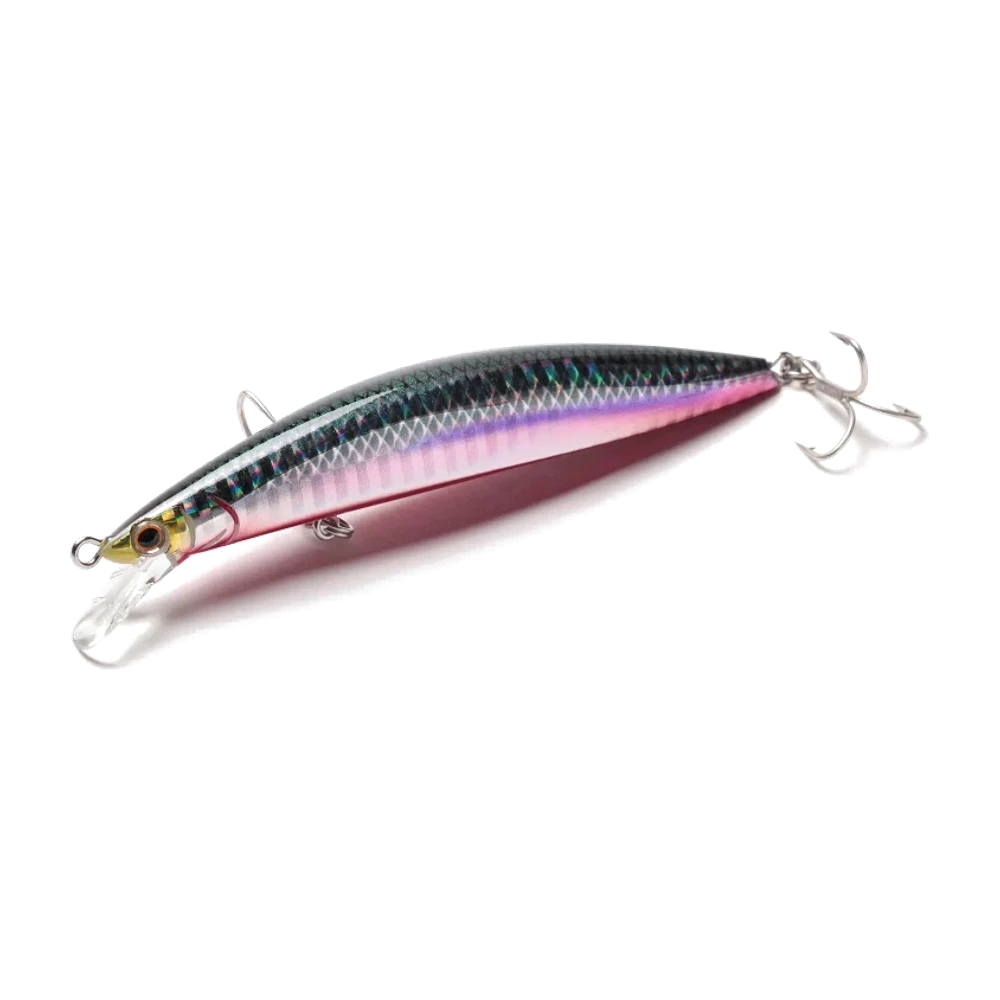
Jackson Athlete Plus: the floating minnow that still swims at a crawl
Not sure this lure fits YOUR spot today? CarnaFish tells you in 10 seconds, from a photo.
On a rocky flat under sixty centimetres of water, on a flood tide, with sea bass feeding right up in the surface, most saltwater minnows pose the same problem: to make them swim properly you have to retrieve at a speed that takes them past too fast and too deep. Slow down and the action dies. Speed up and you plough the rocks.
The Athlete Plus is built for that narrow band. It starts swimming at a very low retrieve speed — the speed at which the lure is barely moving — and it does so while staying in the first metre of water. It is a shallow draught minnow, not an all-rounder that happens to tolerate fishing high.
That distinction is worth making straight away: this is not one more model in the Athlete range, it is the floating counterpart to the sinker, and the two are not fished the same way at all.
What changes compared with the Athlete SS
The Athlete 14 SS is a sinking model built for distance: it goes down, it casts a long way, and it lets you reach a far-off bar or work under the wave when there is a swell running. When you stop retrieving, it sinks.
The Athlete Plus reverses every one of those parameters:
- It floats at rest. You can stop the retrieve over a rock head, let the lure rise, and set off again on the other side without snagging. On a flat strewn with obstacles, that is the difference between fishing and re-rigging every three casts.
- It has a low ceiling. Even if you speed up, it will not go looking for two metres. Its useful layer stays between 30 cm and 1 m.
- It starts sooner. The SS needs speed to vibrate; the Plus gives you its action from the first turns of the handle.
- It casts less far. That is the price. A floating model of the same size naturally loses a few metres to a sinker with weight transfer.
Translated onto the water: the SS for deep water, wind and distance; the Plus for shallow water, a rising tide, and sea bass glued to the surface.
The retrieve: slow and straight, and nothing else
This is a lure you ruin by working it too much.
- Cast across the tidal current, never straight down it. You want the lure to cross the flow, not swim up it.
- Close the bail and wait a second for the line to come tight. The lure floats, you risk nothing.
- Retrieve continuously and slowly, just above the threshold where you feel the vibration come back through the blank. That threshold is low: less than one turn of the handle per second is often enough.
- Add a one to two second stop every five or six metres. The lure rises slightly then picks up its action again: that restart triggers a lot of bites.
- Slow down further at the end of the retrieve, as the lure tracks the rocks along the margin. Sea bass sitting at your feet attack over the last three metres more often than people think.
On the water: with a floating minnow in the sea, the bite almost always comes as the lure crosses the line between broken water and smooth water — the foam line, the edge of an eddy, the boundary between two currents. Aim at that boundary rather than at the feeding fish themselves: sea bass sit in ambush there, whereas over a feeding shoal they are moving constantly.
Things to avoid: big pulls of the rod. The Athlete Plus is not a stickbait, it has no sideways gliding action to exploit. Mistreat it and it loses its axis and comes out of the water.
Setting the layer of water to the centimetre
| Setting | Effect on depth | When to use it |
|---|---|---|
| Rod high, tip at 45° | Rises 20 to 30 cm | Barely covered flats, weed beds |
| Rod low, tip towards the water | Drops 20 to 30 cm | Drop-offs, deep margins |
| 0.45 mm fluorocarbon | Drops slightly, wider action | Choppy water |
| 0.35 mm fluorocarbon | Tighter action, lure runs higher | Clear water, flat calm |
| Very slow retrieve | Stays in the top 40 cm | Sea bass on the surface, dawn |
The leader deserves a moment. Below 0.35 mm you run the risk of being cut off on a rock at the hookset. Above 0.50 mm you visibly choke a lure whose whole point is swimming on very little energy. Between 0.35 and 0.45 mm you lose nothing.
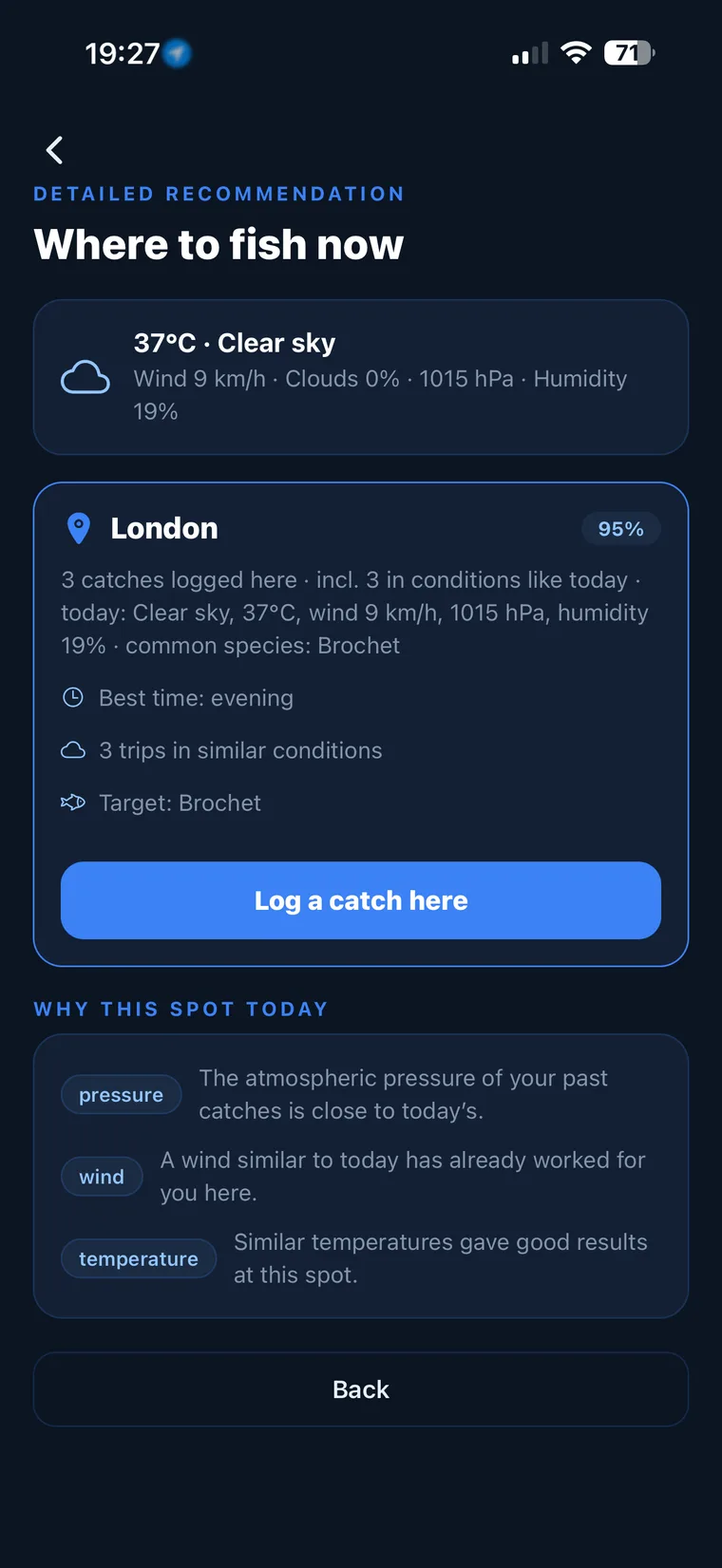
Not sure what to tie on?
Photograph your spot: CarnaFish reads the scene, cross-checks the conditions and gives you the zone, the lure and the retrieve. Free on iOS and Android.
Its windows and its limits
It excels on:
- Rocky flats and foreshores under 50 cm to 1.5 m of water, on the flood as much as on the ebb.
- Estuary mouths late on the ebb tide, when sea bass settle on the gentle flow and feed at mid depth.
- Summer dawns and dusks on a calm sea, with sea bass sipping and refusing anything going past fast.
- The edges of breakwaters and rock armour, where the rise at a standstill lets you shave the blocks without touching them.
It is unsuited:
- In a big sea with strong wind. A light floater takes off on the cast and comes out of the wave. There the sinker takes the advantage back.
- In deep water. Beyond two metres, you are fishing above the fish without knowing it.
- On active fish that want speed. When sea bass are smashing sandeels in full flow, a fast stickbait will cover ground far more efficiently.
Athlete Plus or sinking stickbait
Against the Jackson Pin Tail Tune, the difference is one of kind, not of degree. The Pin Tail is a sinking lipless pencil: it lives on twitches, glides and controlled descents, and it excels when the wind blows. The Athlete Plus has a lip, it swims on its own, and all it asks for is a turning handle. The first is a lure for active searching; the second, a lure for repeated passes over an identified spot.
If you can only take one for a shallow shore session in calm conditions, take the Plus. If the wind gets up or you have to reach a bar at sixty metres, take the other.
Our guide to lure fishing for sea bass revisits these trade-offs according to tide and swell. And if you are unsure which layer of water to fish as you arrive in front of an unfamiliar flat, CarnaFish analyses a photo of the spot and answers.
Key takeaways
- A shallow draught floating minnow: its useful band runs from 30 cm to 1 m, no more.
- It gives its action at very low speed, which the sinker in the same range does not.
- A slow straight retrieve, short stops every five metres, no big pulls.
- Floating at a standstill lets you clear rock heads without snagging.
- It loses to the sinker as soon as there is wind, swell or distance to cover.
FAQ
What is the difference between the Athlete Plus and the Athlete SS?
The Plus floats and fishes the subsurface between 30 cm and 1 m; the SS sinks and is there for distance and deeper layers. On a barely covered flat, the Plus gets through anywhere; in a big sea or a headwind, the SS takes the advantage back.
How fast should you retrieve it?
As slowly as you can while still feeling the vibration in the blank. One turn of the handle per second is often already too fast on a calm sea: this is a lure that is at its best just above its swimming threshold.
How deep does it go?
Between 30 cm and 1 m or so depending on speed and rod position. It does not go much deeper even if you speed up: beyond two metres of water, a sinking model is the better bet.
What leader should you use?
Fluorocarbon between 0.35 and 0.45 mm. Finer and you risk being cut off on rock at the hookset; heavier and you choke an action that relies on very little energy.
Should you work it with twitches?
No, or very little. It is designed to swim on its own on a straight retrieve. A few one to two second stops are enough to provoke; big pulls make it lose its axis and bring it out of the water.
Does it work at night?
Yes, and it is one of its best windows in summer over the flats. Switch to a dark, uniform silhouette, retrieve even more slowly than by day, and fish the first three metres of the margin as carefully as the rest.
The full sea bass lure guideSeason-by-season strategy: which family of lure, when, and why.Go from theory to fish
CarnaFish reads your spot from a photo and gives you the game plan: zone, lure, retrieve. Free on iOS and Android.