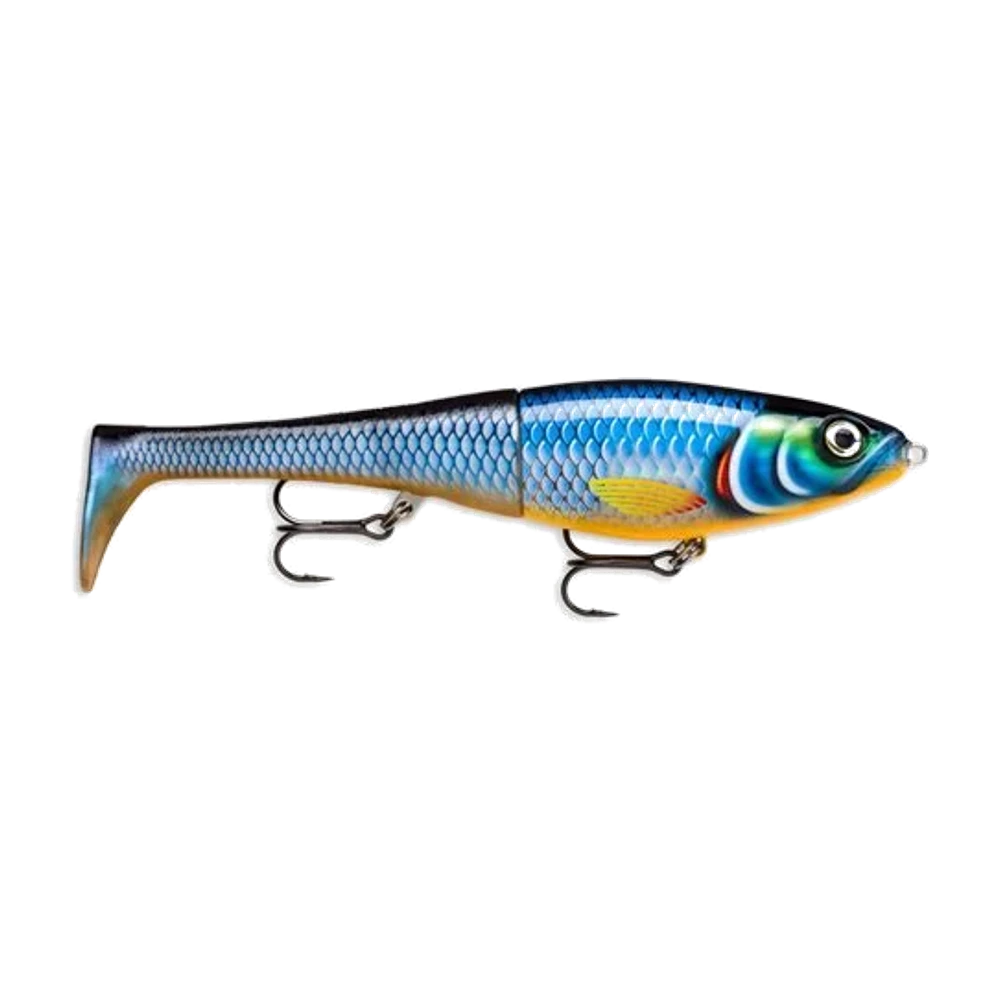
Rapala Peto: the big profile you fish at snail pace
Not sure this lure fits YOUR spot today? CarnaFish tells you in 10 seconds, from a photo.
There is a moment in the season when everything slows down. The water drops below 10 °C, the pike glue themselves to the bottom or hold along a drop-off, and they stop chasing anything. You can run a shad on a jig head past them at exactly the right depth and they will watch it leave. The problem is not the depth, nor the colour: it is that the lure does not stay in front of them long enough.
That is exactly the Peto's window. Its wide, hinged soft rubber tail, mounted on a bulky body, keeps beating at speeds where a normal shad does nothing at all. You can crawl it back, almost at walking pace, and it still works.
This is not a fast searching lure. It is a lure you put in front of a fish you have already located, and drag through its field of vision until it cracks.
The tail does all the work, the body does none
On a normal paddle-tail shad, the beat of the tail drives a wiggle through the body. On the Peto the logic is reversed: the body is bulky, almost inert, and the big hinged rubber tail beats on its own at the back.
That produces three usable effects.
A very low start-up threshold. The tail comes alive the instant the lure moves. There is no minimum speed to reach before the action kicks in, unlike a small-tailed shad that stays dead below a certain rhythm.
A slow, wide roll. At reduced speed the body starts tipping slightly from one flank to the other with every beat. That lateral flash is a visual signal a fish picks up from a long way off in clear water.
A strong pressure wave for a slow movement. The volume of water the tail shifts is considerable. In stained water or at night, that is what a pike detects with its lateral line long before it sees anything at all.
The retrieve: five settings, slowest to fastest
The Peto is fished straight. All the variation is in speed and depth, not in twitches.
- Count the sink. Cast, open the bail and count the seconds until the lure hits bottom. That number gives you the scale of the water column. From then on you fish to a chosen sink time — half that count, for instance.
- Start as slow as you physically can. Continuous cranking, as slowly as you can manage while still feeling the tail beat in the rod tip. If you lose the vibration, you are one notch too slow.
- Keep a straight path. No pulls, no pauses for the first few sessions. The Peto loses its roll the moment you stop it, and restarting it costs two turns of the handle.
- Only speed up at an obstacle. Weed bed, stump, drop-off: two quick turns as you arrive on it, then straight back to the slow rhythm. That is the only break in rhythm that genuinely triggers.
- Finish the cast under the rod. A lot of follows turn into attacks in the last couple of metres. Draw a slow figure of eight with the rod before you lift the lure out.
| Situation | Sink time | Handle rhythm |
|---|---|---|
| Weed in less than 1 m | 2 to 3 s | slow and steady |
| Flat at 2-3 m | 5 to 8 s | very slow, intermittent contact |
| Edge of a drop-off | down to the bottom, then 2 turns | slow with short lifts |
| Water below 8 °C | down to the bottom | the slowest the tail will tolerate |
On the water: with a big soft swimbait, the real adjustment is not speed but how much line you have out. The further you cast, the higher the lure swims at the same rhythm, because the angle of pull goes horizontal. If you want to run deeper without slowing down, cast shorter and fish below you.
The hookset: where pike get lost
A big soft lure absorbs the bite instead of transmitting it. The pike takes it sideways, clamps down, and if you strike immediately you only pull it back out of its mouth.
Three things to respect.
Wait one second. When you feel the weight load up or the swimming stop, count "one" before you strike. That pause gives the fish time to close down and move off.
Strike sideways, not upwards. A strike towards the sky lifts the lure without driving the points home. A firm sweep to the side, rod horizontal, hooks up far better.
Check the trebles every session. On a lure this size, one opened or blunt treble costs you the fish of the day. Keep a hook file in your pocket and touch up every point once an hour.
On the leader side, pike force you into wire or a thick fluorocarbon, in the 0.60 to 0.80 mm range. A heavy snap is essential: the weight of the lure in flight quickly fatigues a fine snap, and it ends up opening on the cast.
Tackle: do not under-gun the rod
With a 39 g lure in the small version and more than double that in the big one, a medium-power rod is a bad bet. It takes the cast badly, it folds on the hookset, and you will never feel the tail beat.
A rod rated 40 to 100 g for the small size, more for the big one, with a tip stiff enough to transmit vibration, is the minimum. A 0.30 to 0.40 mm braid gives you both distance and a safety margin near structure.
The weight of the lure also has an obvious physical consequence: over a full day you will cast two or three times less than with a light lure. That is not a flaw if you accept the logic — the Peto is there to work identified spots hard, not to comb a lake.
Not sure what to tie on?
Photograph your spot: CarnaFish reads the scene, cross-checks the conditions and gives you the zone, the lure and the retrieve. Free on iOS and Android.
Where it is not the right call
- Rivers with strong current: the bulky body gets pushed off line and rides up, and you lose all depth control.
- Active fish feeding on the surface: too slow, you will do better with something fast.
- Small, heavily fished waters: the volume sometimes sends fish running, and a slimmer profile takes over.
- Zander: not its target at all, the volume and the rhythm do not match what that fish is looking for.
Peto or a hard jointed swimbait
A hard jointed swimbait such as the Westin Mike the Pike offers a wide S, a very realistic profile and perfectly stable tracking, but it needs a minimum speed before the joint starts working. The Peto does the opposite: less realism, a simpler movement, but it keeps living at rhythms where the other goes inert.
Against a big soft shad on a jig head such as the Fox Rage Big Eye Pro Shad XXL the gap is different: the rigged shad lets you pick your head weight and therefore your sink speed, while the Peto arrives ready and imposes its own balance. The first is more adjustable, the second simpler to put to work.
Our guide to choosing a pike lure places these three families in a seasonal logic. And if you are unsure what size to reach for when you get to the bank, CarnaFish analyses a photo of the spot and answers.
Key takeaways
- The soft tail beats from the first few centimetres: it still swims when everything else goes dead.
- Slow straight retrieve, no twitching, with one short burst over obstacles.
- Count the sink to pick your water layer, and cast shorter to fish deeper.
- Wait a second before striking, and strike sideways, never upwards.
- Wrong for sustained current, for active fish and for zander.
FAQ
How fast should you retrieve the Rapala Peto?
As slowly as possible while still feeling the tail beat in the rod tip. The moment the vibration disappears, speed up one notch. It is a lure built for rhythms ordinary shads cannot handle.
What rod do you need to cast a Peto?
A rod rated 40 to 100 g for the 14 cm version, and clearly more for the 22 cm. An under-gunned rod takes the cast badly, cushions the hookset and does not transmit the tail's vibration.
Do you need a wire leader with the Peto?
Yes for pike, or failing that a 0.60 to 0.80 mm fluorocarbon. Add a heavy snap: the weight of the lure in flight fatigues small snaps, which end up opening on the cast.
Why do I miss so many bites with this lure?
Two main causes: striking too fast, and striking upwards. Leave a second after you feel the weight, then sweep sideways with the rod horizontal. Also check the sharpness of the points every hour.
Does the Peto work in winter?
Winter is its best period. In cold water pike stop chasing, and being able to hold a swimming action at very low speed in front of a stationary fish becomes the decisive argument.
Should I choose 14 or 22 cm?
The 14 cm covers most situations and stays castable over a full day. Keep the 22 cm for big volumes of water and sessions where you are only after big fish, accepting a very reduced number of casts.
The full pike lure guideSeason-by-season strategy: which family of lure, when, and why.Go from theory to fish
CarnaFish reads your spot from a photo and gives you the game plan: zone, lure, retrieve. Free on iOS and Android.