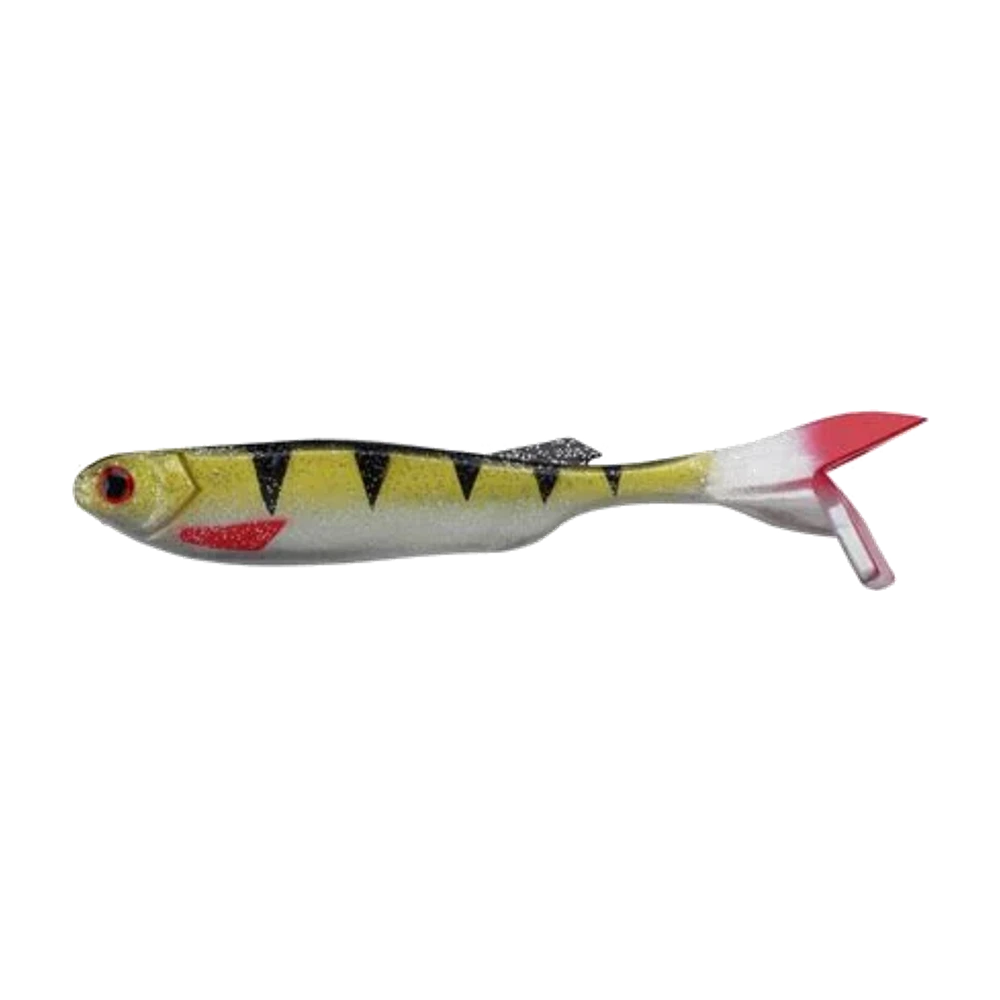
Berkley PowerBait Jointed Minnow: the jointed soft bait for slow pike
This lure shines under specific conditions. CarnaFish tells you in 10 seconds if today is one of them.
A pike in cold water does not hunt, it intercepts. It takes up a position, it waits, and it only agrees to spend energy if the prey passes close enough and slowly enough to make the calculation worthwhile. That is why so many winter sessions end with follows and zero bites: the lure passes well, but it passes too fast.
The problem is that most lures imitating a big baitfish have a minimum speed. Below it, they stop swimming and become a piece of plastic moving forward. A jointed soft swimbait has no such floor: the joint keeps passing on an undulation even at a speed where a hard lure is dead.
The PowerBait Jointed Minnow exploits that property. It is a lure for extreme slowing down, one to pull out exactly when nothing else works.
How the joint changes the action
A one-piece soft shad undulates because its tail resists the water and drags the body along. Below a certain rhythm, that resistance is no longer enough and the body stays straight.
On a jointed model, the mechanics are different. The body is cut into two linked sections, and every change of attitude in the front section sets off an offset in the rear one. The result:
- The undulation starts at almost zero speed. A single very slow turn of the handle is enough to make the whole lure snake.
- The movement is an S, not a beat. It looks more like a fish moving along quietly than prey in flight — which is exactly what a pike conserving energy is looking for.
- The pause stays usable. At a standstill, the rear section keeps pivoting on its own inertia for a second or two, producing residual movement at the most critical moment.
- The lure forgives mistakes in rhythm. It swims correctly over a wide speed range, so you can slow down or speed up without killing it.
The retrieve: one rule, do not rush
- Cast and let it sink on a count, line semi-tight. Count a few seconds longer than your usual instinct.
- Start retrieving very slowly, half a turn to one turn of the handle a second. You should feel a dull, regular rolling in the rod, not a nervous vibration.
- Do not twitch. The action is in the lure, not in your arm.
- Work in stops of two to three seconds every five or six turns. The lure sinks as it glides, rear section still moving.
- Slow down further in the last twenty metres. A pike that has followed from the start almost always commits when the lure slows or turns, never when it speeds up.
| Water temperature | Retrieve speed | Pauses |
|---|---|---|
| Above 15 °C | 1 turn per second | short, 1 s |
| 8 to 15 °C | 1 turn every 1.5 s | 2 to 3 s |
| Below 8 °C | as slow as possible | 4 to 6 s |
On the water: when a pike follows without biting, do not stop the lure dead and do not make it flee. Make it turn. A simple fifty-centimetre sideways move of the rod puts the lure's flank in front of the fish and turns a follow into an attack far more often than an abrupt stop does.
Rigging: the point to check above all others
On a big jointed soft bait, the hook layout decides the conversion rate. Three things to check.
The position of the belly treble. It must sit at the junction of the two sections, never far back on the rear part. Too far back, it gets in the way of the joint and chokes the action.
Adding a stinger. A pike often attacks from behind on a lure of 15 cm or more. A short stinger rig, fixed at the front and reaching the rear third, recovers a large share of the missed bites, without degrading the action as long as the link wire stays supple.
The leader. Supple coated wire or 0.45 mm fluorocarbon minimum. On a lure of this size a pike takes it deep: you cannot afford a light leader.
One last practical point: the soft material wears at the joint after several fish. Check that area regularly, it is where the lure goes first.

Not sure what to tie on?
Photograph your spot: CarnaFish reads the scene, cross-checks the conditions and gives you the zone, the lure and the retrieve. Free on iOS and Android.
When to pull it out, when to forget it
Its real windows:
- Cold water, November to March, on settled, low-mobility pike.
- After a cold front, when the fish refuse anything fast.
- Clear, deep water, where the fish has time to examine the lure over several metres.
- Edges of dead weed beds and drop-offs, retrieved parallel to the structure.
- Fish that follow without biting a faster lure: this is the logical change.
Its limits:
- Fast searching. At this speed you cover very little ground; this is not a search bait.
- Strong current. The jointed soft body gets pushed off line and loses its attitude.
- Dense weed. The exposed trebles snag constantly.
- Very active summer fish, where a faster, noisier lure produces more bites per hour.
Jointed Minnow or one-piece swimbait
Against a classic soft swimbait like the Savage Gear Cannibal Shad, the difference shows in the speed range. The Cannibal needs a minimum of rhythm for its tail to drive the body, but it is more compact, easier to cast and far more forgiving in cluttered ground.
The Jointed Minnow will swim slower and offers a wide undulation along its whole length, which makes it superior on lethargic pike and in clear water. In exchange, it casts less well, wears faster and snags more.
Compared with a hard jointed lure such as the Westin Mike the Pike, it loses in tracking and in durability, but it gains on two counts that matter in winter: softness to the touch, which makes fish hold the lure a fraction of a second longer, and the ability to work slower still.
Our guide to choosing a pike lure covers the moments in the season when slowing down becomes the right strategy. And if you are unsure what lure size to tie on when you reach the bank, CarnaFish analyses a photo of the spot and answers.
Key takeaways
- The joint allows a continuous undulation at a speed where a hard lure dies.
- Very slow straight retrieve, no twitching, with stops of 2 to 6 seconds depending on temperature.
- On a follow, make the lure turn instead of stopping it dead.
- Belly treble at the junction of the sections, stinger recommended above 15 cm.
- A cold, clear water lure; useless for fast searching, in current or in weed.
FAQ
How fast should you retrieve a jointed soft bait?
As slowly as possible while still feeling a regular roll in the rod, roughly one turn of the handle a second in temperate water and noticeably less in winter. The joint keeps working at speeds where a hard lure stops swimming.
Should you add a stinger?
Above 15 cm, yes. Pike frequently attack from behind and a short stinger fixed at the front recovers a good share of the missed bites, provided the link wire stays supple so it does not choke the action.
Is this lure suitable for summer fishing?
It works, but it is not its best period. On active pike, a faster lure produces more bites per hour. The Jointed Minnow takes the lead in cold water and on lethargic fish.
What leader should you use?
Supple coated wire or 0.45 mm fluorocarbon at minimum. On a lure of this size pike often take it deep and an inadequate leader causes avoidable break-offs.
Why has my jointed lure stopped swimming?
Check the joint area first, which wears after several fish, then the position of the belly treble: set too far back, it blocks the pivot between the two sections and kills the undulation.
Jointed soft or jointed hard?
The hard one tracks better and lasts longer; the soft one deforms under the teeth, stays in the mouth a fraction of a second longer and will swim slower still. In cold water, that advantage is often decisive.
The full pike lure guideSeason-by-season strategy: which family of lure, when, and why.Go from theory to fish
CarnaFish reads your spot from a photo and gives you the game plan: zone, lure, retrieve. Free on iOS and Android.