Rapala RipStop 09: the jerkbait with a rigid tail that stops dead
Before tying this one on, it helps to know if the spot actually calls for it. CarnaFish reads the scene from a photo.
Almost every jerkbait shares one flaw: when you stop the twitch, the lure keeps travelling thirty or fifty centimetres before it settles. To a following fish, that is still prey escaping. The RipStop is built around a simple idea that looks a little odd at first: deliberately cut that residual travel, so the bait stops where you decide.
A second lip, but at the back
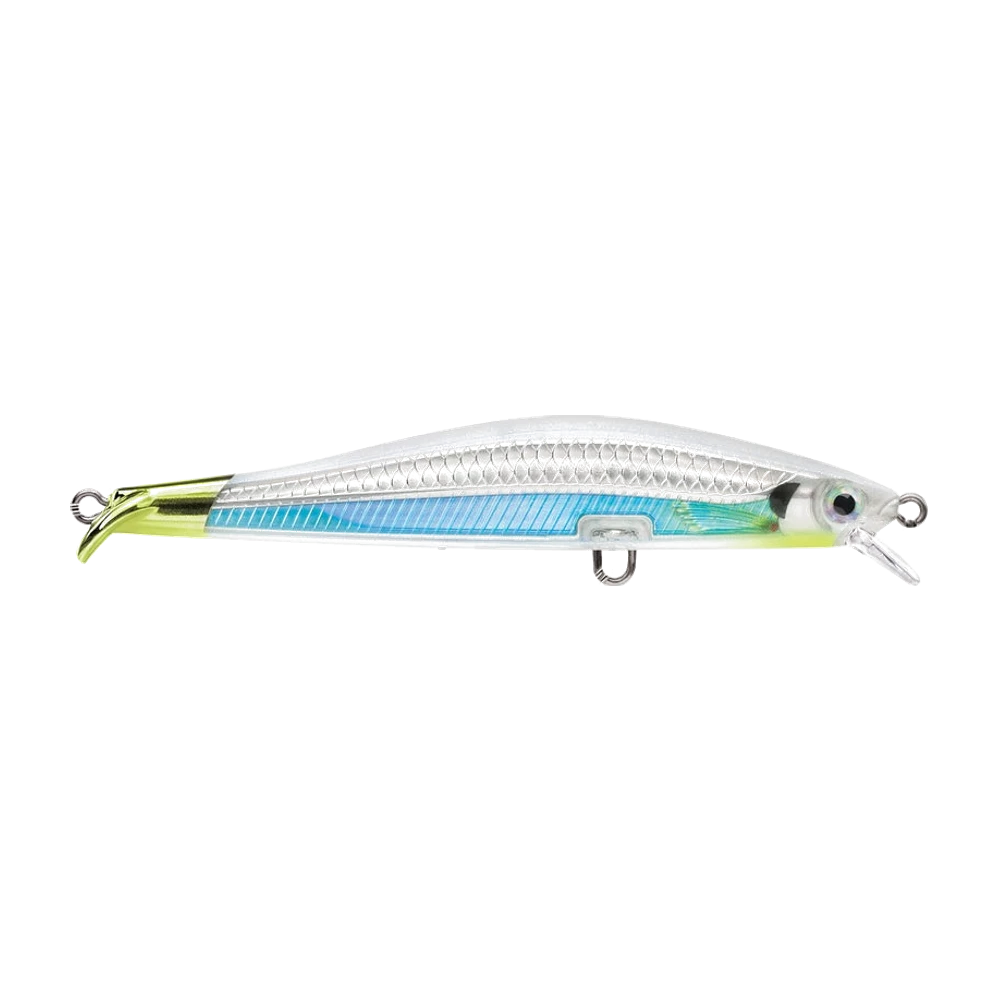
What looks like a tail at first glance is not one. The manufacturer describes a secondary lip set towards the rear of the bait, and that is the piece doing all the work: in the product photo it appears as a rigid chartreuse blade, angled downwards, clearly separate from the body.
Its job is twofold. On the retrieve, that surface makes the rear of the bait work and produces what Rapala describes as a fast, flashing swimbait action — far closer to a paddle-tail bait than to a classic jerkbait. And on the stop, it brakes hard: the manufacturer states a near immediate stop, which is the starting point of the whole concept.
The point is easy to grasp if you have ever watched a fish follow a lure without committing. A bait that keeps moving after the stop is still prey in flight. A bait that stops dead becomes, in a fraction of a second, prey that has just given up — and that is the signal the predator was waiting for.
What happens right after the stop
The description does not end there, and it has to be read closely, because this is where the cadence is decided.
After the stop, the lure produces a subtle shimmy before coming to rest, then lifts its head ever so slightly and rises very slowly. This is not a suspending bait. The word suspend appears in the source only in the list of cadences you can work it with, not as a buoyancy class — and there is no class column in the size chart. The only thing the manufacturer actually states is that very slow, head-first rise.
That changes how you fish it. With a true suspending bait like a Rapala Husky Jerk, you can leave the lure hanging for several seconds without it moving. Here the pause is alive: the bait shimmies, then drifts gently upwards, nose raised. Three to five seconds of stop is enough to lift it through part of the layer you were fishing, so you have to build that vertical movement into your plan instead of putting up with it.
The specs, and the water they put it in
The manufacturer chart has three columns: length, weight, depth. The 09 model measures about 9 cm — the inch value in the source is a rounded conversion, and the 09 in the name matches the centimetres — weighs about 7.1 g, and runs between 0.9 and 1.2 m.
A metre of depth is shallow, and that is deliberate: this is an upper layer bait. Shallow margins, flats over weed, river currents, dam outflows. In Europe it is the size that best matches margin perch and river trout, and a good choice for bass in shallow water. To work deeper, a Rapala Shadow Rap or a heavier model takes over.
For hardware, Rapala states VMC black-nickel fine wire trebles. Fine wire penetrates very fast, which suits hard-mouthed fish, but it deforms more easily on a big fish: check your hooks after every good catch. In the product photo no treble is fitted — an observation from a photo, not a statement about what comes in the box.
Rigging
Fluorocarbon in 20 to 25 hundredths and a round clip. On a 7 g lure, a knot cinched onto the nose ring restrains the head and kills the width of the direction change. A 1.9 m to 2.1 m rod in light to medium power is plenty, and better than a stiff rod that would tear out small fine wire trebles.
If fish follow without taking, do not lengthen the pause: shorten the distance between stops. Two turns of the handle, stop, two turns, stop. It is the close repetition of dead stops that makes a follower commit, not the length of the stillness.

Not sure what to tie on?
Photograph your spot: CarnaFish reads the scene, cross-checks the conditions and gives you the zone, the lure and the retrieve. Free on iOS and Android.
The six stated cadences, and which to keep
The manufacturer lists six ways to work it: straight retrieve, wind and stop, twitch, snap, rip, and suspend. That is a lot, and in practice two cover most of it.
Wind and stop is the baseline: retrieve at moderate speed and cut every five or six turns. It is the rhythm that best exploits what the lure does, and the one to start with.
The rip — a firm, wide pull followed by a complete stop — is the cold water and apathetic fish rhythm. The flash of the pull attracts, the brutal stop triggers. The other four are useful variations when those two produce nothing.
The classic mistake
Fishing the RipStop like a suspending jerkbait, with long motionless pauses. That is not what this lure does: while you wait, it rises. Over ten seconds of stop you are no longer fishing the layer you aimed at. Keep the pauses short and frequent rather than long and rare.
Colors by water
- Clear water: the pearl finish with scaled silver flanks and blue lateral band of the lure in the photo, which plays on flash rather than colour.
- Overcast sky: a roach tone, dark back and pale flanks, keeping a readable silhouette in low light.
- Stained water: a chartreuse base, the one situation where visibility beats realism.
An upper layer bait only shows its worth if you put it on the right margin, and that is exactly what CarnaFish makes easier: one photo of the spot, and the AI suggests the zone, the likely depth and the type of lure suited to the day. To work on the method around perch, our guide to perch fishing with lures covers the other families worth knowing.
What to remember
- A second lip at the rear brakes the residual travel: the bait stops virtually where you decide.
- After the stop, a shimmy then a very slow head-up rise — this is not a suspending bait, and no buoyancy class is published.
- 9 cm for about 7.1 g, running 0.9 to 1.2 m: an upper layer lure, not a deep search bait.
- Fine wire trebles: excellent penetration, but worth checking after every big fish.
FAQ
Is the RipStop 09 a suspending bait?
No, and the distinction matters. The manufacturer describes a very slow rise, head slightly raised, after a brief shimmy. The word suspend appears only in the list of possible cadences, not as a buoyancy class, and the size chart carries no class column.
What is the rigid blade at the rear for?
It is a second lip. On the retrieve it makes the rear of the body work and produces a fast, flashing action; on the stop it brakes the bait and sharply reduces its residual travel.
Which retrieve should I start with?
Wind and stop: moderate speed, a break every five or six turns of the handle. It is the rhythm that best exploits the dead stop, and the easiest to tune while you are getting to know the lure.
Is it suitable for river trout?
Yes, the 9 cm size and the 0.9 to 1.2 m depth suit currents and shallow pools well. The dead stop is particularly effective at the edge of a current seam, where trout sit waiting for food to drift past.
Should the factory trebles be changed?
Not as a rule: the stated fine wire trebles penetrate very fast, a real advantage on small mouths. If you are fishing water where a big fish is likely, though, check their gape after every catch, because fine wire deforms sooner.
Can it be fished on a straight retrieve?
Yes, it is one of the six cadences listed by the manufacturer, and the second lip gives it a fast swimbait action. But you give up the dead stop, which is precisely what sets this lure apart from a standard minnow.
The full bass lure guideSeason-by-season strategy: which family of lure, when, and why.Go from theory to fish
CarnaFish reads your spot from a photo and gives you the game plan: zone, lure, retrieve. Free on iOS and Android.