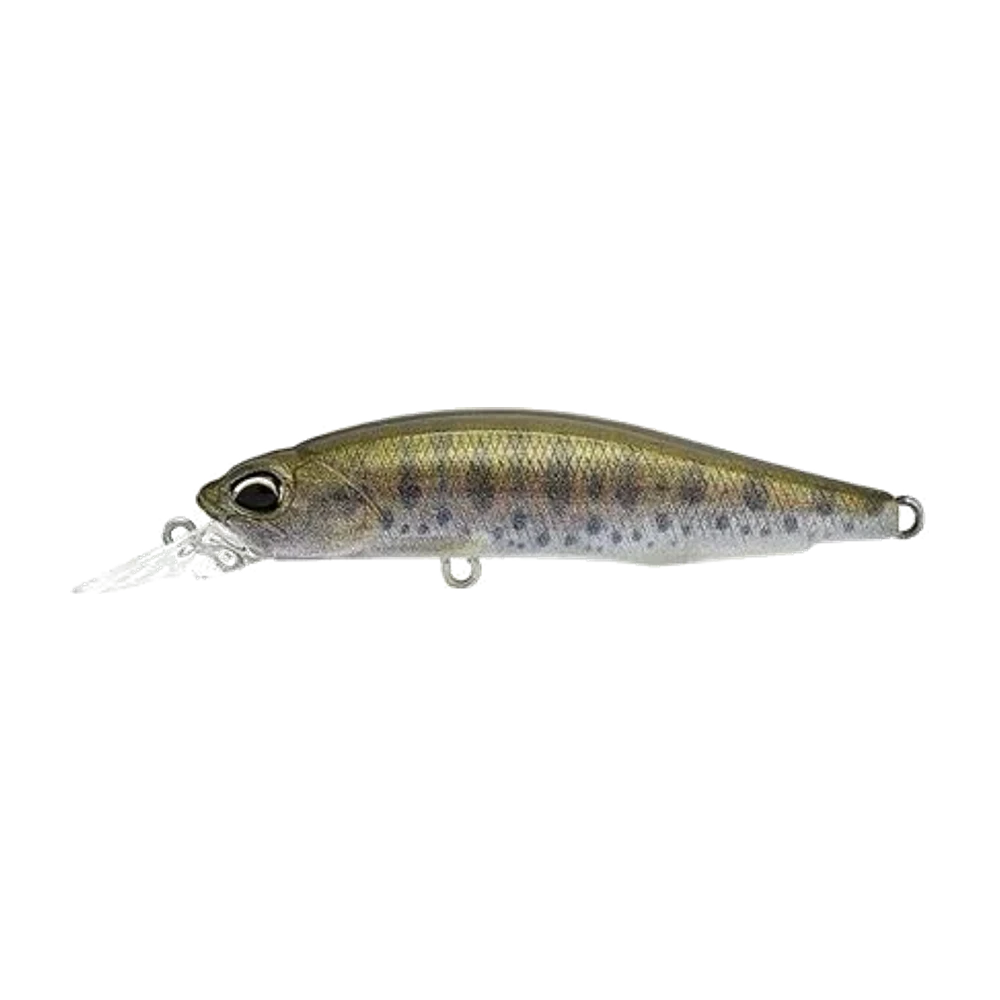
DUO Realis Rozante 63: the minnow you fish on the handle
Before tying this one on, it helps to know if the spot actually calls for it. CarnaFish reads the scene from a photo.
We have ended up turning the minnow into a technical discipline. Twitch, double twitch, jerk, counted pause, take up the slack between every impulse: it is effective, but it is also why a lot of anglers leave their minnows in the box. An hour of well-executed twitching is tiring, and an hour of badly executed twitching catches nothing.
Yet there is a very wide window in which sophisticated retrieves add nothing and cost you fish: cold water and settled fish. Below a certain temperature, perch stop chasing prey that accelerates and stops over and over. They intercept prey moving slowly and steadily within reach. In a trout river the logic is the same — a fish holding in the current moves very little and hits what passes through its lane.
The Rozante 63 is built for that window. Its body is not the elongated tube of a classic minnow but a deeper profile, closer to a shad, with a mass distribution that starts the roll at speeds where most minnows are dead. You fish it on the handle, doing nothing else, and it works.
A shad profile on a rigid body
Three concrete consequences follow from that deeper silhouette.
- A roll that starts at very low speed. The lateral surface of the body gives the water enough to push against for the lure to start rolling on its axis from the minimum retrieve speed. You turn the handle just fast enough to keep the line tight, and the lure is already flashing.
- A wider silhouette head-on. Seen by a fish holding below it, the shape reads more like a small cyprinid fry than a slim tube. That often matches the prey present in the first metre of a pond or a river better.
- Remarkable level-holding. It has no tendency to leave its layer or slew sideways when you speed up slightly or when the current pushes. That is what makes a pure straight retrieve possible: the path needs no correcting.
The trade-off is that the deeper body catches the wind on the cast. At equal weight with a slim minnow, you lose distance. That is the price of a low-speed action.
The straight retrieve: finding the floor speed
The exercise is to find the slowest speed at which the lure still works, then stick to it.
- Cast and let it sink two to three seconds to reach the working layer, around a metre.
- Start turning very slowly, until you feel a regular, fine, continuous vibration in the rod tip.
- Slow down further, until the vibration disappears. You have just found the floor.
- Come back up one notch just above that threshold. That is your fishing speed for the session.
- Change nothing else for the rest of the retrieve. No twitch, no pause, just the handle.
It sounds too simple. That is exactly the point: you can hold that pace for two hours without a single mistake, which is true of no active retrieve.
On the water: when you fish a pure straight retrieve, the only variable left is the angle of your rod. Tip high, the lure rises twenty to thirty centimetres; tip in the water, it gains as much downwards. You change layer without changing lure or speed — it is the fastest adjustment there is, and almost nobody uses it deliberately.
When to add a retrieve after all
The straight retrieve stays the basis, but two variants are worth having in specific cases.
The long stop and go. Fifteen to twenty turns of the handle, then a three-second stop during which the lure stays in its layer, then off again. Save it for fish that follow without biting: the stop forces the decision.
The isolated twitch. A single sharp pull in the middle of an otherwise perfectly regular retrieve. The break works all the better for being rare. Two or three a cast, no more.
For trout in a river, the current supplies the action. Cast across, let the lure swing while keeping just enough tension, and follow the end of the swing with a few slow turns. What counts is the pass through the seam, not what you do with the rod.
Settings by situation
| Context | Speed | Rod angle | Note |
|---|---|---|---|
| Perch in cold water, pond | Floor speed | Tip low | No action at all, absolute consistency |
| Active perch, spring | One notch above | Tip at mid height | An isolated twitch every ten seconds |
| Trout, moderate current | Tension only | Tip high | Swing it across, no forced retrieve |
| Cluttered margin | Floor speed | Tip high | Lifts the lure over obstacles |
On gear, stay light. A UL or L rod of 1.80 to 2.10 m, fluorocarbon of 0.14 to 0.18 mm, a 2000 reel. A more powerful outfit does nothing with 5 g and costs you dropped perch. Straight fluorocarbon is preferable to braid here: its stretch cushions sudden pulls and smooths the path, which is exactly what a straight retrieve wants.
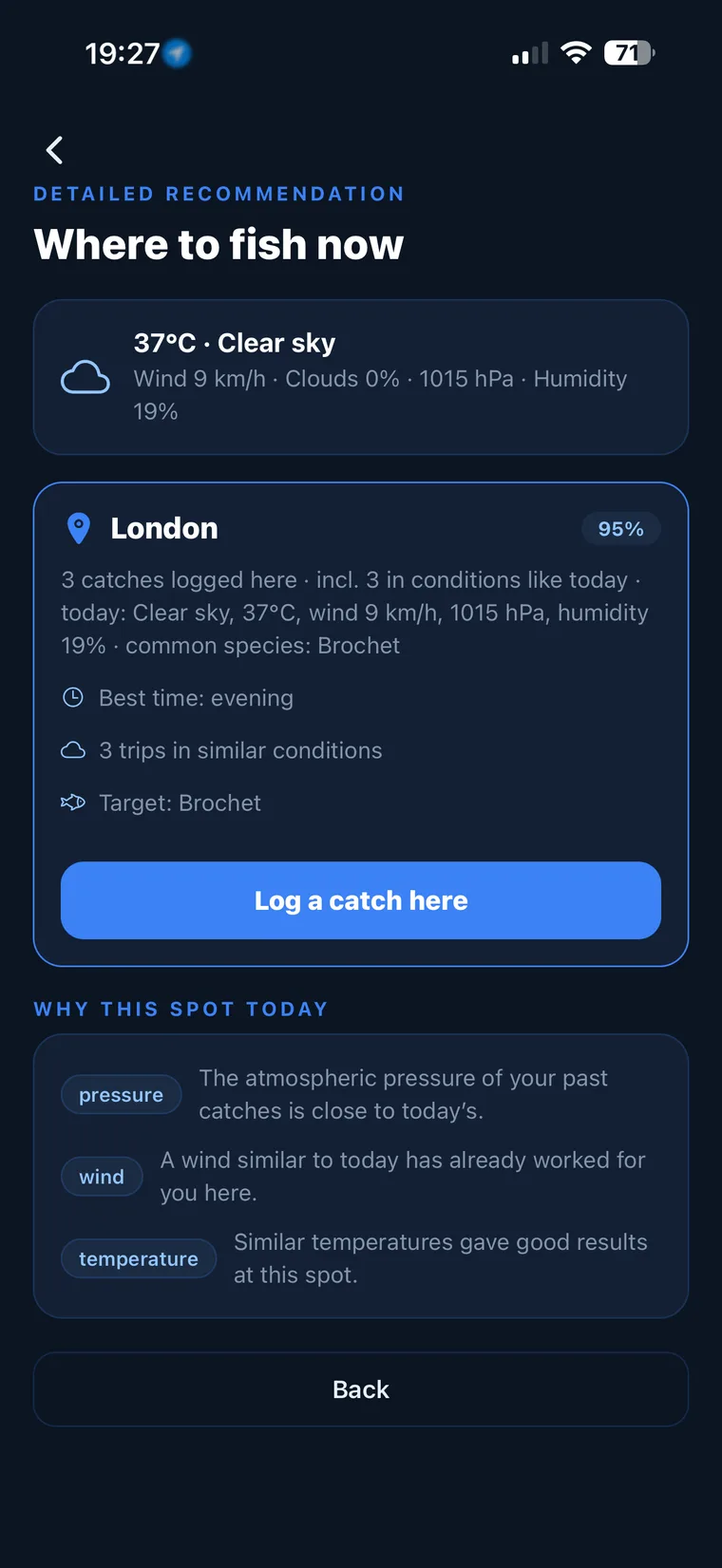
Not sure what to tie on?
Photograph your spot: CarnaFish reads the scene, cross-checks the conditions and gives you the zone, the lure and the retrieve. Free on iOS and Android.
Its limits
It is off the point as soon as the depth exceeds a metre and a half — it will not go down there, and no adjustment will make it. It is also off the point in strong wind, where its deep body costs too much casting distance. And on clearly active fish feeding at the surface, a more demonstrative lure will catch faster: a slow straight retrieve is an approach for fish that are biding their time, not for fish in a frenzy.
Rozante 63 or Rigge 56
These two small minnows look alike on paper and complement each other in reality.
The ZipBaits Rigge 56 is a lure for working. Its slimmer body needs impulses to express itself, and it is at its best on short twitches over fish you have located in very clear water. It is a tool for soliciting a bite, precise and demanding on technique.
The Rozante 63 is a lure for passing through. A little longer, a little heavier, with a deeper body that works without being asked: it covers ground at constant speed and intercepts holding fish. If you had to keep just one for a whole session in cold water, it would be this one; to work on a perch you have seen refusing everything, it would be the other.
In a different register again, a crankbait such as the Illex Chubby 38 brings clean vibration for covering a margin quickly. Our guides to perch fishing with lures and to trout fishing in rivers cover the rest of the armoury. And if you are torn between a straight retrieve and an active one at a given spot, CarnaFish analyses a photo of the spot and answers.
Key takeaways
- A deep shad-type body: the roll starts at speeds where other minnows are inert.
- Find the floor speed, then hold it without changing anything.
- Rod angle sets the swimming layer without changing lure.
- Straight fluorocarbon rather than braid: the stretch smooths the path.
- Unsuited beyond a metre and a half and in strong wind.
FAQ
Do you need to twitch the Rozante 63?
Not necessarily, and in cold water it is often counterproductive. Its action comes out on a slow straight retrieve; save an isolated twitch, two or three a cast at most, for making up the mind of a fish that follows without taking.
What is the right retrieve speed?
The one just above the threshold where the vibration disappears from the rod tip. Slow down gradually until you feel nothing, then speed up a notch: you get the slowest speed at which the lure still works.
How deep does it swim?
Between 60 centimetres and 1.20 m depending on rod angle. Tip high it rises, tip pointed at the water it drops twenty to thirty centimetres: it is the simplest way to change layer mid-retrieve.
Braid or fluorocarbon?
Fluorocarbon of 0.14 to 0.18 mm, straight through. Its stretch cushions sudden pulls and smooths the path, which serves a straight retrieve; braid is mainly useful when you want to transmit sharp impulses, which is not what this lure is about.
Is it suitable for trout in rivers?
Yes, swinging it across the current. Cast to the far side of the seam, keep just enough tension for the lure to roll, and follow the end of the swing with a few slow turns before recasting.
How does it differ from the ZipBaits Rigge 56?
The Rigge is slimmer and shorter: it is a lure for working, demanding precise twitching on fish you have seen. The Rozante has a deeper body and works on a slow straight retrieve: it is a searching lure at constant speed, far less demanding on technique.
The full perch lure guideSeason-by-season strategy: which family of lure, when, and why.Go from theory to fish
CarnaFish reads your spot from a photo and gives you the game plan: zone, lure, retrieve. Free on iOS and Android.