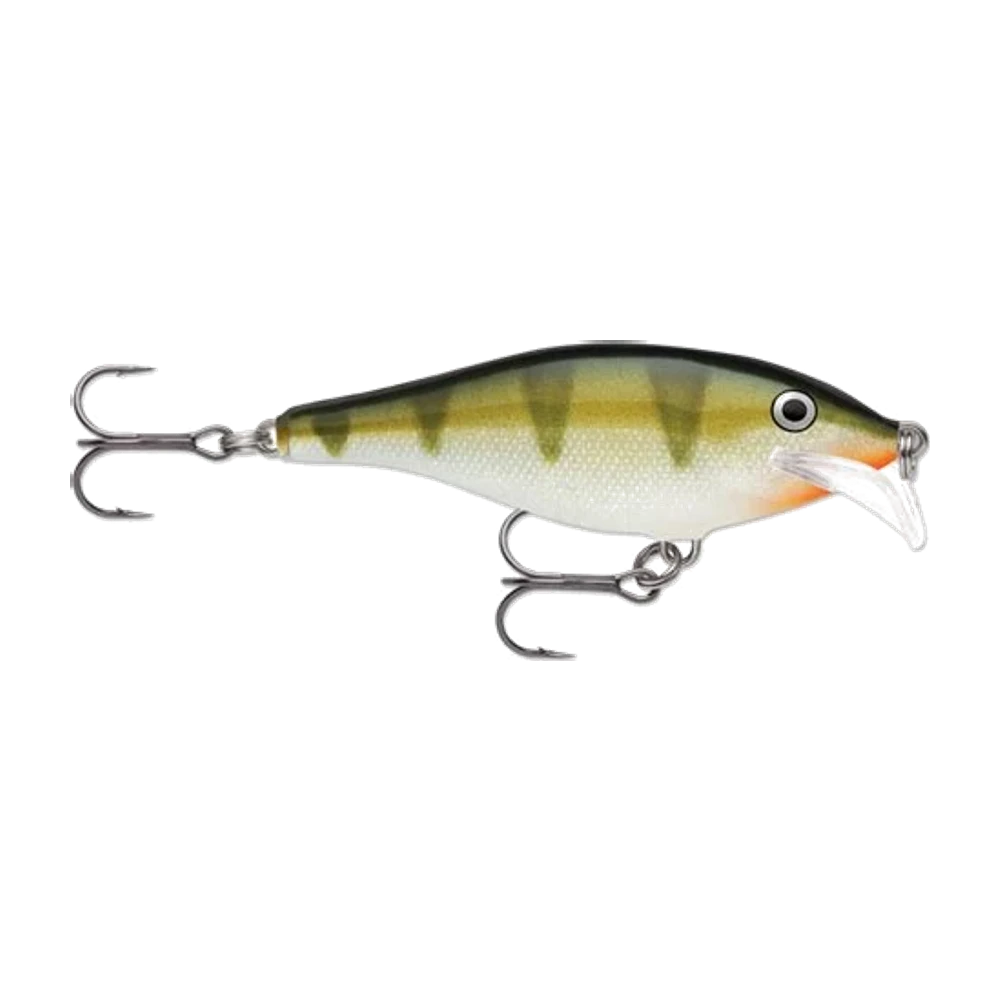
Rapala Scatter Rap Shad: an unpredictable path with nothing to work
Before tying this one on, it helps to know if the spot actually calls for it. CarnaFish reads the scene from a photo.
There is a scenario everyone knows on a zander reservoir: you see the follows on the sounder, or you feel a fish tapping the lure softly at the end of the retrieve, and nothing ever comes of it. The fish is there, it is interested, but something in your presentation gives it time to think — and a zander that thinks does not bite.
The classic fix is to start working the lure: twitches, stops, changes of rhythm. Except that on a crankbait, working it usually breaks the action rather than enriching it, and plenty of anglers have no desire to manage a complicated set of movements for six hours.
The Scatter Rap Shad offers another route: the irregularity is produced by the lure itself, on a perfectly straight retrieve. You wind at a constant speed, and the lure shoots off to the side whenever it feels like it, without you deciding anything.
A bent lip, not a flat one
The whole difference is in the piece at the front of the lure. On a classic crankbait the lip is a flat inclined plate: water slides over it symmetrically and the lure runs straight, with a regular, predictable roll.
The Scatter Rap's lip is bent, which breaks that symmetry. The flow separates on one side then the other, in a way that never repeats. In practice:
- The lure runs straight for a variable distance, sometimes a metre, sometimes three.
- Then it breaks away sideways, darting well off the line of retrieve, and puts itself back on track.
- The moment it breaks away is not predictable, not for you and not for the fish behind it.
That last point is what does the work. A predator following a lure with a regular action settles at its speed and waits. When the lure suddenly escapes to the side, the flight becomes real and the follow tips into an attack. It is the same mechanism as a worked jerkbait — except you did nothing.
The retrieve: above all, do nothing
It sounds trivial, but it is the main reason people fail with this lure: anglers used to twitching keep twitching, and delete exactly what they bought it for.
- Cast and let the lure sink one to two seconds depending on the depth of the spot.
- Retrieve at a medium, constant speed. Look for the rhythm that gives you continuous vibration in the rod tip, without forcing it.
- Do not correct the darts. When you feel the lure break away sideways, you pick up a wobble in the vibration: carry on at exactly the same rhythm. The lure puts itself back on track.
- Slow down slightly over the last three metres. The darts are more marked at low speed, and followers often make their minds up under the rod.
- If you really want to vary things, change your winding speed over ten turns rather than adding twitches.
The only input that genuinely adds something is contact: making the lure touch a stump, a boulder or a drop-off. The bounce creates an extra break-away, a very violent one, which often triggers within the second.
On the water: when you feel the lure skew off, that is the moment the fish makes up its mind. Resist the reflex to speed up or strike at nothing. Hold the same speed for two more turns — the bite almost always comes just after the break-away, not during it.
Setting your water layer without changing lure
With a swimming depth between 1.2 and 1.8 m, this model covers a narrow band. Three levers let you adjust it without changing model.
| What you want | How to do it | Real effect |
|---|---|---|
| Drop 30 to 50 cm | Finer fluorocarbon (0.22 mm instead of 0.28), rod low | Less lift, a more favourable angle of pull |
| Stay higher | Rod high, faster retrieve | The lure rises through the layer |
| Fish deeper for a stretch | Cast further, let it sink 2 to 3 seconds | The lure reaches its depth earlier in the run |
| Keep bottom contact | Slow retrieve, rod at mid-height | Bounces off obstacles, extra break-aways |
One useful remark about line: braid transmits the break-aways better and lets you understand what the lure is doing, but it removes the stretch that protects you from dropped fish. A metre of fluorocarbon leader settles the compromise, and that is the rig I would recommend by default for zander.
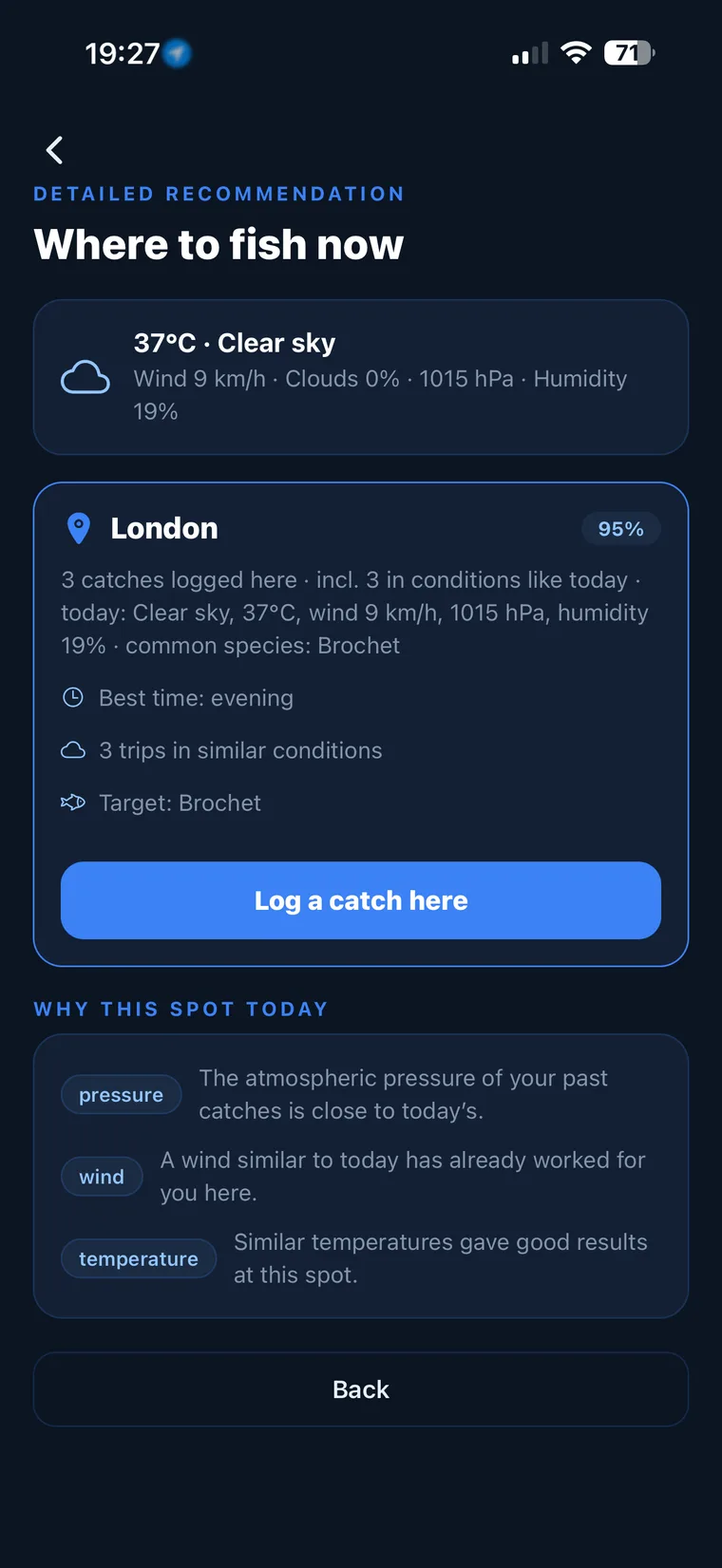
Not sure what to tie on?
Photograph your spot: CarnaFish reads the scene, cross-checks the conditions and gives you the zone, the lure and the retrieve. Free on iOS and Android.
Its windows, and the moments when it adds nothing
It is at its best when fish are present but undecided:
- On zander that follow without committing, especially in late summer and autumn over sand flats and reservoir margins.
- Searching margins in 1.5 m of water, along a rock revetment or a gentle drop-off.
- When you fish long sessions, because a straight retrieve is far less tiring than working a lure continuously for hours.
- For an angler starting out on predators: it gives you an erratic lure action without demanding any technique.
On the other hand it is off the mark in three cases. Beyond two metres of water its swimming depth tops out and you run too high. In very cold water a continuous retrieve is too fast for a settled zander, and a soft plastic on a slow straight retrieve will do better. Finally, in dense flooded timber those unpredictable sideways darts multiply the snags, and what is a quality becomes a problem.
Scatter Rap Shad or Shad Rap: what really changes
The comparison is unavoidable since they share the same size and the same family.
The Rapala Shad Rap is a crankbait with a regular, readable action. Its value is consistency: it produces exactly the same signal turn after turn, which lets you sweep a margin with an identical presentation throughout. On active fish that regularity is a clear advantage, and its predictable path gets through cover better.
The Scatter Rap Shad sacrifices that predictability to gain the unexpected. On active fish it does no better. On fish that follow, that have already watched three crankbaits go by that day, or that refuse an action that is too clean, it takes a clear lead.
The right way to think about them is not "which is better" but "in what order": the Shad Rap to read a margin quickly, the Scatter Rap to go back over it when you know the fish are there but not committing. Our beginner's guide to zander fishing with lures walks through that sequence over a full session. And if you are unsure which water layer to target when you arrive at a reservoir, CarnaFish analyses a photo of the spot and answers.
Key takeaways
- The bent lip produces non-repeating sideways darts on a straight retrieve.
- Do not twitch: working it removes precisely the effect you are after.
- The bite comes just after the break-away, not during it. Hold your rhythm.
- Useful depth 1.2 to 1.8 m, adjustable by 30 to 50 cm through line diameter and rod height.
- The Shad Rap to search fast, the Scatter Rap to convert followers.
FAQ
What is the difference between the Scatter Rap Shad and the Shad Rap?
The lip. The Shad Rap's is flat and produces a regular action; the Scatter Rap's is bent and produces unpredictable sideways darts. The first searches better, the second converts fish that follow without biting.
Do you need to work the Scatter Rap Shad?
No. The irregularity comes from the lure, not the angler. A straight retrieve at constant speed is enough, and adding twitches disturbs the mechanism instead of amplifying it.
What depth does it swim at?
Between 1.2 and 1.8 m depending on speed, line diameter and rod height. Finer fluorocarbon and a low rod gain you an extra 30 to 50 cm.
Is it suitable for zander in winter?
Hardly. A continuous retrieve stays too fast for a zander settled in cold water, and its limited swimming depth keeps it above the fish. A soft plastic on a very slow straight retrieve near the bottom will be more effective.
Braid or fluorocarbon?
Braid with a metre of fluorocarbon leader is the best compromise: you feel the break-aways and the bottom contacts while keeping a little stretch near the lure to limit dropped fish.
The lure keeps skewing off — is that a fault?
No, that is how it is meant to work. If, on the other hand, it lies over permanently and never recovers, check that you are not retrieving too fast and that the front ring has not been twisted when pulling free of an obstacle.
The full zander lure guideSeason-by-season strategy: which family of lure, when, and why.Go from theory to fish
CarnaFish reads your spot from a photo and gives you the game plan: zone, lure, retrieve. Free on iOS and Android.