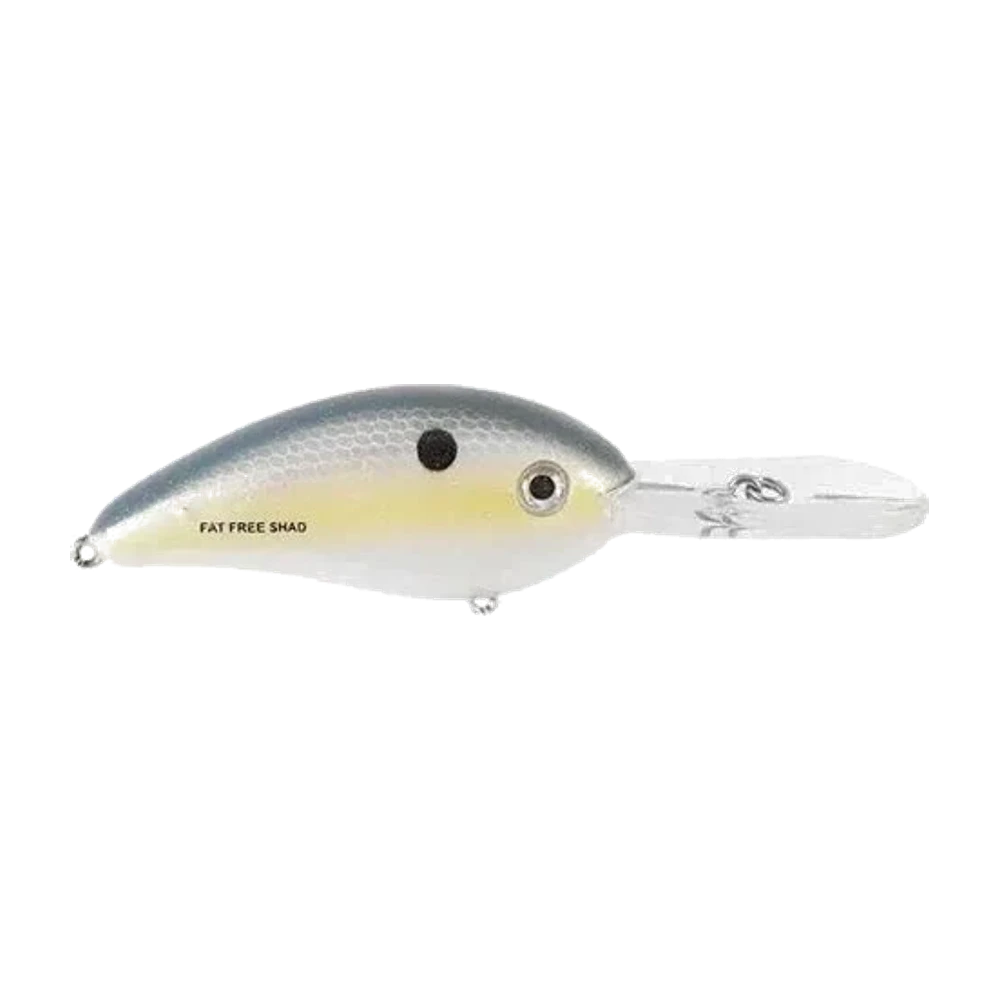
Bomber Fat Free Shad: the deep crank with a bait-fish profile
One lure, endless conditions. CarnaFish reads your spot from a photo so you are not just guessing.
You are fishing a big reservoir in late summer. The forage is bleak and small roach: tall, flat fish, narrow seen head on. You throw a classic deep crank, a big round fat body that rolls widely, and you catch nothing — while the sounder shows bait balls at 4 metres with marks glued underneath them.
The problem is not depth. Depth is right. The problem is that your lure looks like nothing the fish are eating right now, and that it moves too much for clear late-season water.
The Fat Free Shad is built around that answer: reach the same layer as a big round crank, but with a bait-fish silhouette and a much tighter roll. The name is misleading — "fat" here refers to the cross-section, not the shape seen in profile, which is that of a tall, laterally compressed shad.
A tall, flat body, not a balloon
That is the structural difference with most deep cranks on the market.
A round-bodied deep crank displaces a lot of water. It pushes a low-frequency wave that carries far, which is exactly what you want in stained water or on scattered fish you still have to find. The flip side: head on, it is a lump. In clear water, on fish that have watched three boats go by that day, that lump gets refused.
The Fat Free Shad is compressed on the flanks. Three direct consequences:
- The roll is tighter and faster. The lure vibrates high rather than rolling wide. The signal is finer, closer to a fish swimming than a fish in trouble.
- The flank is taller, so the reflecting surface is larger. On each oscillation you get a broad, brief flash, very visible from the side — that is what pulls in a fish sitting off the line of the retrieve.
- Resistance on the retrieve is lower for the same depth. Over a full day of casting, that genuinely matters to your shoulder.
That profile also explains why it works so well for zander, a fish often keyed on slim prey that backs off fast from a lure that moves too much.
Choosing the size: the table that avoids mistakes
The range comes in several formats, and it is the lip as much as the body that sets the layer. Here are on-the-water reference points, with standard fluorocarbon and a full cast.
| Format | Target depth | Typical situation |
|---|---|---|
| Small (≈5-6 cm) | 2.5 to 3.5 m | Margins, shallow flats, perch and bass early in the season |
| Medium (≈6-7 cm) | 3.5 to 4.5 m | Drop-offs, drowned timber, the most versatile format |
| Large (≈7-8 cm) | 4.5 to 5.5 m | Deep ledges, reservoir zander, late summer |
Two corrections worth knowing:
- Dropping one line diameter gains you roughly 30 to 50 cm of depth. Going from 0.30 mm to 0.25 mm is often more effective than changing lure size.
- Lengthening the cast by ten metres does more than any other adjustment. A deep crank only runs at its maximum depth over the middle third of its run.
The retrieve: one wind, three phases
There is no wrist work here. It all comes down to speed and to what you do at the moment of contact.
- Cast long, as far as your rod allows. Distance is variable number one.
- Wind the first ten turns fast to force the lure down. A slow descent burns distance for nothing.
- Switch to a steady, medium speed as soon as you feel the lure loaded. Keep the rod tip low, pointed at the water.
- On contact — a rock, a branch, the bottom — do not pull. Give back half a handle turn. The lure rises by itself and clears.
- Resume the steady retrieve immediately. The bite most often comes in the two metres that follow the deflection.
On the water: when your crank hangs up, the first correct reflex is to give slack, never to pull. Pulling drives the lip into the obstruction and buries the trebles; half a turn given back lets the body's buoyancy do the work and returns the lure to you eight times out of ten.
Why the rod matters more than the lure
A deep crank is fished with trebles and with fish that hook themselves. The rod sorts the fish landed from the fish dropped.
You need a moderate-action rod that bends in the top third and absorbs head shakes. A stiff worming-style rod pulls the treble out of a bass's mouth mid-run, especially when the fish is a long way off and the line is already tight under the lure's resistance.
On the reel, a moderate ratio around 5.4:1 is more comfortable than a fast one: you control speed better and tire less. Fluorocarbon is not a luxury here — it sinks, it transmits contact, and it helps the lure hold its layer.
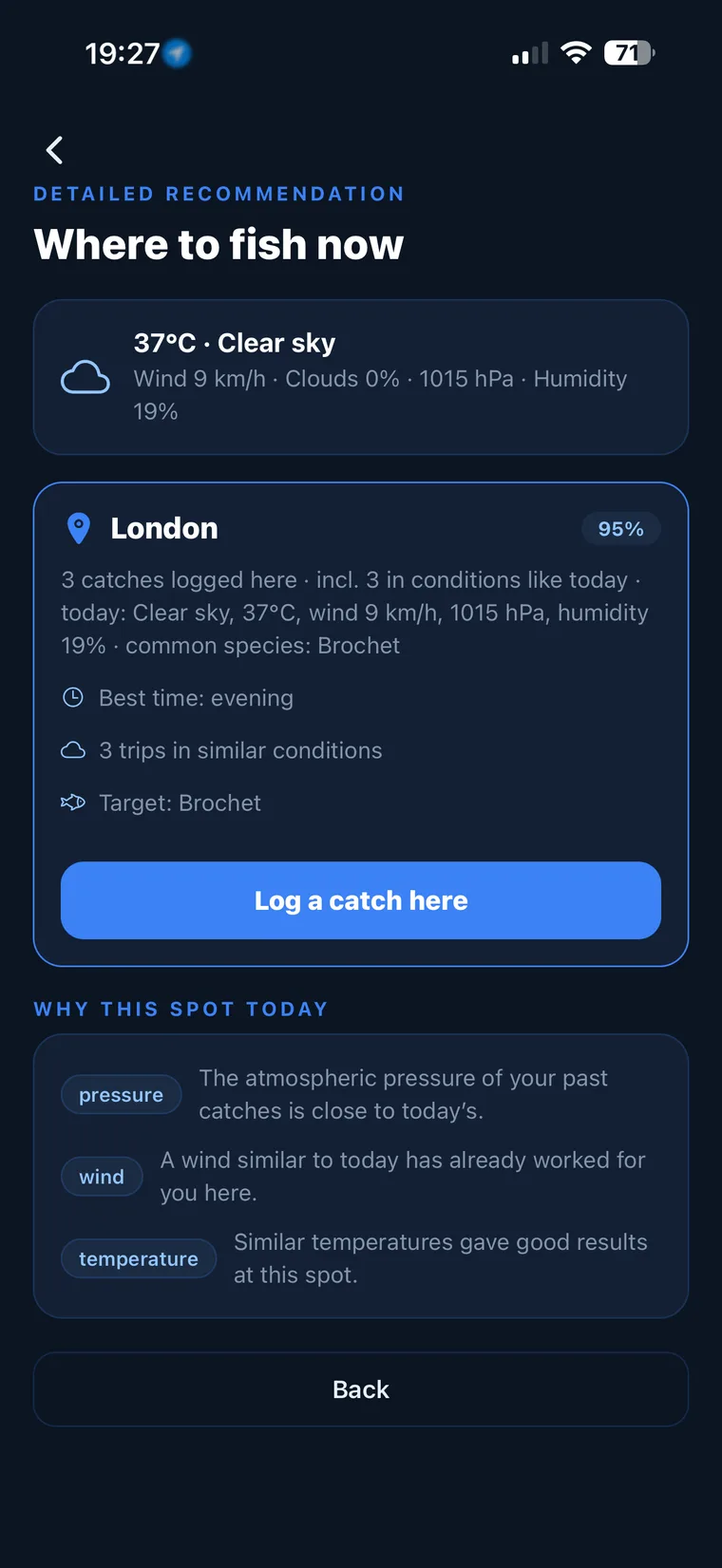
Not sure what to tie on?
Photograph your spot: CarnaFish reads the scene, cross-checks the conditions and gives you the zone, the lure and the retrieve. Free on iOS and Android.
Where it excels, and where not to use it
Its windows:
- Clear reservoirs and big lakes, on drop-offs between 3 and 5 m, when the forage is made up of slim fish.
- Late summer and autumn, when fish drop below the shoals and refuse margin lures.
- Zander sitting on a hard flat, on a brisk retrieve just off the bottom.
- Drowned trees and stumps, precisely because it clears them well.
Its limits, which you have to accept:
- Very stained water: its tight signal does not carry enough. A round crank or a lipless vibrating lure covers it better.
- Dense weed: two trebles and a long lip make a weed collector.
- Less than 2 m of water: you will spend your time ploughing. Take a squarebill.
- Apathetic fish in midwinter: the crank is a lure for fish willing to move.
Fat Free Shad or a round-bodied deep crank
A Strike King 5XD or a Norman Deep Little N trade on volume and a low-frequency wave: they call from a distance, excel in coloured water, and forgive a sloppy retrieve. The Strike King 10XD pushes the same logic deeper still, with the physical effort that goes with it.
The Fat Free Shad takes over when the water clears, when fishing pressure rises, and when the forage is slim: its tight roll and tall silhouette get through where a round body gets refused. In a well-built box the two live side by side — you start on volume, you finish on finesse.
Our beginner's guide to zander fishing with lures covers how to read a drop-off before choosing a depth. And if you are unsure which layer to attack when you arrive on a reservoir, CarnaFish analyses a photo of the spot and answers.
Key takeaways
- Tall, laterally compressed body: tight roll, broad flash, slim bait-fish silhouette.
- Size sets the layer, but cast length and line diameter adjust it just as much.
- On contact with an obstruction, give back half a turn instead of pulling: the lure clears itself.
- A moderate-action rod is compulsory, otherwise you drop fish hooked on trebles.
- A clear-water, slim-forage lure; in stained water a round crank does better.
FAQ
How deep does the Fat Free Shad run?
Depending on size, count on 2.5 to 5.5 m with standard fluorocarbon and a full cast. Finer line adds 30 to 50 cm, and a short cast costs far more than that: maximum depth is only reached over the middle part of the run.
What is the difference from a classic deep crank?
The body is tall and flat instead of round and fat. The roll is therefore tighter and the signal more discreet, with a broader side flash. That is an advantage in clear water and on pressured fish, a drawback in stained water.
Does it work for zander?
Yes, it is one of its windows on reservoirs. Zander do not take well to a lure that rolls too widely; the slim profile and tight vibration suit them, on a steady retrieve in contact with hard bottom.
Should I change the stock hooks?
Not necessarily. If you do, keep an equivalent wire diameter: heavier trebles cost buoyancy, and therefore the lure's ability to free itself from obstructions.
Which rod should I use?
A moderate-action rod, soft in the top. With trebles and a fish hooking itself twenty metres out, a stiff rod pulls the hooks. It is the single adjustment that changes your landing rate the most.
What do I do when it hangs up in timber?
Immediately give back half a handle turn to create slack. The body's buoyancy lifts the lure and the lip pivots clear of the obstruction. Pulling on it is the surest way to leave it there.
The full bass lure guideSeason-by-season strategy: which family of lure, when, and why.Go from theory to fish
CarnaFish reads your spot from a photo and gives you the game plan: zone, lure, retrieve. Free on iOS and Android.