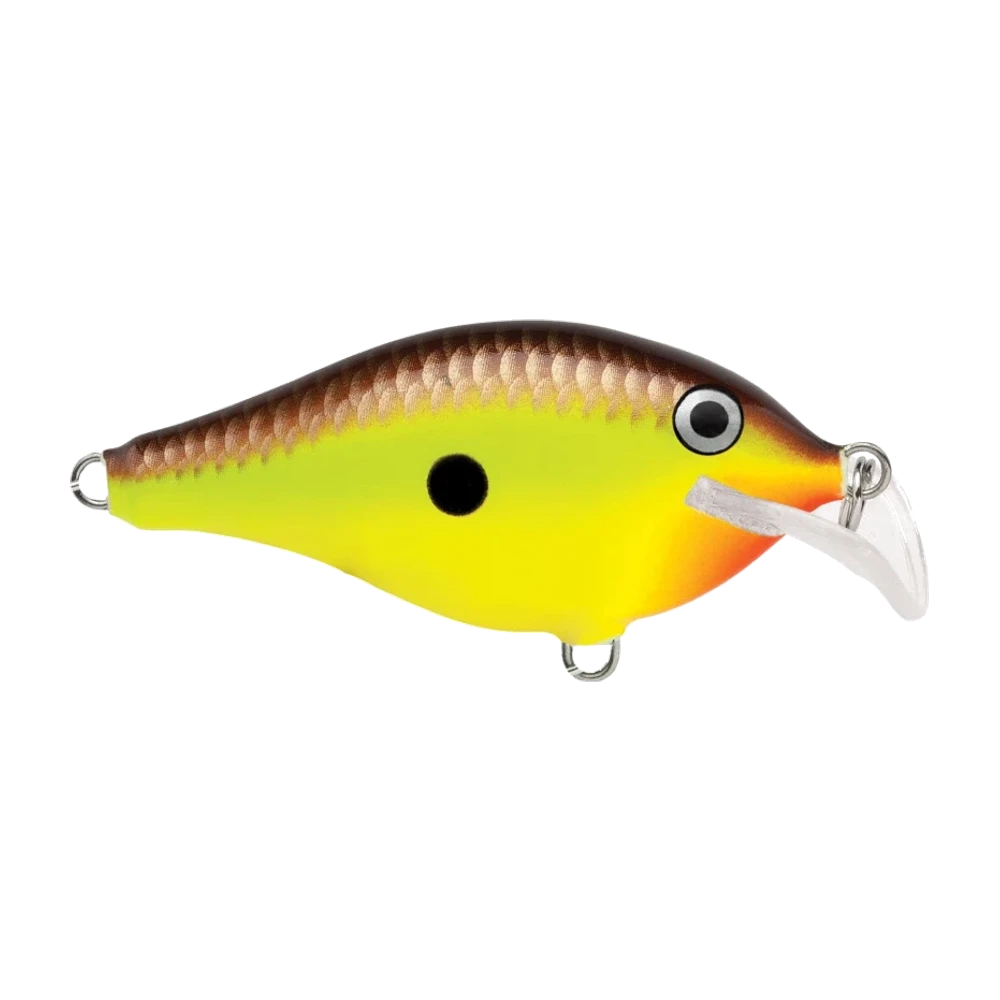
Rapala Scatter Rap Crank: the deflection you get without an obstacle
Rather not fish it blind? Photograph your spot — CarnaFish cross-checks the conditions and points you the right way.
Everyone knows the moment: a crankbait clips a stump, veers violently off line, and gets hit within the second. That is no coincidence. A sudden break in the path is one of the strongest triggers there is — it tells the story of a panicking prey, not a prey crossing the swim.
The problem is that it only works if there is something to hit. Over a sandy flat, in a smooth river pool, above a clean bottom, your crankbait runs dead straight for the whole retrieve and tells no story at all.
The Scatter Rap Crank produces that deflection with no obstacle. Its lip is not flat: it is bent, and that shape destabilises the lure periodically in open water and sends it off to the side before it comes back into line on its own.
A lip that manufactures randomness
The technical idea fits in one sentence: a bent lip creates unstable flow, and that instability produces irregular lurches.
On the water you actually see three things.
The darts are not rhythmic. They do not land every three turns of the handle. They arrive when they arrive, sometimes twice in a row, sometimes after ten seconds of well-behaved swimming. It is precisely that absence of a pattern that separates this lure from a normal crankbait: the fish cannot anticipate.
The dart is sideways and fast, not wide. The lure does not turn around. It shoots twenty to forty centimetres to one side, very quickly, then picks its swimming back up. Seen by a fish, that is an aborted escape.
The return to line is spontaneous. You do nothing. No handling, no correction. The lure self-corrects and runs straight again, which lets you fish a purely straight retrieve.
The retrieve: the right speed, and nothing else
It is the easiest lure in the range to work, with one condition: find the speed window where the lip breaks away.
- Cast across the current if you are on a river, or parallel to a margin on a lake.
- Start a steady retrieve, around a turn and a half of the handle per second to begin with.
- Watch and listen. You should feel a steady action in the rod punctuated by small losses of resistance: those are the darts.
- If you feel no darts, speed up gradually. The break-away needs a minimum of speed.
- If the lure spins out and rises, you have gone too far. Drop back a notch.
- Add no twitches. Working it by hand disturbs the phenomenon instead of amplifying it.
On the water: the right speed is the one where you lose the action once or twice a second in the rod. Too slow and the lure swims politely and you are fishing an ordinary crankbait. Too fast and it comes out of the water spinning. Hunt that window on the first cast of the session: it shifts with the strength of the current, so it needs recalibrating at every spot.
Setting up by size and context
| Context | Size | Target depth | Speed |
|---|---|---|---|
| Perch along a lake margin | 5 cm | 1.2 to 1.8 m | 1.5 turns/s |
| Trout in a river riffle | 5 cm | 60 cm to 1.2 m | 2 turns/s, across |
| Perch on a drop-off | 7 cm | 2 to 2.5 m | 1.5 turns/s |
| High-flow river | 7 cm | variable | the current sets the speed |
On rivers one point is essential: the current contributes to relative speed. Cast across and allowed to swing, the lure can break away on its own without you winding fast. In a strong flow you sometimes retrieve barely faster than it takes to keep the line tight.
Where it excels, and where it adds nothing
The Scatter Rap Crank is an open-water, clean-bottom lure. That is a rare case: most crankbaits go looking for obstacles, this one does without them.
- Sandy and gravelly flats on lakes and reservoirs, where there is nothing to bump into.
- Riffles and river currents holding trout, fished across the flow in 60 cm to 1.5 m of water.
- Shoals of feeding perch on an open spot, when straight-swimming lures start getting refused after two or three fish.
- Clear water, where the dart is visible from a distance.
Conversely it has no value at all in branches, stumps and dense weed. In that context a square-lip crankbait bouncing off wood produces the same deflection effect for free, and gets through cover better. The Scatter Rap snags there without any compensating advantage. It is also badly suited to very slow cold-water fishing: below break-away speed it loses its reason to exist and goes back to being an ordinary crankbait — and there are better ones for that role. Finally, in very murky water, a visual deflection is lost: a deeper vibration carries better.
Not sure what to tie on?
Photograph your spot: CarnaFish reads the scene, cross-checks the conditions and gives you the zone, the lure and the retrieve. Free on iOS and Android.
Scatter Rap Crank or a classic crankbait
The most telling comparison is with a proven searching crankbait. The Rapala Shad Rap offers a tight, regular action that reads very clearly to a fish, and it excels exactly where consistency reassures: cold water, settled fish, a slow and constant retrieve.
The Scatter Rap does the opposite. It bets on unpredictability, so it is aimed at active fish that react by reflex rather than by observation. Switching between them comes down to one simple criterion: if fish follow your crankbait without attacking, go to the Scatter. If they do not react at all, the problem is elsewhere — depth or area — and an erratic path will change nothing.
For perch in very clear water and on tighter spots, an Illex Chubby 38 stays more discreet and casts on lighter tackle. Our guide to perch fishing with lures explains how to chain these approaches on a feeding shoal, and the river trout guide covers reading riffles. And if you are unsure which way to work a current when you arrive, CarnaFish analyses a photo of the spot and answers.
Rigging and small details
Fluorocarbon in 0.20 to 0.25 mm is the right compromise: fine enough not to restrict the darts, strong enough for the rock in riffles. A small round snap is tolerated and even handy, since you will swap sizes often to adjust depth.
Two precautions are worth the effort. Check the alignment of the front split ring regularly: on a lure that is constantly veering off, a twisted loop turns the darts into a permanent spin. And do not replace the trebles with heavier models: the lip's break-away depends on a fine balance, and a few grams at the front are enough to kill it.
Key takeaways
- The bent lip produces sideways darts with no obstacle to hit.
- The darts are irregular and unrhythmic: the fish cannot anticipate.
- Purely straight retrieve, with no manual action to add.
- There is a speed window to find on the first cast, and it shifts with the current.
- No use in branches, in slow winter fishing or in very murky water.
FAQ
How does the Scatter Rap lip work?
It is bent instead of flat, which makes the water flow around the lure unstable. That instability causes unpredictable sideways lurches in open water, after which the lure comes back into line by itself.
Do you need to work the Scatter Rap Crank?
No. A steady straight retrieve is enough, and it is actually better: manual twitches disturb the lip's break-away instead of amplifying it. Everything comes down to speed.
What retrieve speed should you use?
Around one and a half to two turns of the handle per second, adjusted until you feel one or two losses of action per second in the rod. Too slow and the lure runs straight; too fast and it spins out.
What depth does it work at?
Between 1.5 and 2.5 m depending on size and the line you use. On a river with the current in your face, count on a metre to a metre and a half instead, since the flow limits how deep it gets.
Is it suitable for river fishing?
Yes, that is one of its best grounds. Cast across the current, the flow supplies part of the relative speed the break-away needs, which lets you wind very slowly while keeping the action.
When should you prefer a classic crankbait?
When the water is cold and the fish are settled, or when you are fishing in branches. A regular-swimming crankbait reads better to an inactive fish, and a square-lip model already deflects on its own when it hits wood.
The full perch lure guideSeason-by-season strategy: which family of lure, when, and why.Go from theory to fish
CarnaFish reads your spot from a photo and gives you the game plan: zone, lure, retrieve. Free on iOS and Android.