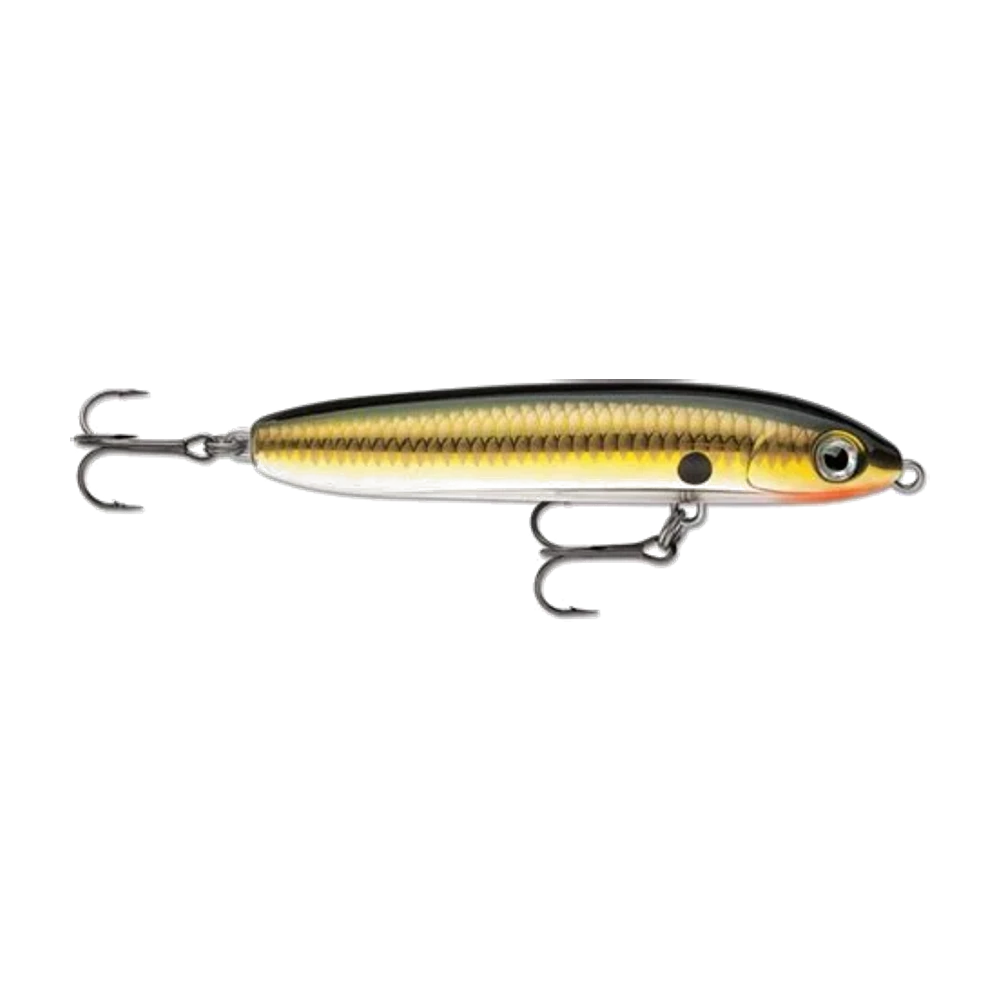
Rapala Skitter V: the walking bait that sprays on every wrist snap
One lure, endless conditions. CarnaFish reads your spot from a photo so you are not just guessing.
There is a frustrating moment in topwater fishing: the bass are feeding, you can see them, but your usual surface lure has stopped producing. The stickbait glides cleanly, silently, and gets ignored. The popper makes too much noise and scatters the shoal. You are stuck between two signals, and neither matches what is happening in front of you.
The Skitter V fills exactly that gap. It walks the dog like a stickbait, but throws water like a popper on every change of direction. One movement, two signals.
The V hull, and what it produces
Look at the lure head on: the belly is not round, it is cut into a V, with a front that forms a bow. That is not a styling detail.
When the lure zigzags, it does not slide flat across the surface. On every change of direction, the bow bites into the water and throws a spray out to the side, on the opposite side to the turn. The result is a Z-shaped path leaving two alternating splash trails, plus a bubble trace.
Three concrete differences from a classic walking bait:
- The sound signal is richer: a slap of water on every wrist snap, where a round stickbait makes almost nothing.
- The visual trace carries further, which counts enormously in the sea where fish spot feeding activity from a long way off.
- The lure grips a rippled surface better: the bow keeps contact when a round-bellied model starts skating and breaking off.
An honest trade-off: on flat water with wary fish, that extra spray can be too much. This is not a lure for glassy conditions.
Where it sits between the Skitter Walk and the Skitter Pop
The Skitter family covers three distinct behaviours, and confusing them costs you whole sessions.
The Rapala Skitter Walk is the pure walking bait: a clean zigzag, glide, very little noise, one rolling ball. It is the choice on calm water, educated fish or discreet feeding on small prey.
The Rapala Skitter Pop is a true popper: cupped mouth, a big plop, a lot of water displaced on the spot. It is the choice when you need to call a fish from a distance onto a precise spot, or to fish very slowly and let the lure work without moving forward.
The Skitter V is the hybrid: it moves like the Walk but sprays like the Pop, continuously. Translated into decisions on the shoreline: when the Walk gets ignored because it is too quiet, and the Pop scares fish off or covers too little ground because it does not travel, you clip on the V.
The retrieve: wrist, not arm
- Cast beyond the feeding zone, never into it. You bring the lure towards the fish, you do not land it on top of them.
- Rod at 45 degrees downwards, line slightly slack. That is the non-negotiable condition: with a tight line the lure cannot shoot to the side.
- Give sharp, rhythmic wrist snaps, taking up a quarter turn of the handle between each. One snap, one quarter turn. The rhythm needs to be metronomic.
- Hold a cadence of 2 to 3 snaps per second when searching, slower on a fish you have located.
- Break the rhythm every five or six sequences: two very fast snaps then a one-second stop. The lure sits still, nose slightly down. A lot of bites come on that restart.
On the water: when a sea bass misses the lure on the surface, do not stop and above all do not strike. Carry on walking at exactly the same rhythm, without speeding up. The fish comes back in most cases within two or three seconds, and it comes back more committed than on the first attack. It is the reflex stop that kills the second chance, not the fish.
Choosing the size by sea state and prey
| Situation | Size | Cadence | Note |
|---|---|---|---|
| Feeding on fry, calm sea | 9 cm | fast, short amplitude | switch to the Skitter Walk if it gets refused |
| Short chop, scattered feeding | 11 cm | medium, medium amplitude | the most versatile format |
| Built sea, wind, big fish | 13 cm | wide and pronounced | holds the surface when it is churning |
The main trap is dropping down a size when nothing bites. On the surface and in the sea, it is usually the amplitude of your movement that needs changing, not the lure. A tight, fast zigzag imitates a panicking shoal; a wide, slow zigzag imitates a single wounded fish. Those are two completely different propositions with the same lure.
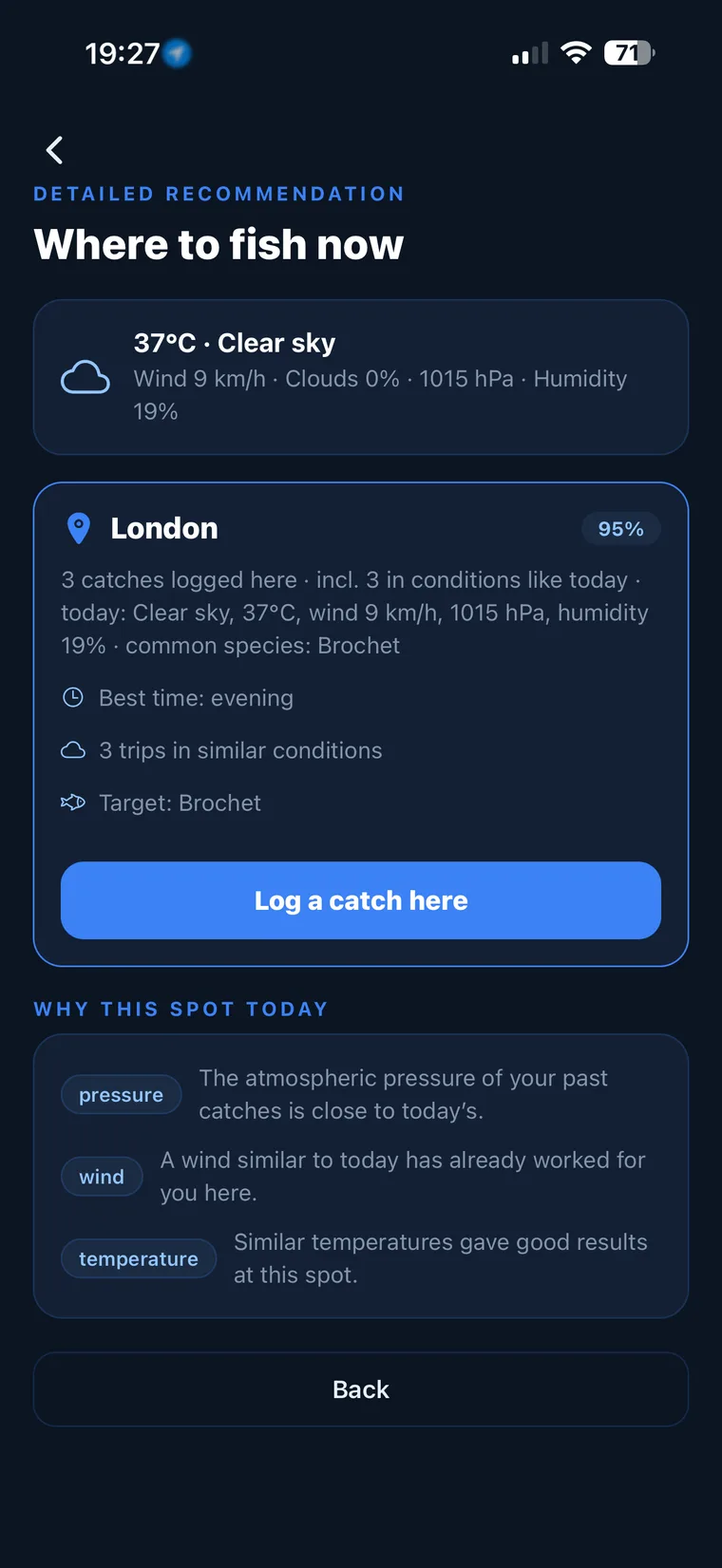
Not sure what to tie on?
Photograph your spot: CarnaFish reads the scene, cross-checks the conditions and gives you the zone, the lure and the retrieve. Free on iOS and Android.
The rig, and the classic mistake
A metre of 0.35 to 0.45 mm fluorocarbon leader, joined to braid. On the surface, fluorocarbon is not there for stealth, it is there to take the abrasion of teeth and rocks the moment the fish runs.
A direct knot works, but a small round snap helps the lure break off to the side. Avoid flat snaps and swivels: they block the pivot.
The stock trebles deserve a systematic check. On a topwater lure a sea bass comes off during the jumps, and even a slightly opened hook is enough to lose the fish. Stay with an equivalent diameter in stainless: heavier trebles make the nose sink and kill the walking action.
Where it excels, and where it is unsuited
It is at its best on a rippled to choppy sea, at sunrise and sunset, over active feeding or fish holding along a rocky margin. It also works very well for searching: you cover a lot of ground fast, which a popper does not allow.
It is unsuited on perfectly glassy water with educated bass — too much signal, and you push them away. It is useless as soon as the fish are deep and will not come up: water below 12 °C, strong midday sun, and you are wasting your time on the surface. Finally, it does not get on with a strong following wind, which flattens the line onto the water and stops the lure shooting sideways.
Our guide to sea bass fishing with lures details the time windows where topwater beats sinking lures. And if you are hesitating between surface and subsurface when you get to a spot, CarnaFish analyses a photo of the spot and answers.
Key takeaways
- V hull: the lure zigzags like a stickbait but throws water on every turn.
- It occupies the space between the quieter Skitter Walk and the louder, more static Skitter Pop.
- Rod low, line slightly slack, steady wrist snaps with a quarter turn between each.
- If a fish misses, carry on at the same rhythm without striking: it comes back.
- A bad call on glassy water with educated fish, or when the bass will not come up.
FAQ
What is the difference between the Skitter V and the Skitter Walk?
The Walk glides silently in a zigzag; the V does the same zigzag but its bow throws water on every change of direction. The Walk is the right call on glassy water and wary fish, the V when the surface is rippled or the fish are ignoring a quiet lure.
Should you prefer it to a popper?
Yes as soon as you need to cover ground, because it keeps moving forward. A popper keeps the advantage on a precise, small spot where you want noise without moving the lure.
How do you get a walking bait to shoot sideways?
Drop the rod towards the water and work with a slightly slack line. With a tight line your snaps pull the lure straight towards you instead of letting it pivot. The movement comes from the wrist, not the arm.
What size should you choose for sea bass from the shore?
The 11 cm is the most versatile format: castable in moderate wind, present enough for an adult bass without being excessive. Keep the 13 cm for a built sea and big fish, and the 9 cm for fish feeding on fry.
Does the Skitter V work in freshwater?
Technically yes, for pike or bass, but it is armed and sized for the sea. In freshwater, lighter walking baits offer a finer action and hooks better matched to the size of the fish.
What time of day should you use it?
Dawn and dusk first, then all day when the sky is low and the sea is rippled. In full midday sun on clear water, the bass stay deep and a topwater will not bring them up.
The full sea bass lure guideSeason-by-season strategy: which family of lure, when, and why.Go from theory to fish
CarnaFish reads your spot from a photo and gives you the game plan: zone, lure, retrieve. Free on iOS and Android.