Rapala PXR Jowler 127: the cupped-mouth stickbait that splashes as it walks
This lure shines under specific conditions. CarnaFish tells you in 10 seconds if today is one of them.
An August morning without a breath of wind, the surface flat as oil, and the fish have already seen three stickbaits go past since first light. The classic silent zigzag has stopped producing. That is exactly when a bait that walks and splashes at the same time changes things: the Jowler 127 is built on that double signature, and it is what earns it a slot next to a traditional walking bait.
Two signals in one lure
Rapala describes the Jowler as a walking bait fitted with a cupped mouth, designed to produce what the brand calls a splash-and-walk action: a hard-cutting splash combined with the side-to-side walk, at any speed.
In practice that means you no longer have to choose between a popper and a stickbait. A classic popper works on the spot, in bursts, and covers little ground. A stickbait like the Heddon Zara Spook covers a lot of water but stays quiet. The Jowler does both at once: it moves forward zigzagging like a walker while throwing water at every change of direction thanks to its cupped mouth.
That signature matters on what anglers call a technical shoreline — a reed edge, a line of jetties, a grass line — where the fish sits with no clear view. The sound of thrown water brings it out, the lateral travel gives it time to climb.
The knocker: calling fish in, and casting further
Rapala states an internal dual frequency knocker that grabs the attention of predators from afar and doubles as a cast booster. Both functions rest on the same part: a sliding internal weight.
On the retrieve, that weight hits the walls at every rod stroke and generates sound across two distinct frequencies, broader than a single clack. On the cast, it shifts rearward and stabilises the lure in flight — the same weight transfer principle found on many modern jerkbaits, and it makes a real difference on a bulky surface bait, normally sensitive to wind.
The result is a lure you can genuinely put a long way out, which counts in topwater fishing where a short approach spooks fish before you even cast.
The numbers to know
The manufacturer table gives three values: 5 inches, that is 12.7 cm — the 127 in the name is the length in millimetres — for 0.94 oz, about 26.6 g, in the topwater class. So this is a strictly surface bait with no subsurface action at all.
Twenty-six and a half grams on a 12.7 cm body makes it a genuine power bait. It needs a rod capable of loading it: count on 6 ft 6 in to 7 ft 3 in in medium-heavy, with enough backbone to deliver crisp strokes without the blank folding. Too soft a rod will not walk this lure, it will drag it.
Rigging
Braid in the 30 to 50 lb range for direct transmission and a floating line, with a metre of fluorocarbon leader when the water is clear. A round snap is better than a direct knot: it leaves the nose free to pivot, which is the condition for the zigzag. On a pike spot, swap the leader for heavy fluorocarbon or soft titanium — a topwater bait gets grabbed sideways, and teeth reach the line.
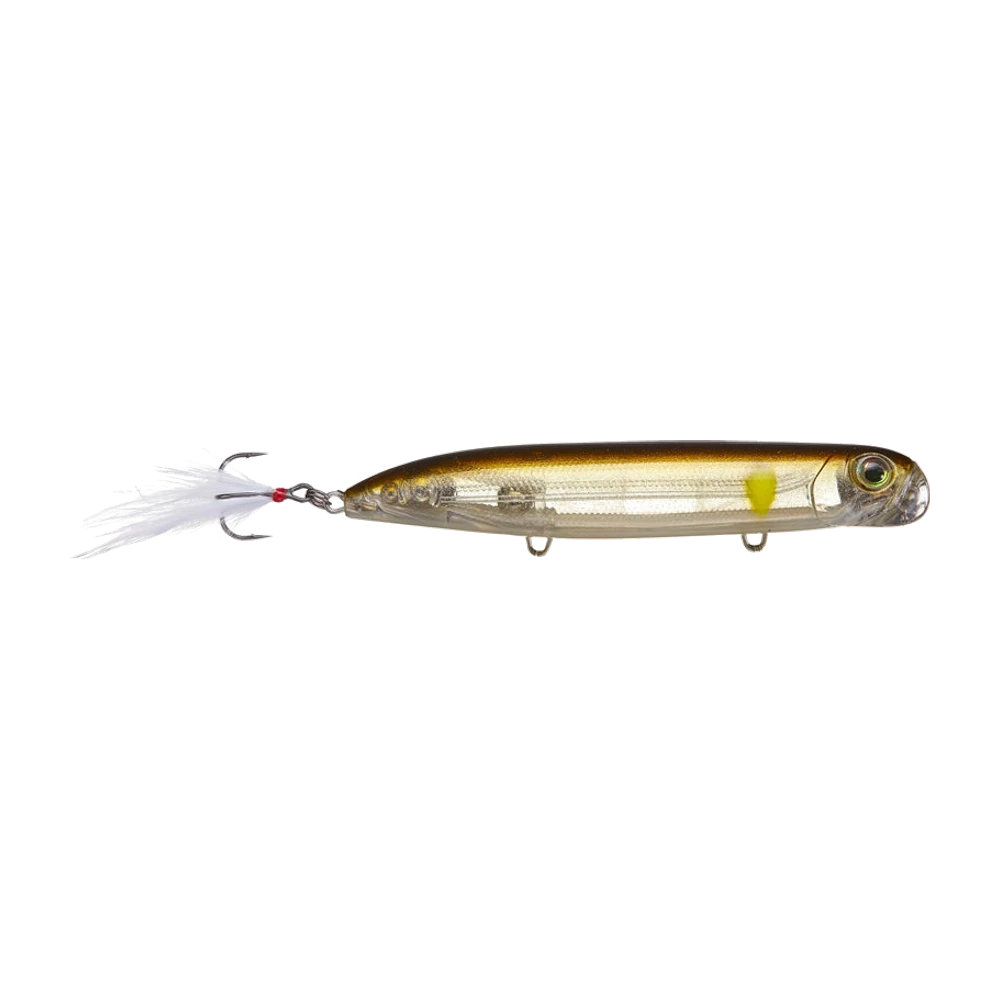
As for hooks, Rapala states VMC RedLine trebles with a dressed feather tail. On the product photo, only the feathered rear treble is fitted, on a red split ring; both belly hangers are empty. That is an observation on a product photo, not a specification.
The tail feathers are not decoration. When you stop the retrieve they keep opening and closing for two or three seconds, and it is often during that breathing pause that the fish commits. If you never pause, you throw away half the value of that dressing.
The classic mistake
Working it too hard. The natural reflex on a big topwater is to pull sharply to make noise, and what you get is a string of splashes with no walk at all: the bait tracks straight and sprays. The walk comes from short, regular rod strokes, a loose wrist, and a bit of slack in the line between each one. The Jowler splashes on its own thanks to its mouth; your job is to give it rhythm, not force.
The other mistake is setting the hook on the noise. A surface strike is spectacular and the reflex is to swing immediately, usually into thin air. Wait until you feel the weight of the fish in the rod, then set sideways.
Not sure what to tie on?
Photograph your spot: CarnaFish reads the scene, cross-checks the conditions and gives you the zone, the lure and the retrieve. Free on iOS and Android.
Colours by light and water
On the surface the fish sees the lure backlit: the silhouette, not the actual colour of the flanks, is what carries. So think in contrast first.
- Clear water, bright sun: a translucent body with a gold back like the one photographed, which lets light through and stays credible on a wary fish.
- Low light, dawn and dusk: a strongly contrasted dark back, which cuts a clean outline against the sky.
- Stained water: a solid white or chartreuse belly, to give a visible target to a fish rising from below.
Where it shines, and where it is useless
The Jowler is an active search bait: long shorelines, shallow flats over grass, jetty lines. It is no use on a tight spot where the fish sits under a laydown a couple of metres off the bank, because it needs distance to settle into its walk. There, a more compact popper like the Rapala Skitter Pop works better in place. And on water churned up by wind, the splash gets lost in the chop: a quieter Rapala Skitter Walk or a subsurface bait takes the edge back.
Reading the surface starts with reading the spot, and that is exactly what CarnaFish does: one photo of the spot, and the AI suggests the zone, the depth and the type of lure that fit the conditions of the day. To work out when topwater beats everything else for pike, our guide to choosing a pike lure walks through the families worth knowing.
Key takeaways
- Cupped mouth plus side-to-side walk: the Jowler does the job of a popper and of a stickbait at the same time.
- Internal dual frequency knocker that also serves as a long-cast system, a real asset on a bulky surface bait.
- 12.7 cm for about 26.6 g, classed topwater: you need a medium-heavy rod to work it properly.
- Short rod strokes make the bait walk; violent ones only make noise.
FAQ
Is the Jowler 127 a popper or a stickbait?
Both at once. Rapala presents it as a walking bait with a cupped mouth, able to throw a splash while walking side to side. That is what sets it apart from a popper, which works on the spot, and from a classic stickbait, which is far quieter.
Does it need a particular rod?
Yes. At 26.6 g and 12.7 cm, a medium-heavy rod of 6 ft 6 in to 7 ft 3 in is a minimum to keep a regular walk going. Too soft a rod absorbs the strokes and the lure simply tracks straight.
Does the Jowler work for pike?
Its 12.7 cm size and sound signature suit pike spots on European waters very well, over shallow flats and along grass lines. Use an abrasion-resistant leader: a surface strike often comes sideways across the body.
How fast should it be worked?
Rapala states the action holds at any speed. In practice, start slowly with one- to two-second pauses, then speed up if fish follow without committing. Rhythm, far more than raw speed, is what triggers the strike.
Do the rear treble feathers do anything?
Yes. They carry the movement on through the pauses, when the body itself is already still, and they give a rear aiming point. A surface bait with no dressing loses that signal on the stop.
How many hooks come fitted?
Rapala states VMC RedLine trebles with a dressed feather tail, without giving a count. The product photo shows a single treble, at the rear, and two empty belly hangers: an observation on a photo, not a specification.
The full bass lure guideSeason-by-season strategy: which family of lure, when, and why.Go from theory to fish
CarnaFish reads your spot from a photo and gives you the game plan: zone, lure, retrieve. Free on iOS and Android.