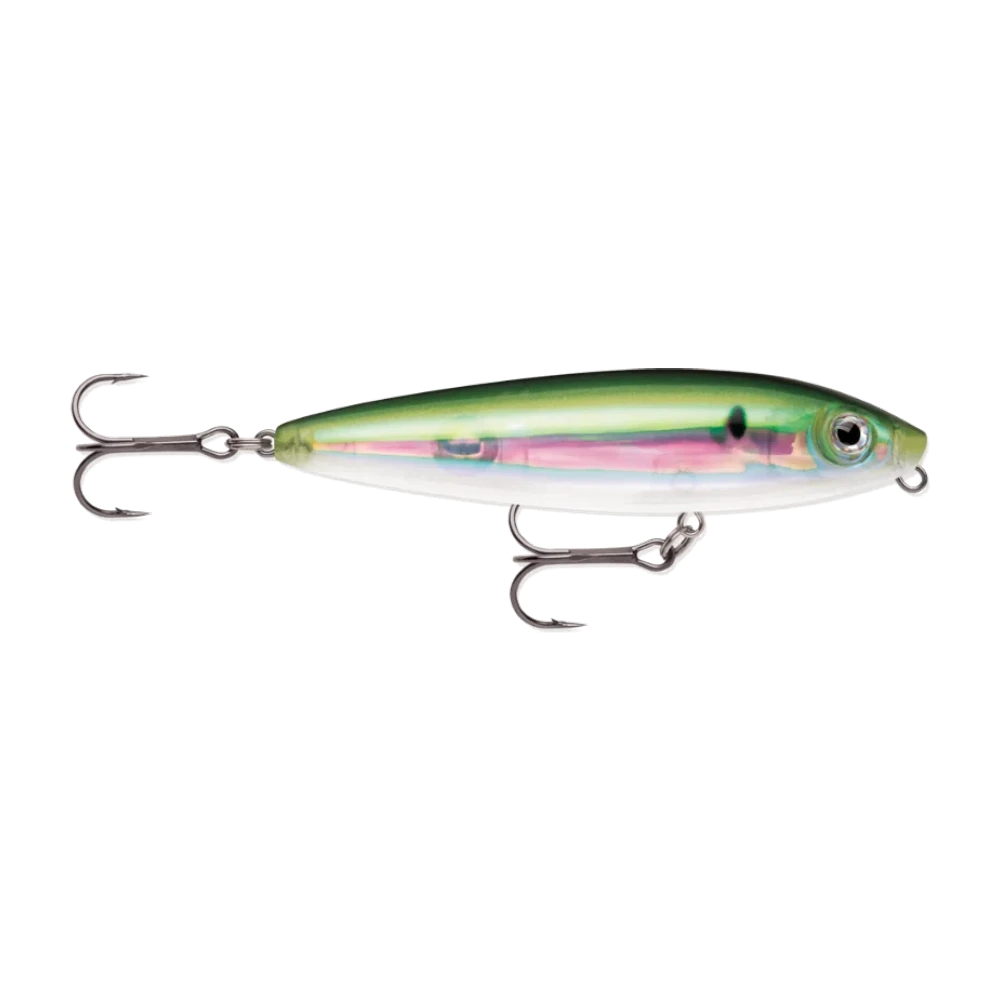
Rapala Skitter Walk: the walking bait that forgives a clumsy hand
Not sure this lure fits YOUR spot today? CarnaFish tells you in 10 seconds, from a photo.
Walking the dog is the technique everyone tries once and plenty of people give up on. The principle is simple on paper — a series of snaps that makes a floating stick zigzag — but in reality the lure skews off, crosses itself on the line, or runs dead straight without the slightest swing. After ten minutes, back on goes a jerkbait.
The problem is rarely the angler. It is the lure. Some stickbaits only accept a perfectly calibrated movement: too soft and they never start the turn; too sharp and they take off. The margin is narrow, and it disappears completely as soon as there is a ripple on the water.
The Skitter Walk was designed the other way round. Its mass distribution and stocky profile give it a wide working window: the zigzag starts with a fairly broad range of movements, and it stays readable on choppy water. It is the walking bait you learn on, and often the one you keep.
A short body that pivots instead of gliding
The difference from a long, slim stickbait comes down to glide length. A very elongated lure glides a long way between two snaps: you need well-spaced, precise impulses, or the lure has not finished its movement when the next one arrives and it turns sideways.
The Skitter Walk is shorter and thicker for its length. Direct consequences:
- A shorter glide between two snaps, so a tight zigzag that stays in a narrow corridor. You can work a spot two metres wide without the lure leaving it.
- A fast pivot: the nose changes direction almost immediately after the impulse, which forgives an irregular cadence.
- A slightly tail-down float, which keeps the head at water level. The lure never noses under and does not take on water if you snap too hard.
It also carries internal rattles that produce a sharp click on every change of direction. That is no detail: on choppy water, that sound signal replaces the visual one when the fish can no longer see the silhouette.
The retrieve: rod low and wrist alone
Here is the sequence that works, in order.
- Position yourself so you can retrieve with the rod tip down, pointed at the water at around 45 degrees. If you fish with the rod high, the lure lifts instead of pivoting.
- Cast and let the lure settle for a second. Take up the slack without pulling on the lure.
- Give short, sharp wrist snaps, 15 to 25 cm of amplitude, taking up a quarter turn of the handle between each. Rhythm matters more than force.
- Find the cadence: around one snap every half second. If the lure crabs sideways, slow down. If it runs straight, sharpen your impulses.
- Slip in a two-second pause every five or six zigzags, especially after passing an obstacle.
The hookset deserves a note of its own. On the surface, the classic mistake is striking at the sight of the attack. The fish often misses its first pass, and a strike at nothing rips the lure off the spot. Wait until you feel the weight in the rod, then strike sideways, never upwards.
On the water: when a fish misses the lure, do not cast straight back to the same place. Leave the Skitter Walk motionless for three or four seconds exactly where it is, then start again with two slow zigzags. A sea bass or a pike that has missed almost always comes back, but to a lure that looks wounded, not to one taking off at full speed.
Choosing the size by species and conditions
| Situation | Indicative size | Why |
|---|---|---|
| Sea bass off a beach, little chop | 8 cm | Discreet profile, matches small baitfish |
| Sea bass on a rocky point, wind and chop | 11 cm | Casting range, silhouette visible in the waves |
| Pike in summer weed | 11 cm | Enough volume and sound to call from a distance |
| Inactive pike, late season | 8 cm | A reduced signal when the big profile is refused |
| Visible activity on small fry | 8 cm | Consistency with the size of the prey |
On rigging, two points make the difference. A 0.15 to 0.25 mm braid transmits the snap without stretch: with mono alone the impulse is lost and the zigzag goes soft. And a 0.30 to 0.40 mm fluorocarbon leader gives you abrasion resistance against rock or teeth, without restricting the lure. For pike on a heavily structured spot, a short supple wire leader remains the wiser option, even at the cost of a little finesse in the action.
If you use a snap, pick a fine, supple one. A rigid, wide snap stops the nose pivoting freely and kills the zigzag.
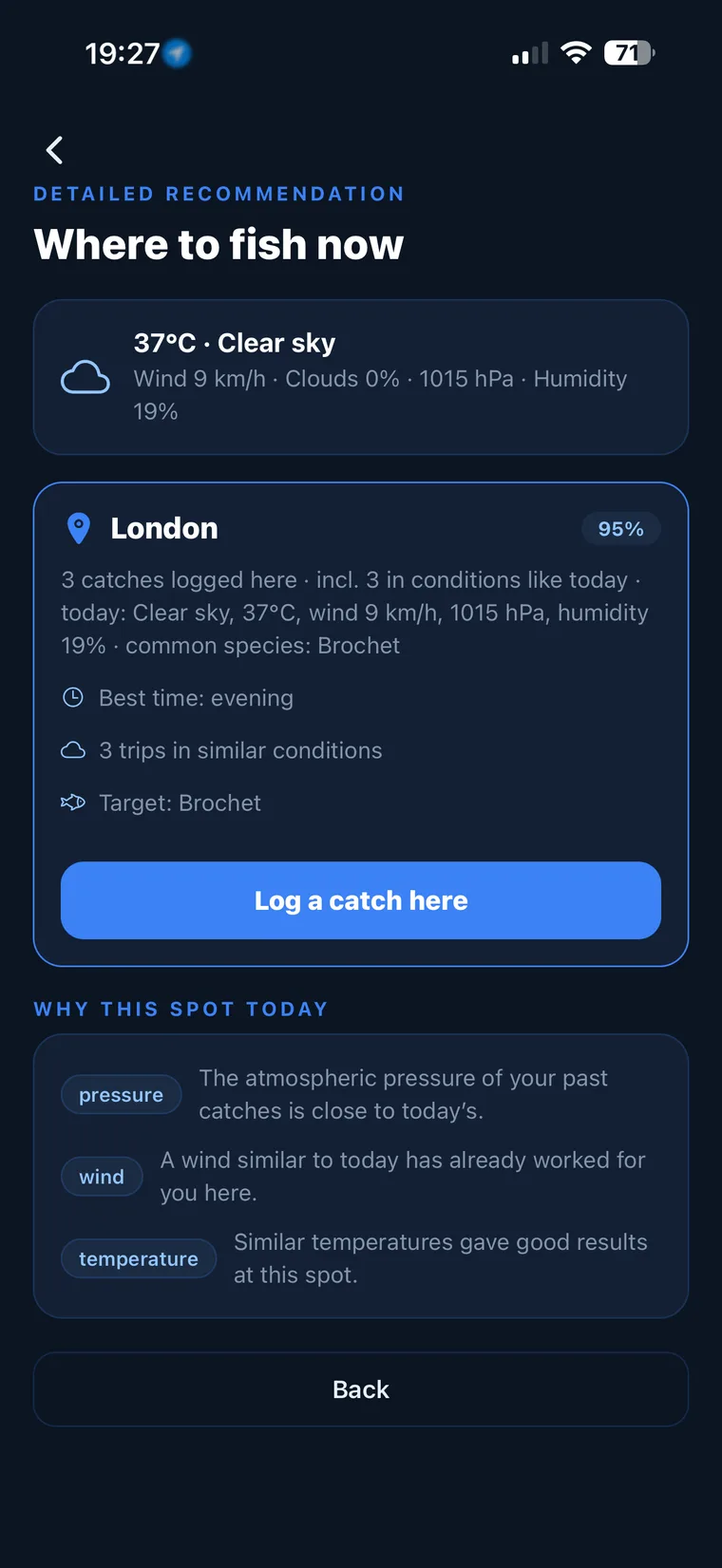
Not sure what to tie on?
Photograph your spot: CarnaFish reads the scene, cross-checks the conditions and gives you the zone, the lure and the retrieve. Free on iOS and Android.
Where it excels, and where not to expect much
The Skitter Walk shines in three precise contexts:
- Margins and shallow ground, when fish are feeding over less than two metres of water. That is the natural domain of topwater.
- Slightly choppy water, where a quiet popper gets lost. The click and the zigzag stay perceptible in the ripple.
- Visual searching: you cover a margin fast and you see the refusals, which tells you immediately what mood the fish are in.
It is a poor choice in several cases, though. Over deep, cold water the fish do not come up and you are fishing thin air. In surface weed and lily pads, the trebles snag constantly — a weedless frog such as the Spro Bronzeye is infinitely more relevant. And in very clear water, dead flat, on educated fish, the signal is sometimes too insistent: a quieter lure gets through better.
Skitter Walk or Zara Spook
The Heddon Zara Spook is the historic benchmark of the genre, and the comparison is enlightening. The Zara glides further on every snap and traces a wider zigzag: it covers more water, calls from further away, and demands a more regular movement to avoid tangling. It is the choice for big expanses and for anglers who already have the movement down.
The Skitter Walk zigzags tighter, forgives more and holds better on choppy water. It is also the better of the two for working one precise spot for a long time — along a jetty, on a rocky point, at the edge of weed — because it barely moves forward while you work it.
If you want even more noise to call from a distance in stained water, a Whopper Plopper takes over with a spinning tail and a straight retrieve. Our guides to sea bass fishing with lures and to choosing a pike lure place topwater within a complete strategy. And if you are unsure when to switch to the surface, CarnaFish analyses a photo of the spot and answers.
Key takeaways
- Short, stocky body: tight zigzag, fast pivot, a forgiving movement.
- Rod low, 15 to 25 cm wrist snaps, a quarter turn between each.
- Strike on felt weight, never at the sight of the attack.
- 8 cm for sea bass and wary fish, 11 cm for pike and wind.
- Avoid it over deep cold water or in dense vegetation.
FAQ
How do you get the walk the dog right with the Skitter Walk?
Keep the rod tip pointed at the water and give short, sharp wrist snaps, taking up a quarter turn of the handle between each. If the lure runs dead straight, your impulses are too soft; if it turns sideways, they are too close together.
Should you choose 8 or 11 cm?
The 8 cm suits sea bass on calm water and wary fish. The 11 cm casts better, stays visible in the chop and matches pike in the main season.
Do you need a wire leader for pike?
Yes if you fish among obstacles or in an area holding big fish: even thick fluorocarbon will not survive a sideways take. Choose a short, supple wire, which restricts the zigzag less than a rigid one.
Why do fish miss this lure so often?
On the surface, the attack comes from below and the fish has to judge a target that is zigzagging. Misses are normal: leave the lure still for a few seconds after the attack rather than striking at nothing or casting again.
Does the Skitter Walk work in the sea?
Yes, that is one of its favourite grounds. On rocky points and beaches, its stable float and internal click stay readable to a sea bass despite the swell and the chop.
Braid or mono to work it?
Braid, with a fluorocarbon leader. Mono stretches and absorbs part of the snap, which makes the zigzag soft and irregular, especially beyond twenty metres of line out.
The full sea bass lure guideSeason-by-season strategy: which family of lure, when, and why.Go from theory to fish
CarnaFish reads your spot from a photo and gives you the game plan: zone, lure, retrieve. Free on iOS and Android.