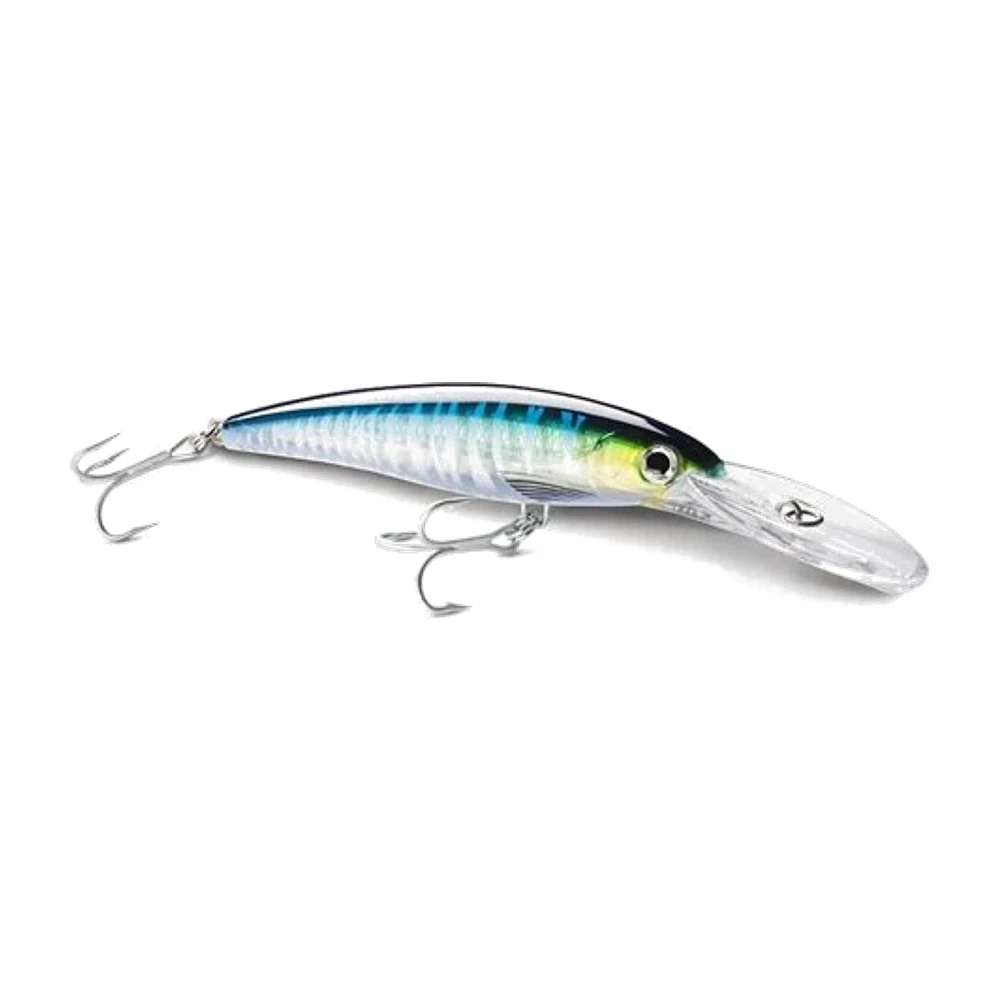
Rapala X-Rap Magnum: setting your trolling depth to the metre
Rather not fish it blind? Photograph your spot — CarnaFish cross-checks the conditions and points you the right way.
When you troll, the problem is almost never the lure. It is knowing where the lure is. You pass over a six-metre pinnacle, the sounder shows echoes pinned to the structure, and you have no idea whether your lure is working at three metres or at seven. You circle for an hour, catch nothing, and change colour — when the problem was vertical, not chromatic.
The X-Rap Magnum exists to remove that uncertainty. It is a range built around a single idea: each version is calibrated to reach a given depth and hold it, including at speeds where most minnows blow out. The numbers in the range are not sizes, they are target depths.
From there, the fishing changes in nature. You are no longer looking for a lure that works, you pick a water layer and sweep it.
What lets it hold a depth at 6 knots
Three elements, and they compensate for one another.
A long, thick, steeply angled lip. That is what takes the lure down, but above all it is sized not to flex under pressure. At trolling speed, a casting minnow's thin lip bends, which changes its angle of attack and pops the lure out of the water. Here, the stiffness holds the angle constant.
Substantial mass, carried low. The ballast pulls the body down and stabilises the roll. That is what stops the lure lying over when you accelerate to clear a channel.
An elongated body with a narrow beam. Less frontal volume, so less parasitic drag. The lure absorbs the speed in a tight roll instead of turning sideways.
The concrete result: you can troll between 4 and 7 knots without the action degrading. That is the useful range for sea bass over tide races, and it also lets you follow a boat that is searching rather than dictating a speed to your navigation.
The depth is not in the lure's name, it is on your spool
This is the point most anglers underestimate. The stated depth of a trolling diver assumes a given length of line let out. Let out thirty metres instead of sixty and you easily lose a third of the depth.
Four variables drive the result:
- The length of line let out. That is the main adjustment. The more you let out, the deeper you go — up to a plateau beyond which the angle of pull stops getting any lower.
- Line diameter. Fine braid offers far less resistance than thick mono. Going from 0.40 mm mono to 0.20 mm braid can gain a metre or two at the same length.
- Speed. Counter-intuitive: beyond a certain speed, a diver rises. Maximum depth comes at the bottom of the range, not the top.
- The weight of the snap and hooks. Marginal, but measurable on the light versions.
| Target version | Indicative line let out (fine braid) | Typical use |
|---|---|---|
| 3 m version | 25 to 35 m | Plateaus, rocky margins, surface feeding |
| 5 m version | 40 to 55 m | Gentle slopes, shallow pinnacles |
| 7 m version | 60 to 75 m | Tide races, steep edges |
| 9 m version and up | 80 m and beyond | Deep pinnacles, searching for settled fish |
These figures are starting points, not a table of truth. The right method stays empirical: let out your length, note it, and watch the sounder to see if the lure touches the structure. The day you snag, you know your real depth at that exact place — it is the most useful piece of information of the day.
On the water: when you do not know what depth the fish are at, do not change lure, change your line let out in ten-metre steps and give each step ten minutes. You are sweeping vertically through a zone you already know horizontally, which pays far better than churning through new ground at random.
The rig: what breaks and what holds
Trolling applies constant load, very different from casting and retrieving. Three points deserve attention.
The snap. Take it oversized and locking. A snap that opens under constant tension lets go at the worst possible moment, and it is by far the leading cause of lost lures when trolling.
The leader. One to two metres of 0.40 to 0.60 mm fluorocarbon. It absorbs the shock of a violent run and resists abrasion on teeth and structure. Stay reasonable on diameter: too thick and it drags, and you lose depth.
The hooks. The stock trebles are fine, but check their points every two or three trips. When trolling, a lure sometimes spends twenty minutes on the bottom without you noticing, and points blunt quickly on rock.
One last useful habit: check the lure's action behind the boat before you let line out. If it runs off to one side, a slight adjustment of the front ring with pliers, in the opposite direction to the drift, is enough to straighten it.
Not sure what to tie on?
Photograph your spot: CarnaFish reads the scene, cross-checks the conditions and gives you the zone, the lure and the retrieve. Free on iOS and Android.
Where it is at its best, and where it is off the mark
It excels when depth is the main variable:
- Isolated pinnacles and shallow banks, where the fish are pinned to the structure and passing two metres too high gives you nothing.
- Steep edges and slopes, following the contour at constant speed.
- Searching unknown ground, where covering water fast counts more than finesse of presentation.
- Rough water, where its mass lets it keep its action when a light lure would become unmanageable.
On the other hand it is unsuited to casting from the shore: its weight and its lip make it a chore to cast with a bank rod, and its action needs speed to express itself. It is equally off the mark on apathetic fish in cold water, which will not follow a lure passing at 6 knots, and on heavily cluttered spots where a diving lip finds every obstacle.
X-Rap Magnum or a casting diver
The classic confusion is taking a casting diver and trolling it. It works, badly, and it shows up in the speed range.
An Illex Depth Raider is a diver designed for casting and retrieving: it gets down fast over a short distance and handles a variable retrieve, with twitches and stops. On a long, fast troll its useful speed range is narrower and its action degrades sooner.
The X-Rap Magnum does the opposite: it does not like stops, it likes constant speed and continuous pull. If your plan is to cast from the shore, take a Rapala Max Rap Long Cast instead, built for casting distance. Our guide to sea bass fishing with lures explains when trolling beats casting. And if you are unsure what depth to target when you arrive over a pinnacle, CarnaFish analyses a photo of the spot and answers.
Key takeaways
- The versions in the range correspond to target depths, not to sizes.
- Real depth depends above all on line let out and diameter: fine braid, and note your length.
- Useful trolling range between 4 and 7 knots; beyond that the lure rises instead of diving.
- Oversized locking snap and 0.40-0.60 mm fluorocarbon: that is where things break.
- When nothing bites, change your line let out in ten-metre steps before you change lure.
FAQ
How deep does an X-Rap Magnum really run?
The stated depth assumes a long length let out and fine line. With only thirty metres of line you easily lose a third of the figure. Count on 25 to 35 m of braid for a 3 m version, 60 to 75 m for a 7 m version.
What speed should you troll at?
Between 4 and 7 knots. The action stays stable across that whole range. To reach maximum depth, stay at the lower end: beyond that, pressure makes the lure rise.
Braid or mono for trolling?
Braid as the main line, with a 0.40 to 0.60 mm fluorocarbon leader. Braid, finer for the same strength, creates less drag and gains you a metre or two of depth at the same line let out.
Can you cast an X-Rap Magnum from the shore?
It is possible but uncomfortable: the mass and the lip make the cast heavy, and the lure needs speed to swim properly. For casting from the bank, a minnow designed for distance will suit better.
How do you know if your lure is touching bottom?
The rod tip loads in jerks and the braid transmits sharp, irregular knocks. Note the length you had out that day over that structure: you get a real measurement of your depth, more reliable than any table.
What colour should you choose for inshore trolling?
Natural sandeel or mackerel patterns in clear water and normal light. In coloured water or under heavy cloud, switch to a higher-contrast finish: at 6 knots the fish has to decide fast, and contrast beats realism.
The full sea bass lure guideSeason-by-season strategy: which family of lure, when, and why.Go from theory to fish
CarnaFish reads your spot from a photo and gives you the game plan: zone, lure, retrieve. Free on iOS and Android.