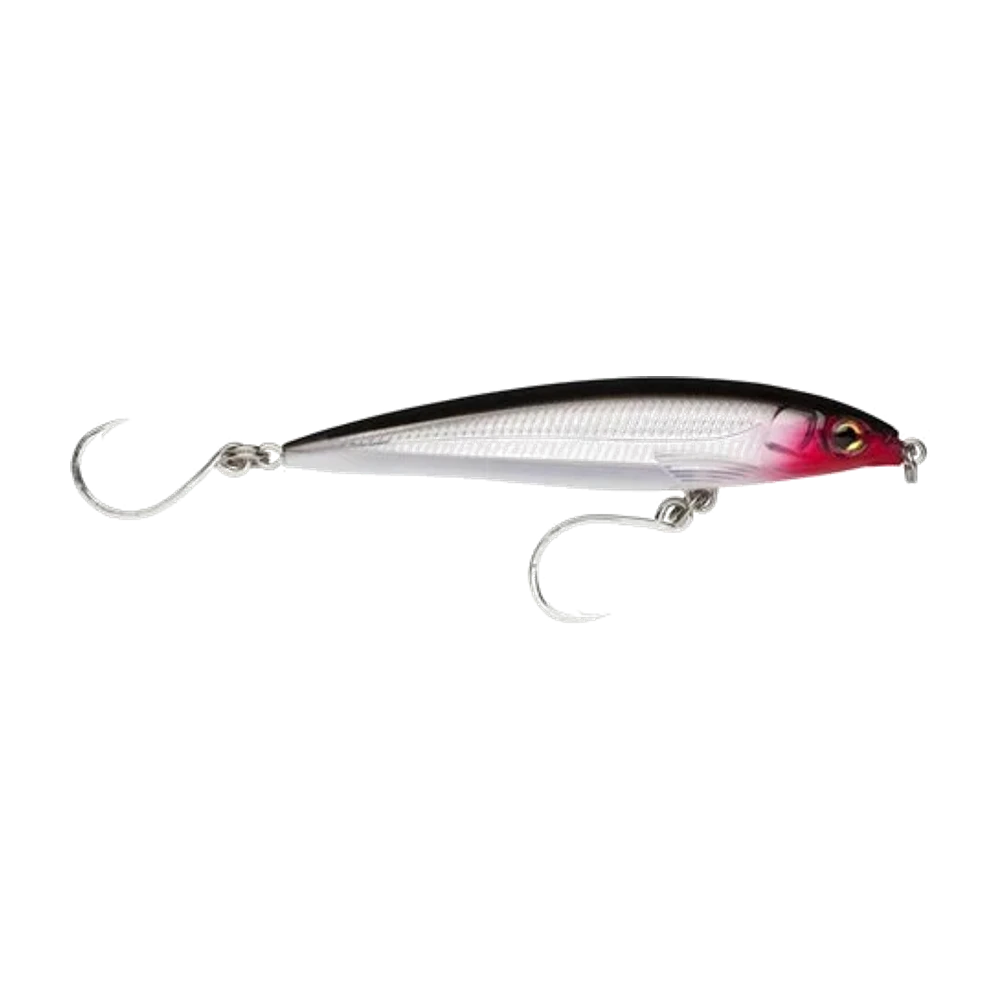
Rapala MaxRap Long Cast: winning the ten metres you are missing from the shore
Before tying this one on, it helps to know if the spot actually calls for it. CarnaFish reads the scene from a photo.
The bass are feeding on the outer bar, forty metres out. You are on the sand with an 11 cm minnow that helicopters as soon as there is a quartering wind and lands at twenty-five metres. You can see the fish, you cannot reach them. It is the commonest frustration in shore fishing for bass.
The problem is almost never the rod. It is the lure: a standard minnow has its mass spread over its whole length, so it flies sideways, offers a grip to the wind and stalls at the first gust. The MaxRap Long Cast fixes that with a sliding weight that shifts to the rear on the cast, then returns to the swimming position once the lure is in the water.
The result is not spectacular to watch, but it is counted in metres: on the same rod, with the same line, you typically gain fifteen to twenty per cent of distance, and above all you keep that distance when the wind gets up.
What the weight transfer actually does
The moment you release, an internal weight slides towards the tail of the lure. Three effects follow.
- The lure stabilises in flight. It goes out like an arrow, nose first, instead of tumbling. A lure that spins loses most of its energy in the first twenty metres.
- The centre of gravity moves back, which increases useful range for the same casting energy.
- The weight returns to the front on impact, putting the lure back into its swimming position from the first turns of the handle. That return is what separates a well-designed system from a lure simply weighted in the tail, which would swim off-kilter.
In practice you notice it mostly by sound: a well-cast MaxRap Long Cast makes a steady whistle, not the irregular flapping of a lure helicoptering.
Setting up the cast to benefit from it
The system does not make up for poor technique. Three points to watch.
- Let out about thirty to forty centimetres between lure and rod tip before loading. Too short and you lose the whip effect; too long and you lose control.
- Push the cast rather than snapping it. The weight transfer needs progressive acceleration to happen cleanly. A brutal flick of the wrist sends the weight forward too early.
- Feather the spool at the end of the flight with your index finger. The lure lands flat, the slack stays short, and you are in contact from the first turn.
A 0.35 to 0.45 mm fluorocarbon leader is a good compromise: strong enough for rock and shellfish, fine enough not to cancel out the distance gain. On thin braid — 0.12 to 0.16 mm — the difference in range is sharper still.
On the water: when the wind is quartering from behind, do not cast high. A flat cast, almost parallel to the water, carries further than a lofted one, because the lure stays under the strongest layer of wind. It is counter-intuitive but it holds up every session.
The retrieve in the surface layer
This lure runs high, between thirty centimetres and a metre. That is deliberate: it is the zone where bass come up to feed on shoals of fry, especially at the turn of the tide.
A sustained straight retrieve is the baseline. Wind at medium-fast speed, rod high if you want to hold the lure even closer to the surface, rod low to make it work a little deeper. On a feeding fish, do not slow down: bass are perfectly happy with prey that flees fast.
Short pulls with a restart come in when the feeding stops. Two brief taps of the rod tip, then three turns of the handle, then repeat. The lure kicks sideways, straightens up, and that break triggers followers.
A sawtooth retrieve works in the surf: speed up on the top of the wave, slow down in the trough. That stops the lure blowing out and leaving the water.
Not sure what to tie on?
Photograph your spot: CarnaFish reads the scene, cross-checks the conditions and gives you the zone, the lure and the retrieve. Free on iOS and Android.
When it works and when to put it away
It is at its best on bar beaches and rocky points in a decent sea, when you need to reach a distant zone, and at dawn and dusk, when bass rise into the upper layer.
It is poorly suited in three situations. In less than a metre of water over cluttered bottom, it snags quickly. On a bass glued to the bottom in midwinter, it passes too high: a shad on a jig head will be more accurate. And in rivers or estuaries with strong current, its tight swim blows out easily when you retrieve against the flow — you then have to fish across it.
MaxRap Long Cast or a surface stickbait
A stickbait such as the Xorus Patchinko 140 also casts a very long way and stays entirely on the surface: it creates a stronger visual signal, but it requires the fish to agree to come all the way up. That is the choice for visible feeding and a calm sea.
The MaxRap Long Cast works just under the surface. It stays effective when bass are active without feeding openly, when chop makes a surface lure unreadable, and it is far easier for a beginner to fish: a steady retrieve is enough, whereas a stickbait demands a mastered walk. For a more pronounced mid layer, a slim minnow such as the Duo Tide Minnow Slim will run a little deeper with a wider swim.
Our guide to lure fishing for sea bass covers how to read spots and tide times. And if you are unsure what to tie on when you arrive at the beach, CarnaFish analyses a photo of the spot and answers.
Key takeaways
- The sliding weight stabilises the lure in flight: the gain shows up most in a headwind.
- Push the cast, do not snap it, or the weight transfer will not happen.
- Working zone between 30 cm and 1 m: this is a top-layer lure, not a deep searcher.
- Feather the spool at the end of the flight so the lure lands flat and you are in contact at once.
- Unsuitable for bass glued to the bottom, or retrieved straight into strong current.
FAQ
Does the MaxRap Long Cast really cast further?
Yes, thanks to a sliding weight that shifts back on the cast and stabilises the lure in flight. The gain is modest in calm conditions but becomes very clear in a head or cross wind, the situation where a standard minnow starts to spin.
How deep does it run?
Between about thirty centimetres and a metre. With the rod high you hold it closer to the surface; with the rod low and a faster retrieve you gain a few tens of centimetres.
What rod and line should I use?
A 2.70 to 3.00 m sea rod rated 10-40 g, a 0.12 to 0.16 mm braid and a 0.35 to 0.45 mm fluorocarbon leader. Heavier braid cancels out a good share of the distance gain.
What retrieve speed for bass?
Sustained. Unlike freshwater, slowing down does not always pay with bass: prey fleeing fast triggers feeding fish well. Only slow down when activity drops off.
Snap or straight knot?
Both work. A fine snap makes changes easy and does not spoil the swim; a straight knot stays slightly more discreet in very clear water. Avoid heavy snaps, which drag the nose down.
Can it be used in freshwater?
Technically yes, on big windy lakes where distance matters. But its tight swim and very high working zone make it less versatile than freshwater minnows for pike or perch.
The full sea bass lure guideSeason-by-season strategy: which family of lure, when, and why.Go from theory to fish
CarnaFish reads your spot from a photo and gives you the game plan: zone, lure, retrieve. Free on iOS and Android.