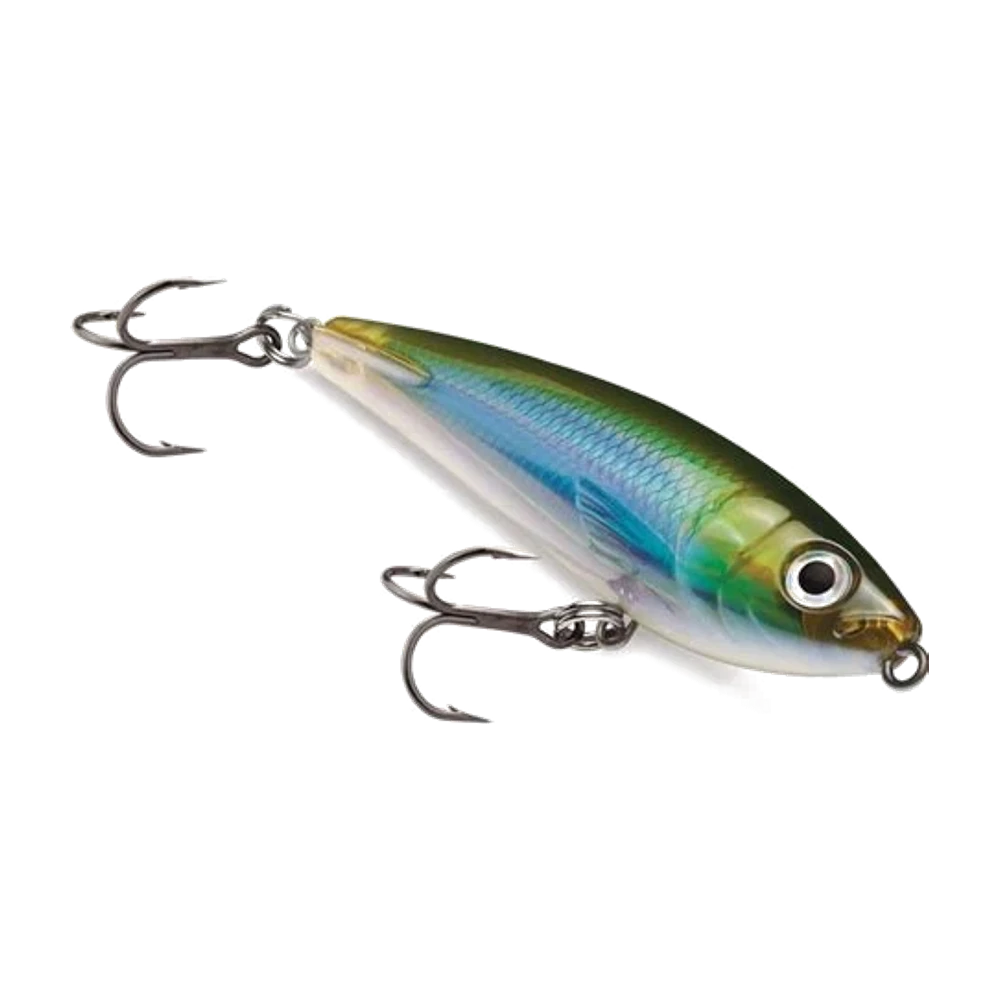
Rapala X-Rap SubWalk: the walk the dog that happens underwater
The right lure in the wrong spot still catches nothing. CarnaFish spots the zone that works, from a single photo.
There is one situation that drives you mad: the fish reacts to your topwater, you see the swirls, you hear the strikes — and you hook nothing. Three attacks, zero fish. The bass shoulders the lure without taking it, the pike rolls underneath it and leaves.
It is almost never a hookset problem. It is a depth problem. A fish that is not fully committed attacks from below, brakes at the last moment, and stops just short of breaking the surface. The lure stays in the air, the fish stays in the water, and the two never meet.
The SubWalk closes that gap in a very simple way: it does exactly the same zigzag as a walking bait, but thirty to fifty centimetres lower. The fish that brakes finds the lure right where it stops.
A zigzag that no longer depends on the state of the surface
A topwater stickbait needs a clean water-air interface to pivot. As soon as chop builds, the lure is alternately in the wave and in the trough, and the zigzag falls apart. That is why topwater becomes unusable beyond a certain wind strength, even when the fish are feeding.
Below the film, that problem disappears. The SubWalk works in a homogeneous mass of water: its zigzag keeps the same amplitude in twenty knots of wind as it does on a flat calm. In practice, you gain whole fishing days that topwater would have wasted.
A second, less obvious effect: the lure stays permanently visible to a fish sitting below it, whereas a topwater is only a silhouette distorted by the mirror. The reflective flank works on every pivot, replacing noise with a visual signal.
The countdown, your only depth control
The SubWalk sinks slowly. That is what hands you control of the running depth: you decide how deep to fish at the moment you start working it, not before.
| Sink time after splashdown | Approximate running depth | Use |
|---|---|---|
| None, straight into the retrieve | 15 to 30 cm | Fish feeding on top, shallow water |
| 3 seconds | 40 to 60 cm | Default setting on active bass |
| 6 to 8 seconds | 80 cm to 1.2 m | Fish that follow without rising, cold water |
| 12 seconds and more | 1.2 to 1.5 m | Deeper flats, pike sitting on submerged weed |
Once the retrieve is under way the lure rises very slightly. Over a long retrieve, give it a one-second pause every ten seconds so it settles back into its layer.
On the water: when you miss several attacks in a row, do not downsize the lure and do not change colour. Add three seconds of countdown. Nine times out of ten the fish was attacking properly, just fifteen centimetres below where you were working the lure.
The retrieve: soft and continuous
- Cast and count according to the depth you want. Keep the line semi-tight on the drop: a bite on the fall is not unusual, especially from pike.
- Drop the rod to forty-five degrees towards the water, tip pointed at the lure.
- Give soft wrist glides, at a steady rhythm, around two a second. The motion is noticeably softer than on top: underwater, the lure needs less energy to pivot.
- Take up the slack between glides, without ever pulling the line properly tight. A tight line turns the zigzag into a straight line.
- Slip in a one to two second stop every five or six glides. The lure sinks while holding its attitude: that is the phase in which a follower decides.
One rigging detail governs everything else: the connection. A round snap lets the lure pivot freely on its attachment point, and that degree of freedom is what allows the change of direction. A knot tied tight to the split ring restricts the start of the turn and softens the zigzag into a lazy path.
The hardest thing to learn is the dosage. An angler used to topwater walking baits gives glides that are too sharp, pulling the SubWalk out of its running plane or spinning it on itself. Halve your amplitude and increase the regularity.
Conversion rate, the real reason to tie one on
With a topwater, a fish has to commit completely to make contact. It crosses the interface, turns over, and often misses the trebles. Underwater it does not have to make that move: it eats in its own swimming plane, and the hooks are inside its mouth rather than above it.
In practice, over a single day on bass, the ratio of converted attacks swings clearly in favour of subsurface as soon as the fish are not feeding frantically. The price is that you lose the show, and above all you lose the visual information: you no longer see the refusals, so you have to read the situation blind.
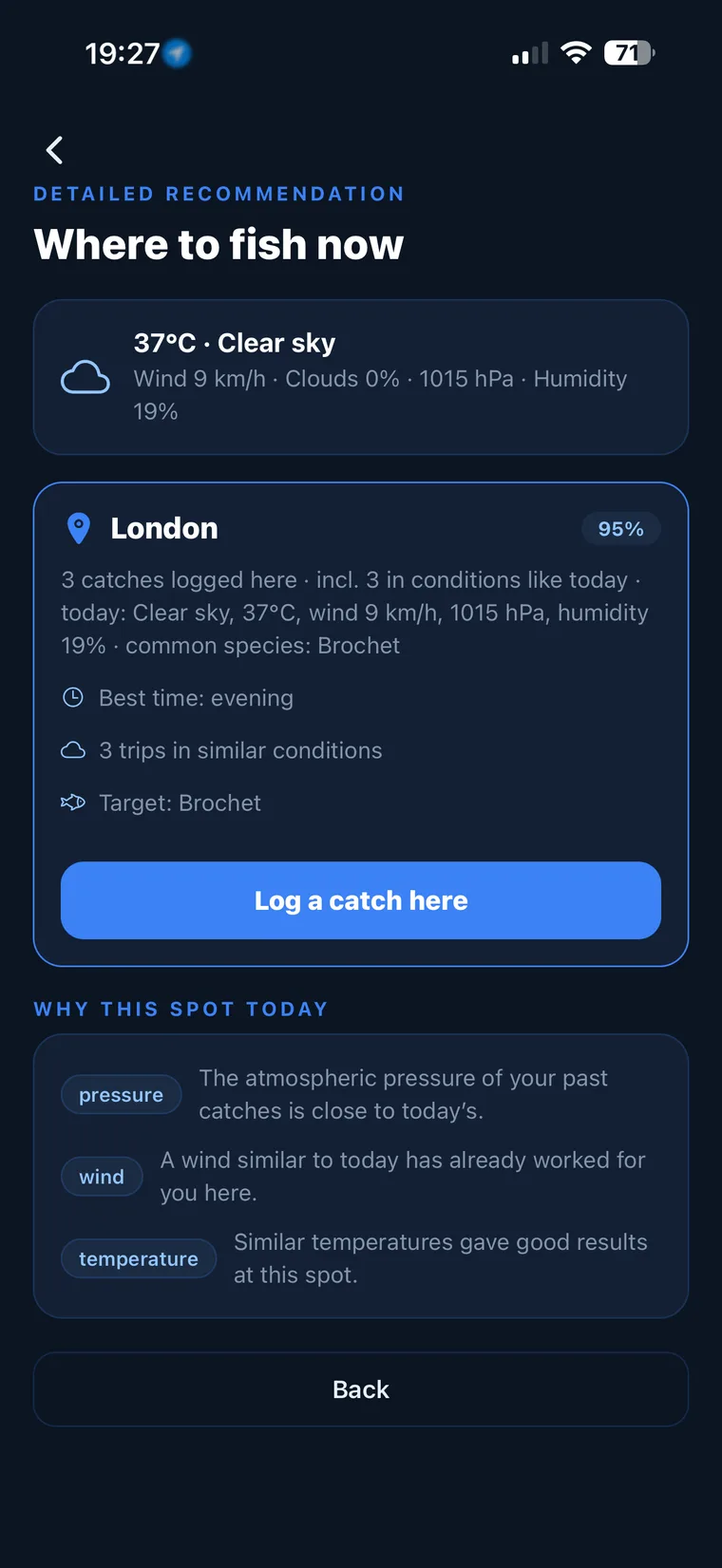
Not sure what to tie on?
Photograph your spot: CarnaFish reads the scene, cross-checks the conditions and gives you the zone, the lure and the retrieve. Free on iOS and Android.
Where it does not belong
- Very shallow, cluttered water: it sinks, so it snags. In less than fifty centimetres of water over weed, a floating lure is the only option.
- Fish smashing bait on the surface: when it is boiling, a topwater gets just as many bites and brings the fish in faster.
- Fast searching: the glide rhythm forces a slow retrieve, so you cover little ground.
- Strong cross current: the lure drifts and the zigzag deforms; a minnow or a weighted lure swims through it better.
SubWalk or floating walking bait
The Rapala MaxRap Walker covers the other half of the problem: it stays on top, it calls from a distance, and it works when the fish are willing to come up. The Rapala Skitter Walk, shorter and more forgiving of your technique, plays the same role with a wider margin for error.
The SubWalk is not their replacement, it is their logical follow-up: you start on top, and as soon as you count two or three refusals you switch to the SubWalk without changing spot or technique. The motion is the same, only the depth changes. Our guide to lure fishing for sea bass covers that sequence. And if you are unsure which layer of water to attack when you arrive at a spot, CarnaFish analyses a photo of it and answers.
Key takeaways
- Same zigzag as a walking bait, but 30 cm to 1.5 m below the surface.
- The countdown after splashdown is your only depth control: three seconds by default.
- Soft, closely spaced glides, rod low, line never fully tight.
- It converts better than topwater as soon as fish attack without committing.
- It snags in very shallow water and loses its point when fish are properly smashing bait on top.
FAQ
How deep does the X-Rap SubWalk run?
From 15 to 30 cm if you start working it the moment it lands, and down to 1.2 or 1.5 m if you let it sink for a dozen seconds. You set the depth with the countdown; the lure will not get there on its own.
How do I get the zigzag underwater?
Rod low, soft wrist glides at around two a second, and take up the slack between each one. The motion is softer than on top: glides that are too sharp pull the lure out of its running plane.
Does it work for pike?
Yes, particularly over submerged weed at a metre or a metre and a half, where pike rise little but react to a profile zigzagging just above them. Use an abrasion-resistant leader.
Do I need a wire leader for pike?
On confirmed pike water, yes, or failing that a heavy fluorocarbon of 0.60 to 0.80 mm, which many anglers accept. Teeth find braid easily during a lateral glide, when the lure presents itself side on.
Can it be fished on a straight retrieve?
You can, but you lose the point: wound in straight it swims straight, with no zigzag. If you want a straight swimming action, a sinking minnow does the job with less effort.
What do I do when it spins during the retrieve?
That is the sign of glides that are too violent, or a line held permanently tight. Reduce the amplitude, leave a little slack between glides, and check the snap has not been bent forward.
The full sea bass lure guideSeason-by-season strategy: which family of lure, when, and why.Go from theory to fish
CarnaFish reads your spot from a photo and gives you the game plan: zone, lure, retrieve. Free on iOS and Android.