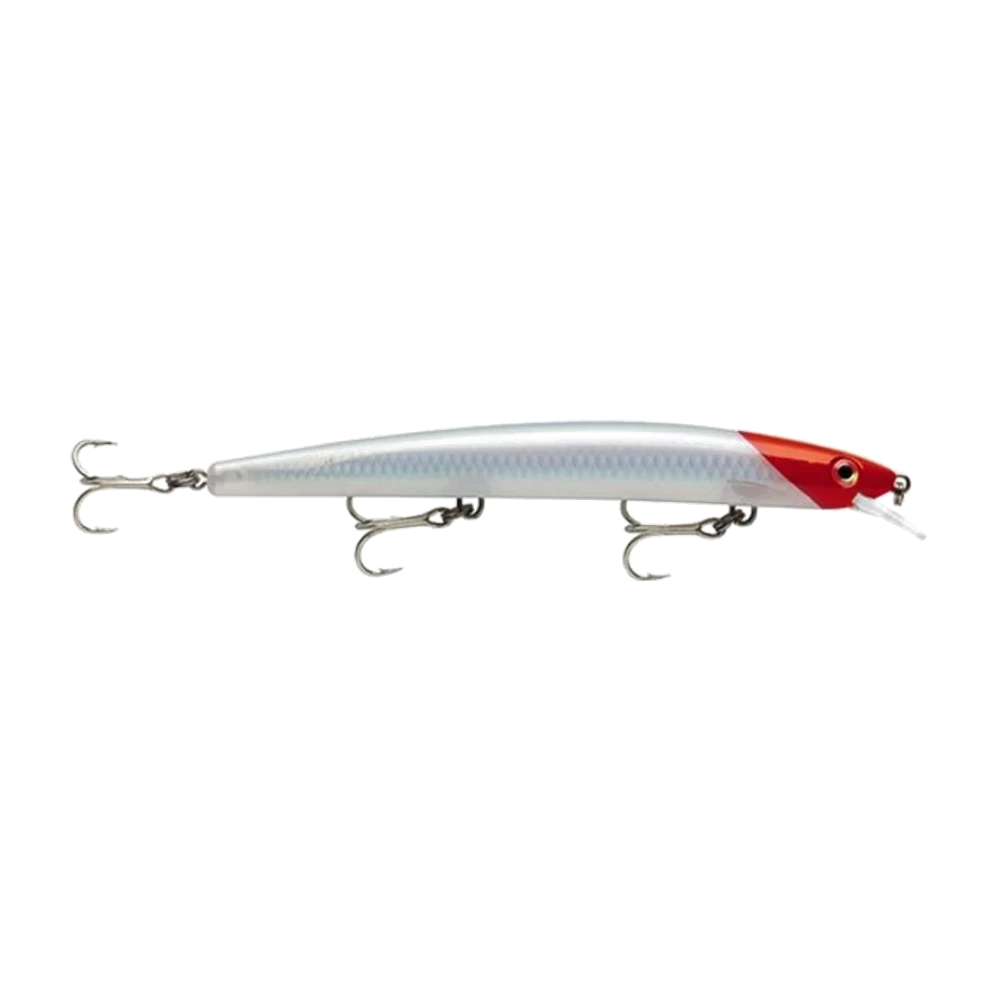
Rapala MaxRap Walker: the walking bait that reaches out
Before tying this one on, it helps to know if the spot actually calls for it. CarnaFish reads the scene from a photo.
The fish are up, but they are sixty metres out. Birds dropping, splashes, obvious activity — and your surface stickbait lands twenty metres short. By the time you have wound in and cast again, the feeding has moved.
That is the real limit of most topwater lures: they are light for their volume, they catch the wind, and they do not carry. Walking the dog stays a margin technique when it would be deadly further out.
The MaxRap Walker is built around that precise problem. Thirteen centimetres, a little over twenty grams, a minnow profile rather than a cigar: it casts like a sinking lure while remaining a floating walking bait.
A minnow profile, not a cigar
Most walking baits take the shape of the historic stickbait: a round-sectioned body, thick in the middle, that pivots almost on the spot. That geometry produces a tight zigzag and a lot of water displacement, but it brakes on the cast.
The MaxRap Walker starts from a very different profile, tapered, closer to a sandeel than a cigar. The consequences are direct:
- It cuts through the air far better, so it carries a long way and handles a headwind.
- The zigzag becomes a long glide: the lure kicks firmly sideways and covers distance on every jerk instead of sitting still.
- The silhouette matches elongated prey — sandeel, garfish, needlefish — which triggers bass feeding high.
- The return to centre is clean, which lets you link jerks without letting the lure wander off line.
Gliding rather than pivoting: what it changes in the retrieve
- Cast beyond the feeding fish and slightly ahead of the direction they are moving, never on top of them.
- Drop the rod parallel to the water, tip pointed at the lure, arms low.
- Link sharp but short jerks, about one every half second, taking half a turn of the handle between each. The movement comes from the wrist, not the forearm.
- Do not look for a tight zigzag. On this lure, a well-delivered jerk produces a glide of sixty centimetres to a metre sideways. That amplitude is what you should hear and feel.
- Put in a one-second stop every six or seven jerks, especially at the end of the retrieve near the boat or the bank, where followers make up their minds.
That retrieve covers far more ground per minute than a classic walker. On mobile feeding fish, it is decisive: you stay in the fish instead of chasing them.
On the water: on a feeding shoal, do not aim at the centre of the boil. Cast three to five metres in front, ahead of the movement, and let the fish come to your lure. The big ones are almost always on the edge and underneath, not in the middle of the commotion where the small ones are.
Cadence and amplitude for what you are targeting
| Situation | Cadence | Amplitude of the movement |
|---|---|---|
| Bass actively feeding on sandeels | fast, 2 jerks per second | short, tight glides linked together |
| Bass sitting on a flat, calm water | slow, 1 jerk per second | wide, with 1 to 2 s pauses |
| Pike on a weed bed edge | slow and steady | wide, long glides, marked pauses |
| Cross wind or chop | sustained | short and sharp, to keep contact |
The underlying rule: the more active the fish, the faster and tighter you go. The more they hesitate, the longer you make the glides and the pauses.
A useful check for correcting yourself: look at the wake. A well-worked walker leaves two clearly separated zigzag tracks behind it. If you only see a straight line with a few wobbles, your jerks are too close together or your line has stayed permanently tight. Give a little slack and space the movement out, without changing its force.
Two adjustments that make the difference
The connection. A round snap is clearly preferable to a straight knot: it lets the lure pivot freely on its tow point, and that degree of freedom is what allows the glide. A tight knot on the ring kills the start of the turn.
The leader. A 0.40 to 0.50 mm fluorocarbon is a good compromise at sea: strong enough to take a brutal attack at close range, supple enough not to restrict the action. Heavier and you stiffen the whole thing, and the glides shorten.
Not sure what to tie on?
Photograph your spot: CarnaFish reads the scene, cross-checks the conditions and gives you the zone, the lure and the retrieve. Free on iOS and Android.
Where you should tie on something else
- Short, precise spots: under a branch, in a two-metre hole in the weed, you have no room to exploit metre-long glides.
- Very shallow, cluttered water: the two trebles find everything that sticks up.
- Fish that swipe without committing: if you are stacking up refusals, the problem is the water layer, not the topwater lure.
- Small fish dominating: at thirteen centimetres, you are sorting sizes. That is an advantage if you want good fish, a handicap if you just want to get bites.
MaxRap Walker, Skitter Walk or Super Spook
The Rapala Skitter Walk is shorter and more forgiving: it tolerates a rough movement and pivots almost on the spot, which makes it better on a precise spot and for learning the technique. The MaxRap Walker demands a more accurate movement but covers three times the ground.
The Heddon Super Spook plays in another register again: a big volume, a deep rattle and a call that carries far in stained water. The MaxRap Walker is more discreet and finer, so better in clear water and on wary fish. Finally, the Lucky Craft Sammy 100 remains the reference when you need to slow down and work a single square metre.
If you are stacking up missed hits on the surface, the problem is not the choice between these models: drop thirty centimetres. Our guide to lure fishing for sea bass covers the time windows when topwater beats everything else. And if you are unsure which surface lure to tie on when you reach the bank, CarnaFish analyses a photo of the spot and answers.
Key takeaways
- Tapered body and 21 g: it casts much further than a classic walker and handles wind.
- It glides instead of pivoting: 60 cm to 1 m per jerk, so a lot of ground covered.
- Rod low, wrist only, one jerk every half second when searching.
- A round snap is compulsory so the lure can start its turns.
- A poor choice on short, precise spots, where a more compact walker does better.
FAQ
Is the MaxRap Walker hard to work?
It asks for a more regular movement than a short walker, but the amplitude of its glides makes mistakes obvious straight away. Rod low, wrist only, half a turn of the handle between each jerk: the rhythm comes in a few minutes.
How far can it be cast?
Its slim profile and 21 g put it among the topwater lures that carry the furthest, including in a quartering headwind. That is exactly the reason to pick it when feeding fish are showing well out.
Does it work for pike?
Yes, on weed bed edges and shallow flats, with a slower cadence and marked pauses. Add an abrasion-resistant leader, as pike often attack sideways during a lateral glide.
Do I need a snap?
Yes. A tight knot straight onto the nose ring restricts the start of the turn and shortens the glides. A moderately sized round snap restores the pivoting freedom you need.
What colour at sea?
A silver flank with a blue or green back in most cases, a dark back when you are fishing against the light since the fish only sees a silhouette, and brighter tones under a low sky or in coloured water.
What if fish hit it without getting hooked?
Change neither size nor colour: change the water layer. A stickbait working just under the surface catches those fish that brake before breaking through, and converts far better.
The full sea bass lure guideSeason-by-season strategy: which family of lure, when, and why.Go from theory to fish
CarnaFish reads your spot from a photo and gives you the game plan: zone, lure, retrieve. Free on iOS and Android.