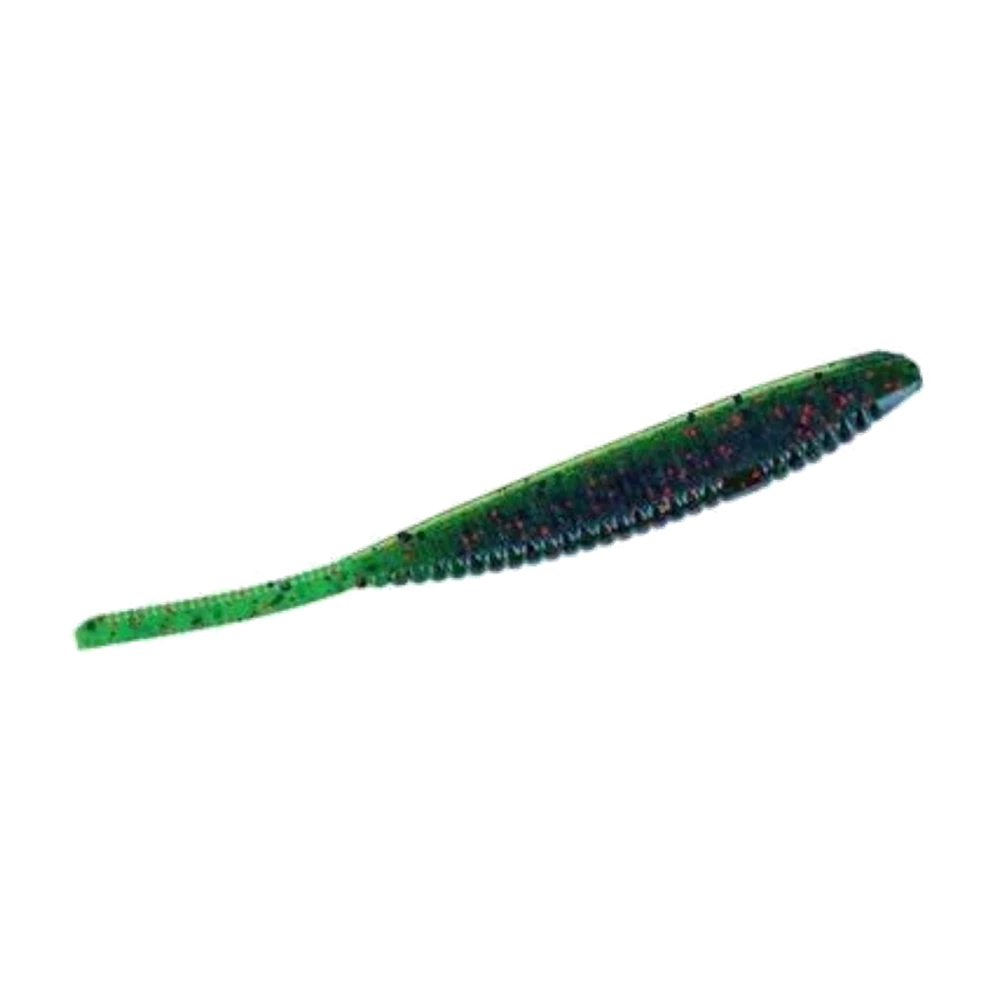
Gary Yamamoto Shad Shape Worm: the flat body that glides instead of dropping
The right lure in the wrong spot still catches nothing. CarnaFish spots the zone that works, from a single photo.
Take two soft plastics, drop them side by side in a metre of clear water and watch them sink. A standard shad drops straight and fast, tail beating steadily. The Shad Shape Worm does something else: it sinks twice as slowly, it slides off to one side, and it barely oscillates. It does nothing spectacular — that's precisely the argument.
On heavily fished water, in high summer, on bass or big perch that have watched vibrating shads go past all season, the absence of a signal becomes an advantage. The fish has nothing to analyse, nothing to find suspicious. It sees the silhouette of a small fish sinking gently and crookedly, like a wounded or dead baitfish, and it comes up.
That is this bait's entire territory: the situations where not vibrating is what makes fish bite.
A flattened section, and what it does on the fall
The Shad Shape Worm's body isn't cylindrical. It's flattened laterally, with a tall, thin section and a small tapered tail.
Three hydrodynamic consequences:
- The lifting surface is large relative to the mass. On the fall, the body leans on the water like a leaf, which slows the descent noticeably.
- The path skews. A flat body doesn't drop straight down: it slides to one side, sometimes the other, over twenty to fifty centimetres. That drift takes the bait out of your casting line, and a fish sitting off to the side sees it coming towards him.
- The tail quivers without kicking. It transmits no vibration to the rod tip, but it moves constantly under the slightest displacement of water. It's a very short-range visual signal, exactly right for finesse fishing.
The material, a soft plastic heavily loaded with salt, adds two things: a density that lets you fish with very little weight, and a softness that makes the fish hold the bait a moment longer.
Four rigs, four different problems
This bait only has the action its rig gives it. Choosing the rig isn't a detail, it's half the decision.
| Rig | Situation | What you're after |
|---|---|---|
| Drop shot, 3 to 10 g weight | Fish off the bottom, vertical or cast | Bait held at depth, quivering on the spot |
| Split shot, 1 to 3 g at 40 cm | Gentle margin, clean flat | Slow pull, gliding fall after every lift |
| Wacky, hook through the centre | Holding fish, vertical structure | Both ends quivering on the way down |
| Weightless Texas | Weed, drowned timber, lily pads | Snag-free passage, very slow fall |
The drop shot is still the most versatile rig with this shape, because it makes direct use of the bait's strength: staying credible while barely moving. The rig itself is covered in our drop shot guide.
For line, stay thin: 0.16 to 0.22 mm straight fluorocarbon, or 0.06 to 0.08 mm braid with an equivalent fluorocarbon leader. Diameter has a real effect on the fall — thick line brakes and straightens the descent, which kills the sideways drift you're looking for.
On the water: with this bait, never take up slack during the fall. Your line has to stay slightly loose, otherwise a tight line turns the gliding descent into a regular arc back towards you — you lose the lateral drift, which is exactly what separates it from an ordinary soft plastic. Pick up the slack only after bottom contact.
The rhythm: count, don't animate
The most common mistake is treating this bait like a shad and forcing a retrieve on it.
- Cast past the spot you're aiming at, so you arrive over it on the drop rather than under tension.
- Give line immediately and let the bait sink on a slack line. Watch the line.
- Wait for bottom contact, or the count matching the depth band you want on a drop shot.
- Three to five seconds of stillness, doing nothing. On a drop shot, simply moving the rod is enough to make the tail quiver.
- One slow twenty to thirty centimetre pull, then give line again for another gliding fall.
- Repeat, counting pauses rather than turns of the handle.
Counting the pauses is the only genuinely useful adjustment. On active fish, three seconds is enough. On fish in the middle of an August day, go up to ten or fifteen seconds — it's long, it's boring, and it catches fish.
Not sure what to tie on?
Photograph your spot: CarnaFish reads the scene, cross-checks the conditions and gives you the zone, the lure and the retrieve. Free on iOS and Android.
Its conditions, and the ones where it's useless
It makes sense:
- In clear, calm water, where the silhouette and the slowness register.
- On fish that have already been fished for, which refuse vibrating shads and active lures.
- In high summer and deep winter, the two thermal extremes where fish barely move.
- On precise vertical spots: dock pilings, stumps, rock walls, weed edges.
- On big late-season perch, often easier to convince on a drop shot than on a straight retrieve.
And it's useless in three cases. In coloured water, its lack of vibration makes it undetectable beyond a metre. In noticeable current, the gliding fall stops existing and the bait flattens out. And for searching a large area, its rhythm of three minutes per cast makes coverage impossible — you have to locate with something else first.
Shad Shape Worm or Senko: two very different falls
The comparison is unavoidable since both come from the same house and share the same salted plastic.
The Yamamoto Senko 4 is a round-section stick worm. Its fall is vertical, with the characteristic shimmy from both ends that built its reputation, especially on a wacky rig. It drops faster, puts out a stronger signal, and it's deadly on fish that respond to a decisive fall.
The Shad Shape Worm offers the opposite: the profile of a small fish rather than a stick, a slower and above all skewed fall, and an even more discreet signal. Where the Senko imitates something falling, this one imitates something gliding.
In practice you choose on what the fish are eating: Senko when bass are on bottom prey or crayfish, Shad Shape Worm when they're on baitfish and refusing active imitations. Our beginner's guide to bass fishing explains how to read that difference on a given water. And if you're unsure which rig to pick when you reach a margin, CarnaFish reads a photo of the spot and answers for you.
Key takeaways
- The flattened body slows the fall and skews it sideways by 20 to 50 cm: that's the core mechanism.
- No vibration of its own. The absence of a signal is the argument on educated fish.
- Slack line through the whole descent, otherwise you delete the drift.
- The rig makes the action: drop shot to hold a depth band, split shot to search slowly, wacky on vertical structure.
- Ineffective in coloured water, in current, and for covering large areas.
FAQ
Why does the Shad Shape Worm sink crookedly?
Because its body is flattened laterally. That section gives a lot of lift for little mass, which slows the fall and makes the bait slide sideways instead of dropping straight down.
Which rig should I start with?
The drop shot with a 3 to 10 g weight. It's the rig that makes the most of the bait's ability to stay credible while almost motionless, and it works just as well on bass as on big perch.
How long should the pauses be?
Three to five seconds on active fish, ten to fifteen seconds in high summer or in cold water. It's the most rewarding adjustment in this style of fishing: before you change bait or colour, lengthen the pauses.
What's the difference with a Senko?
The Senko is round and drops vertically with a pronounced shimmy from both ends. The Shad Shape Worm is flat, sinks more slowly and slides off to one side, with a far more discreet signal and the profile of a small fish.
Does it work in coloured water?
Poorly. It produces no vibration, so a fish only detects it by sight and at short range. In dirty water, a bait with a kicking tail or strong vibration covers the ground far better.
What line diameter should I use?
0.16 to 0.22 mm fluorocarbon, or 0.06 to 0.08 mm braid with an equivalent leader. Thicker line brakes the descent and straightens the path, which kills the lateral drift you're after.
The full bass lure guideSeason-by-season strategy: which family of lure, when, and why.Go from theory to fish
CarnaFish reads your spot from a photo and gives you the game plan: zone, lure, retrieve. Free on iOS and Android.