Missile Baits Quiver Worm: the ribbed worm with an ultra-thin paddle
Before tying this one on, it helps to know if the spot actually calls for it. CarnaFish reads the scene from a photo.
A straight worm creates very little signal: the fish has to see it, or pass within a yard of it. A swimbait with a big paddle sends a message so loud that it pushes wary fish away. Between the two lies a band that few baits occupy — enough vibration to be found from a distance, enough restraint not to alarm anything. That is exactly the gap the Quiver Worm is built into.
Two engines on the same body
The Quiver Worm runs on two distinct signals, and that is what separates it from a plain worm.
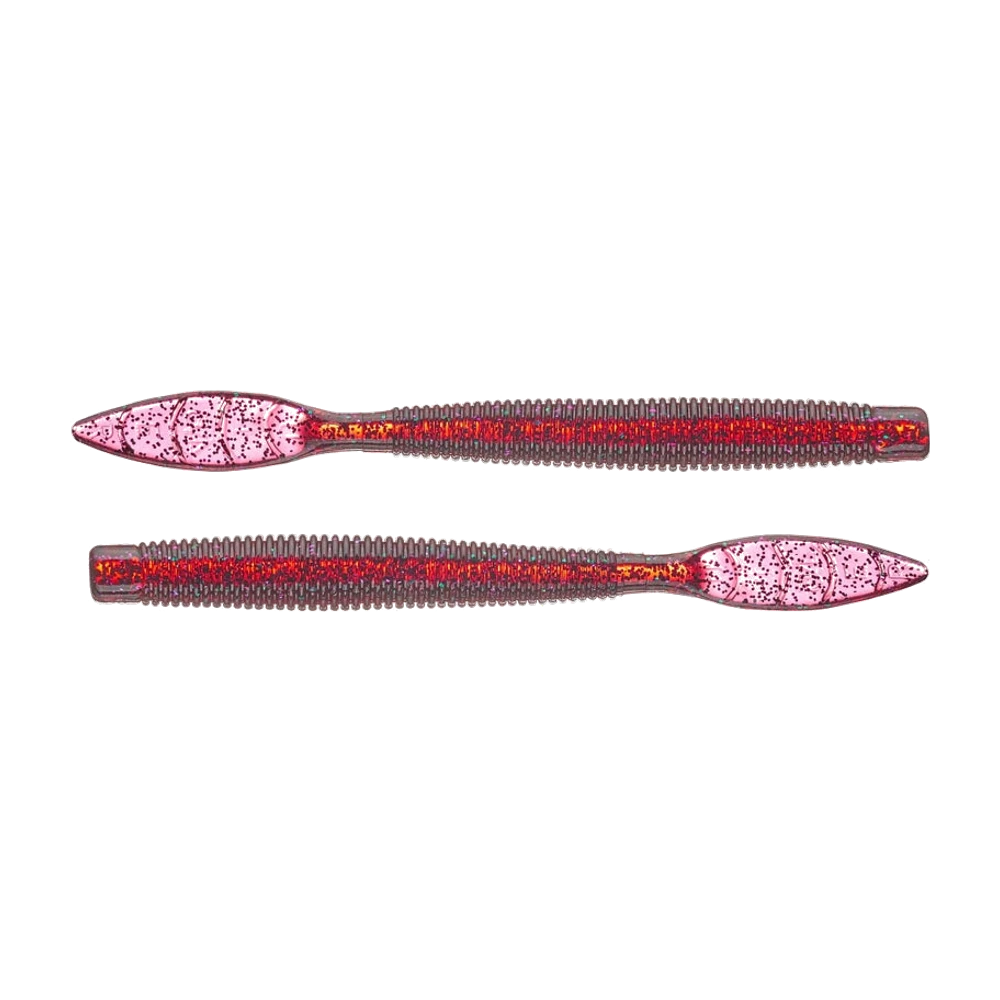
The first comes from the body: it is heavily ribbed, with deep grooves along its entire length, and the manufacturer claims it moves a tremendous amount of water to create real vibration. In the photo the ribs are obvious to the naked eye, far more pronounced than the decorative scoring on an ordinary soft plastic. That signal is low frequency: it is what a fish picks up through its lateral line in stained water, from several yards away.
The second comes from the tail. It is a paddle, but a very thin one, much slimmer than a standard swimbait's, and scored with tiny ridges. It does not kick wide like the tail of a Keitech Easy Shiner 3: it quivers. The manufacturer describes a motion that copies the fast tail flicker of a small baitfish, not the broad swim of a swimbait. That distinction matters when the time comes to pick a retrieve speed.
The thin paddle: what it buys and what it costs
The upside is clear. A paddle that thin starts on nothing: a shake of the rod tip on a drop shot, a thread of current over the bottom, and it comes alive. You do not need to move the bait forward to get movement, which changes everything on a tight spot with a located fish.
The downside is just as clear, and worth stating: a very thin paddle is fragile and tears faster than a thick one, especially where it joins the body. Check that junction after every fish. It also handles fast retrieves poorly — past a certain speed it folds flat and the bait rolls instead of vibrating. That is not a manufacturing flaw, it is the logical consequence of the trade-off.
The Tokyo rig, the least familiar setup
The manufacturer lists the Tokyo rig first among its recommendations, and it is the setup that exploits this bait best. It remains uncommon in Europe, even though it solves a specific problem.
How it works
A Tokyo rig is a hook joined by a split ring to a short rigid wire, with one or two weights slid onto the end of it. The weight sits on the bottom, the wire holds it away, and the bait stays suspended just above the substrate instead of lying down in it. For a worm with a thin paddle, that is ideal: the tail stays in the flow, out of the silt, and quivers without any input from you.
The other benefit of the Tokyo rig is verticality. You can drop the bait into a hole in the grass and let it work in place for thirty seconds, which no sliding rig truly allows. On bass sitting tight in high summer, that is often the only presentation that triggers.
The other recommended rigs
On a drop shot the Quiver Worm is right at home: the bait hangs suspended and the paddle works on the smallest movement of the line. On a shaky head the appeal is different — the ribbed body stands up and the bait pivots on the head, sweeping the paddle along the bottom.
Texas and Carolina rigs bring you back to more classic search fishing. Texas gives you a bait that slips through scattered vegetation; Carolina lets it work well behind the weight, and that is where the ribs really pay off, because constant tension keeps them vibrating the whole way.
With a thin-paddle bait, the most common mistake is reeling fast to feel something in the rod. You will feel nothing, and that is normal: the vibration is too faint to travel up a blank. Trust the behavior of the line and keep the speed down.
Not sure what to tie on?
Photograph your spot: CarnaFish reads the scene, cross-checks the conditions and gives you the zone, the lure and the retrieve. Free on iOS and Android.
Scent, an argument worth keeping in perspective
The manufacturer notes a strong dose of scent in the plastic. That is a genuine plus on slow presentations — a fish that holds the bait one second longer is one more hookset in the day. But do not build your fishing on it: scent works on retention, not on detection, and a scented bait in the wrong place is still a bait in the wrong place. The Berkley PowerBait MaxScent Flat Worm pushes that reasoning further if that criterion is what interests you.
Colors by water clarity
- Stained water: the brown laminate with red and orange flake from the photo, with its translucent pink paddle — a contrast of material more than of color, which works well when visibility hovers around a yard.
- Clear water: green pumpkin, over vegetation or gravel, when discretion matters more than visibility.
- Dark water or low light: black and blue, for a hard silhouette that the ribs underline further.
What the manufacturer does not publish
The technical description gives no length, no size range and no pack count for this model. We know the build and the recommended rigs, not the dimensions. If you need to match the bait to a specific hook or a Tokyo rig size, check the package: an approximate figure here would not help you buy correctly. For reference, the Missile Baits Magic Worm from the same brand comes in 10.2 and 15.2 cm, but nothing says the Quiver Worm follows the same grid.
The best worm in the world does not replace reading the spot, and that is exactly what CarnaFish is for: a photo of the spot, and the app suggests the zone, the depth and the presentation that fit the day's conditions. For the fundamentals of tackle and spots, our beginner's guide to bass fishing starts from scratch.
Key takeaways
- Two complementary signals: the low-frequency wave of the deep ribs, and the high-frequency quiver of the thin paddle.
- The paddle starts without forward motion, which makes the bait deadly on a static presentation — and also makes it more fragile.
- The Tokyo rig exploits it best: the tail stays in the flow above the bottom.
- Neither length nor pack count is published by the manufacturer, so check the package.
FAQ
What exactly is a Tokyo rig?
A hook joined by a split ring to a short rigid wire, weighted at its end. The weight rests on the bottom and the wire holds the bait suspended just above it, where it works in place instead of lying down in the silt.
How fast should I retrieve the Quiver Worm?
Slowly. The paddle is very thin and folds flat past a certain speed, which makes the bait roll instead of vibrate. On a straight retrieve, stay at a pace where you can see the line moving without jerks.
What is the difference with the Magic Worm from the same brand?
The Missile Baits Magic Worm is a straight worm with a tapered tail and no paddle: all of its work happens on the fall and the pause. The Quiver Worm adds a thin paddle that vibrates the moment the bait moves, so one more signal on the retrieve.
Does the paddle tear quickly?
Faster than a thick one, yes, especially where it joins the body. That is the price of thinness. Check that area after every fish and keep a spare or two if you are fishing it all day.
What size is this worm?
The manufacturer publishes no length for this model. That is something to read off the package, all the more so because it drives the hook choice and the Tokyo rig size you should build.
Do I need a scented bait for slow fishing?
It helps with hold time: the fish keeps the bait a little longer, which gives you time to set. But scent replaces neither spot selection nor presentation. It is a bonus, not a strategy.
The full bass lure guideSeason-by-season strategy: which family of lure, when, and why.Go from theory to fish
CarnaFish reads your spot from a photo and gives you the game plan: zone, lure, retrieve. Free on iOS and Android.