Roman Made Negotiator: 3 oz of jointed swimbait that sinks slowly
Not sure this lure fits YOUR spot today? CarnaFish tells you in 10 seconds, from a photo.
Some lures cost more than the reel that casts them. The Roman Made Negotiator belongs to that small family of Japanese baits built by hand, one at a time, whose retail price runs into the hundreds of dollars. The real question is not whether they are worth it — that one is personal — but what a 3 oz swimbait that sinks slowly actually does in the water, and what it demands from the angler holding the rod.
What the spec table really says
The maker's table runs to a single line, but all three values matter. The Negotiator measures 7 in, or 17.8 cm, weighs 3 oz, around 85 g, and belongs to the slow sink class.
That last entry is the most important of the three, and the one most often skimmed over. A slow sink is neither a floater you crank under the surface nor a weighted bait that dives for the bottom: it is a lure that descends gently when you stop reeling, then holds the depth it reached as long as you keep a steady retrieve going. In practice you pick your layer by counting seconds after the splashdown, then reel. That lets you work a break at twenty feet and a grass edge at five with the same bait, purely by counting longer or shorter.
Roman Made also states that each bait is handmade with a customized weight system, which produces differences between individual lures. That is honest, and it has a practical consequence: two Negotiators bought on the same day will not necessarily sink at the same rate. Time yours the first day out and write the number down — that is your reference for every session afterwards.
Two segments and a rigid tail fin
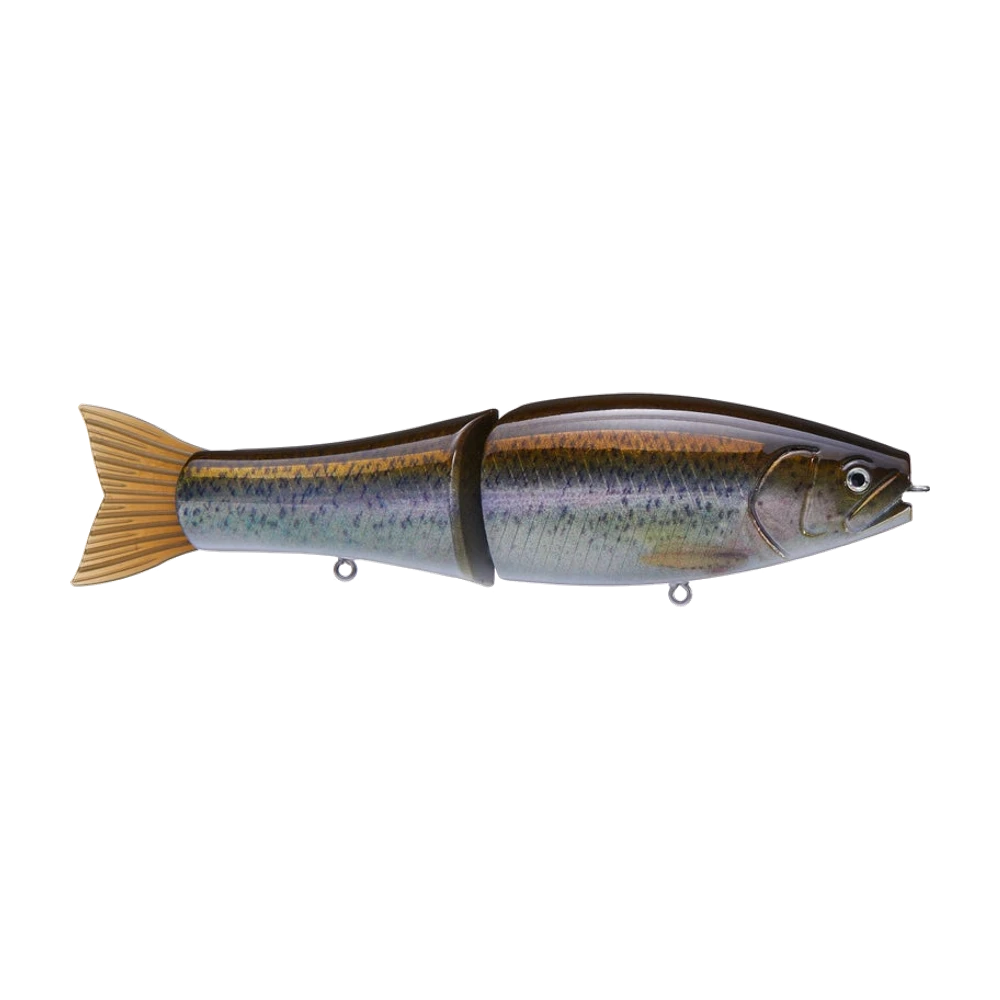
In the product photo the body splits into two sections joined by a wide, shallow hinge, and the tail is a rigid forked caudal fin, moulded with its rays, in a translucent amber material. It does not flap like a soft paddle: it works as a rudder. Almost all the movement therefore comes from the central joint, which lets the rear of the body sweep from one side to the other.
A two-piece swimbait tracks wider and slower than a three or four-piece. It does not shimmy: it rolls through a broad S with a visibly snaking path. That looks far less lively from the bank, which is exactly why it draws big fish that refuse anything busy. On an eighteen-centimetre bait, the slowness is also what makes the volume believable: prey that size does not sprint.
Still in the photo, the lure is presented bare, with two belly screw eyes and a nose tie, no trebles fitted — an observation from a product photo rather than a specification, and the description gives no detail about the hooks supplied. Check that point before fishing it, and fit generously sized split rings: with 3 oz being cast all day, that is the part that fails first.
Working it, and the tackle that forces
Rod and line
85 g is not a big crankbait: it is the weight of a catfish lure. You want a dedicated swimbait rod rated to at least 100 g, with a butt long enough for two-handed casting, paired with a heavy casting reel. For line, 30 to 50 lb braid, because a bait at this price that finds a laydown comes back by brute strength or does not come back at all.
The rhythm
A very slow continuous retrieve, reel only, rod held low: that is the baseline. The S sets in after a few turns of the handle and needs nothing else. To break the regularity, a sharp twitch every five or six turns kicks the rear of the body out to one side before the bait resumes its track — that offset is what makes a following fish commit.
The classic mistake
Working it like a jerkbait. A string of hard pulls on an eighteen-centimetre two-piece makes it roll on itself and lose its swim, without ever producing the clean glide of a true one-piece glide bait like the Savage Gear 3D Bleak Glide Swimmer. The Negotiator is fished with the reel, not with the rod.
Not sure what to tie on?
Photograph your spot: CarnaFish reads the scene, cross-checks the conditions and gives you the zone, the lure and the retrieve. Free on iOS and Android.
Colors: two finishes, two strategies
The retailer collaboration covers two patterns only, and they do not address the same water.
- TW Albino Gizzard: a pearl white built from layered opaque coats, with purple-green transitions at the front and blue tones toward the rear. The maker describes a blurred silhouette that suggests movement even when the lure sits still — that is their argument, not a measurement. In practice a pearl white works best in clear water and good light, where the fish reads volume rather than detail.
- TW Young Bow: a young rainbow trout finish with an illuminated effect along the flank. It is the card to play on trout-stocked waters, where big fish have learned to hunt stockers, and more broadly on cold clear lakes.
There is no dark or chartreuse option in this exclusive series. If you fish stained water, this is simply the wrong bait: a pearl or trout finish gives you nothing there but a silhouette, and a silhouette costs a great deal less elsewhere.
Who it is actually for
Roman Made aims it at bass feeding on gizzard shad or trout, and the bait is built with very large fish in mind. In Europe, a jointed swimbait of 17.8 cm and 85 g that sinks slowly is also a genuine pike lure — provided you add a wire or titanium leader, which plenty of anglers forget on a bait this expensive. It plays the same ground as a Gan Craft Jointed Claw or a Huddleston 8 Trout, on the same logic: few bites, but big fish.
The best swimbait in the world still does nothing cast at random. Reading the spot before you tie on something like this is exactly what CarnaFish makes easier: one photo of the swim and the AI suggests the zone, the depth and the presentation that suit the day's conditions. For the big-lure and European predator side of things, our guide to choosing a pike lure fills in the rest.
Key takeaways
- 17.8 cm, 85 g, slow sink class: it is the density, more than the size, that defines how you fish it.
- You pick the depth by counting seconds after the cast lands, then reeling at a constant speed.
- Two segments and a rigid tail fin: a wide slow S, produced with the reel and never with the rod.
- Handmade with an individual weight system: time your own bait's descent, it will not necessarily sink like anyone else's.
FAQ
What size and weight is the Roman Made Negotiator?
Seven inches, or 17.8 cm, for a published 3 oz, around 85 g. The maker lists it as slow sink.
Does the Negotiator float?
No. The maker's table gives it explicitly as slow sink: left alone it descends gently. That is what lets you choose your swimming depth by counting the drop before you start the retrieve.
What rod do you need to cast 85 g?
A dedicated swimbait rod rated to at least 100 g, with a butt long enough for two-handed casting, matched to a heavy casting reel and 30 to 50 lb braid. A standard pike rod will not take that weight across a full day.
Why do two baits not swim the same?
Because Roman Made claims handmade construction with a customized weight system, and warns that this produces differences between individual lures. Time the sink rate of yours on the first session; it is the only reliable reference.
Can you fish it for pike?
Yes, the size and mass suit European predators perfectly, but add a wire or titanium leader without exception. Without one, a well-placed tooth costs you the whole lure.
Which of the two colors should I pick?
TW Albino Gizzard, pearl white, in clear water and good light; TW Young Bow, the trout finish, on cold waters and lakes where salmonids are part of the menu. Neither finish is designed for stained water.
The full bass lure guideSeason-by-season strategy: which family of lure, when, and why.Go from theory to fish
CarnaFish reads your spot from a photo and gives you the game plan: zone, lure, retrieve. Free on iOS and Android.