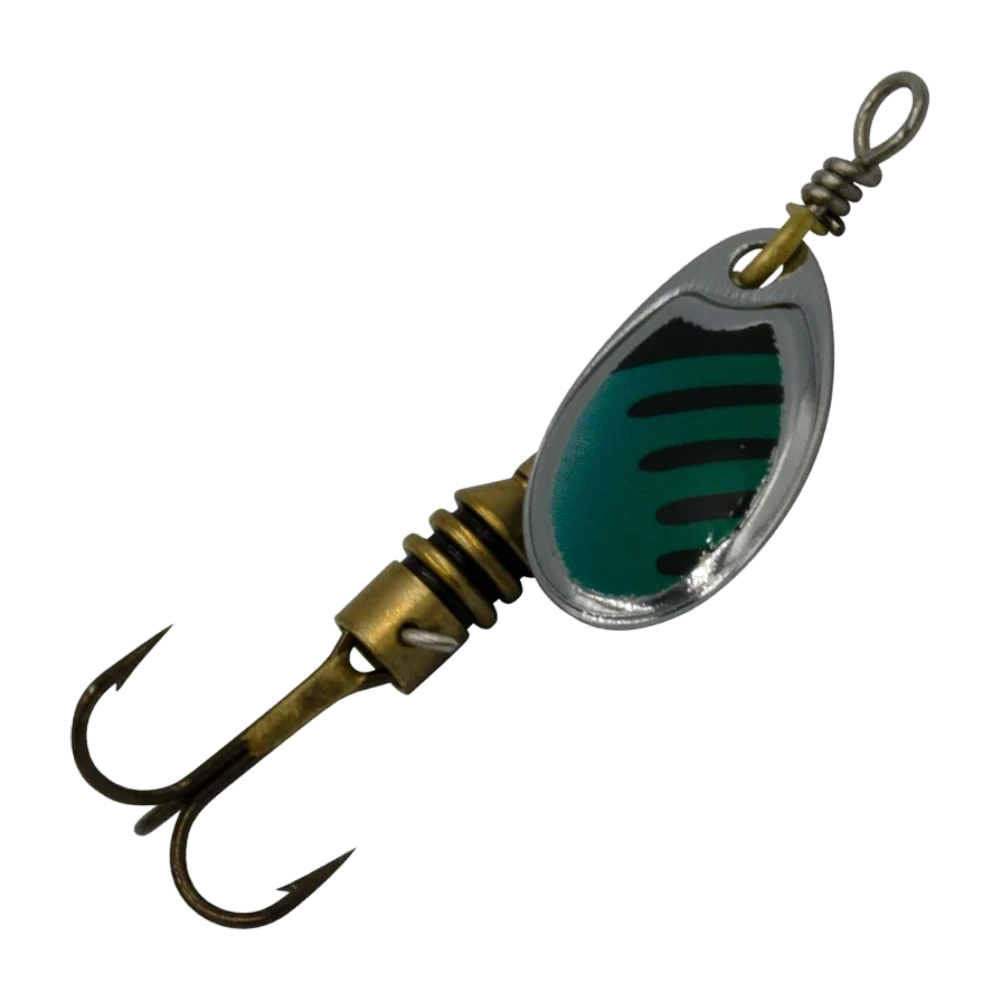
Rublex Celta: the inline spinner for narrow streams
Not sure this lure fits YOUR spot today? CarnaFish tells you in 10 seconds, from a photo.
A stream two metres wide, a metre and a half of visibility ahead of you because of the branches, and a four-metre pool with a trout holding at the head of the current. You get one cast before it sees you. That cast has to be short, it has to land precisely, and the lure has to work immediately, from the very first centimetre of the retrieve.
That is the Celta's brief, and it is why it has sat in river anglers' boxes for decades. It is not the spinner that vibrates hardest or calls from furthest away: it is the one that starts fastest and holds best in current.
A weighted-body spinner, not a blade-driven one
The distinction is technical but it explains everything. On a classic wide-bladed spinner the body is just a cylindrical weight and the blade does the work: it generates a lot of lift, and the lure climbs in the water column as soon as you speed up.
The Celta is built differently. Its streamlined body carries most of the mass, and its narrower blade turns at a tighter angle. Three direct consequences:
- It generates less lift. You can speed up to keep contact without the lure rising to break the surface. In pushing current, that is decisive.
- It starts in a shorter distance. The blade begins turning within the first few centimetres, before you have even taken up the slack. On a five-metre cast, you do not lose half your swim.
- It casts better than its volume suggests. The compact body concentrates the mass. In size 2 or 3 you can place a precise cast under a low branch with a short rod.
In exchange, it calls from less far than a wide blade, and on a flat still lake it is markedly less convincing. It is a lure for moving water.
Choosing the size: the table that saves you buying six
The commonest mistake is picking one do-everything size and never touching it again. Size is chosen on water depth and current strength, not on the size of the trout.
| Size | Approximate weight | Where it really earns its place |
|---|---|---|
| #0 – #1 | 1.5 to 2.5 g | Streams under 3 m wide, under 40 cm of water, very clear |
| #2 | 3 to 3.5 g | The all-round small-river size, pools from 50 cm to 1 m |
| #3 | around 5 g | Medium river, sustained current, or canal perch |
| #4 – #5 | 6.5 to 8 g | Heavy flow, steep gradient, or deep downstream water |
If you are only going to own two, take a #1 and a #3. They cover the essentials, and you adjust depth through speed and casting angle rather than changing lure every ten minutes.
The retrieve: fish upstream, not downstream
Plenty of anglers cast a spinner across or downstream because it is more comfortable: the current turns the blade for them. The problem is that the trout is facing into the current. It sees you coming, and it sees a lure moving upstream in a way nothing alive does.
The right sequence is the reverse, and it takes discipline.
- Read the spot before you move up. Head of a pool, downstream of a boulder, the seam between two weed beds. You need to know where you are casting before you leave cover.
- Position yourself downstream, crouched if need be, and cast past the spot, a metre above it.
- Start winding the moment it lands. Not a second of drift: the lure has to be working before it reaches the zone.
- Match the speed to the current so the blade keeps turning without winding faster than the flow. You should feel a steady vibration in the rod at all times.
- Follow with the rod tip as the lure passes the spot: lifting the rod slightly raises it twenty centimetres and often triggers the moment a fish is following.
- Move up one spot and start again. You fish a stream going up, never going down.
On the water: if you lose the blade for half a second, it is almost always a bite, not the blade stalling. In current, trout often take the Celta head on and bring it back towards you: the vibration disappears before the rod bends. Set the hook on the loss of vibration, not on the pull.
The rig: the swivel is not optional
An inline spinner turns the line. With nothing to absorb that rotation, an hour's fishing leaves you with twisted nylon that loops on the cast and breaks on the hookset.
- A small rolling swivel, placed 30 to 40 cm above the lure, solves it. Do not put it right on the split ring: it weights the front end and hampers the blade starting up.
- Nylon in 0.16 to 0.20 mm is plenty for river trout. It is stretchier than fluorocarbon, which forgives sharp hooksets at short range.
- The treble can be swapped for a barbless single if you release your fish. You lose a little hook-up rate, you gain a lot at unhooking.
Finally, remember to check the shaft: bent after a snag, it can be straightened by hand, but if it is scored the lure is due for replacement.
Not sure what to tie on?
Photograph your spot: CarnaFish reads the scene, cross-checks the conditions and gives you the zone, the lure and the retrieve. Free on iOS and Android.
Colours: the real variable is the colour of the water
- Fast, clear water, bright sky: silver blade, light body. The flash is enough.
- Tannin-stained water, forest streams, peat: gold or copper blade, dark body. Contrast carries better than a flash that gets lost.
- Water up after rain: go up a size and switch to a gold blade. The trout will not see the lure beyond a metre, it has to feel it coming.
- Perch in a canal or gravel pit: bodies with red or orange spots often come out on top, on fish hunting in shoals.
Celta, Aglia or a modern spinner
Against a Mepps Aglia #3, the Celta is heavier for a given size, rises less and is easier to control in a fast seam. The Aglia, with its wide blade, generates more vibration and calls from further: on calm water, a pond or a backwater, it keeps the advantage. In practice, plenty of river anglers carry both and swap at the first spot that fails to produce.
Against a Smith AR Spinner, the comparison is different: the AR relies on a very heavy body and a tiny blade to cast a long way and sink fast, which makes it a big-river or lakeshore tool. The Celta stays easier to read on small volumes of water and easier to work through pools a few metres long.
Our guide to river trout fishing covers how to read the spots you work your way up. And if you are unsure what size to tie on when you reach a pool you do not know, CarnaFish analyses a photo of the spot and answers.
Key takeaways
- Weighted body and narrow blade: little lift, immediate rotation, good control in current.
- Size is chosen on water depth and current strength, not on the size of the fish.
- You fish moving upstream, casting past the spot, and winding from the moment it lands.
- A rolling swivel 30-40 cm up is essential, or the line twists within the hour.
- Excellent in moving water, markedly less convincing on flat, currentless water.
FAQ
What size Celta for stream trout?
A #1 for small shallow streams and very clear water, a #2 as the all-round size as soon as you have 50 cm to 1 m of water. The #3 becomes useful on a medium river or when the current pushes hard.
Should I fish upstream or downstream?
Upstream, in almost every case. The trout faces into the current: working upstream you come in behind it and the lure moves in the natural direction. Fishing downstream has the fish spotting you before you even cast.
How do I stop the line twisting?
Fit a small rolling swivel 30 to 40 cm above the lure, never directly on the split ring. It is the only genuinely effective solution; swivels sitting right at the lure hamper the blade starting up.
How does it differ from a Mepps Aglia?
The Aglia has a wider blade, more lift and more vibration: it calls from a distance and suits calm water well. The Celta, with its weighted body, stays lower and is easier to control in sustained current.
Does the Celta catch perch?
Yes, particularly in #2 and #3 along canal, gravel pit and slow river margins. Bodies with red or orange spots are often more productive on perch than strictly natural finishes.
Why has my Celta stopped turning?
Usually the shaft is bent after a snag, or the split ring has jammed against the blade. Check the shaft against the light; if it is clearly scored, replace the lure — a blade that turns irregularly stops catching.
The full trout lure guideSeason-by-season strategy: which family of lure, when, and why.Go from theory to fish
CarnaFish reads your spot from a photo and gives you the game plan: zone, lure, retrieve. Free on iOS and Android.