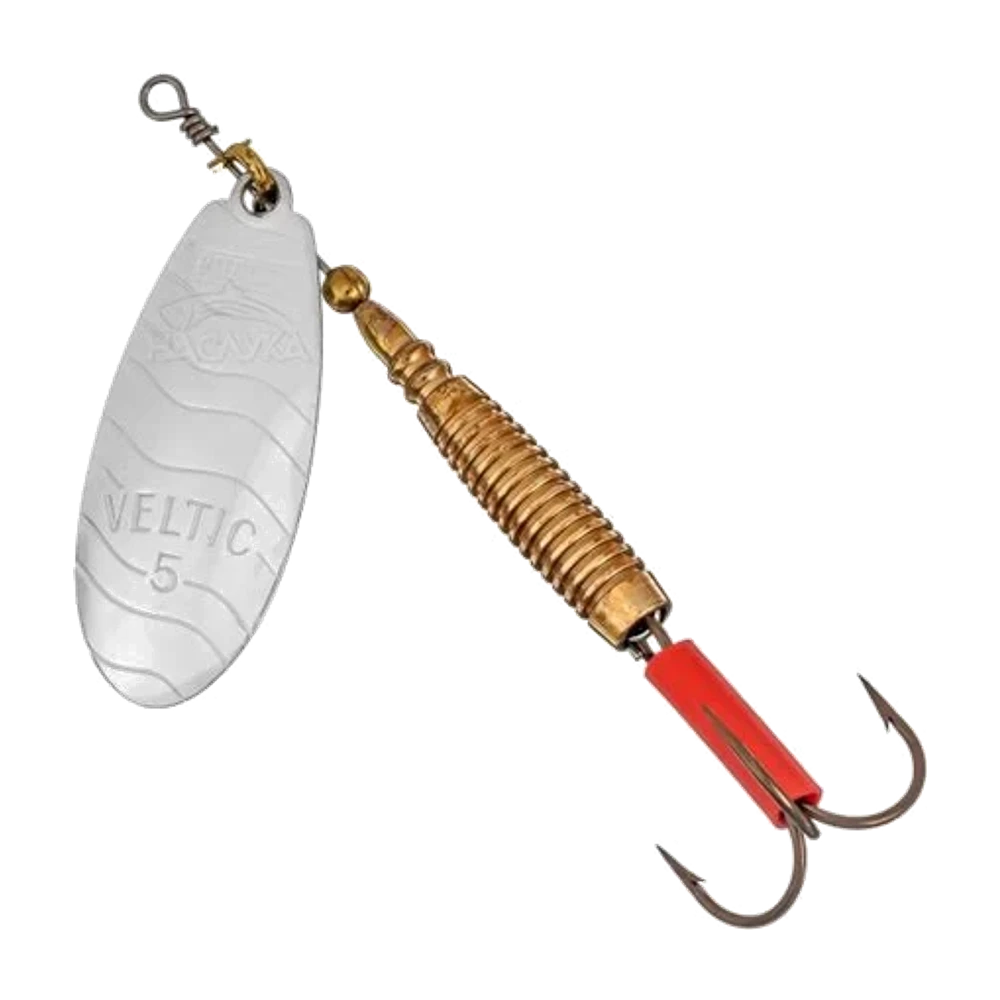
Rublex Veltic: change the angle rather than the lure
Rather not fish it blind? Photograph your spot — CarnaFish cross-checks the conditions and points you the right way.
A two-and-a-half-metre pool on a mid-mountain river, under an old bridge. You know there is a good trout in it: you saw it move last week. You put five spinner casts through, always from the same point, always the same way. Nothing. You change colour. Nothing. You change model. Nothing.
The problem was probably neither the colour nor the model. A settled trout sees your lure arrive at a given angle, at a given speed, in a given layer of water. If those three parameters do not change, your tenth cast delivers exactly the same information as the first.
The Veltic is an interesting spinner precisely on that point: its compact body, relatively heavy for its size, keeps the lure on its axis even when you present it across the flow or downstream, which gives you three genuinely different presentations from a single lure.
Why a compact body changes the presentation
On a spinner, the blade creates a permanent sideways pull. The longer and lighter the body, the more the lure skews across the flow and "kites" in the current, until it comes up to the surface.
The Veltic limits that fault:
- A short, concentrated mass that stays aligned with the axis of pull. You can cast three-quarters downstream and wind very slowly without the lure immediately climbing to the surface.
- A blade that starts over a very short distance, which allows slow retrieves and mid-swim speed changes without losing rotation.
- A tight, well-transmitted vibration. Fishing a pool you see nothing: the rod tip is your only feedback. A blade that goes quiet tells you immediately that you are too slow, too high, or that you have picked up a leaf.
It is not an ultra-light starter for ten centimetres of water, nor a heavy-flow spinner. It is a control spinner.
Working a pool in three passes
The order matters: you start with the least intrusive pass and finish with the most aggressive.
- First pass, three-quarters upstream. Cast above the pool, let the lure drift and drop for three seconds, then wind just fast enough to feel the blade. The lure comes down into the pool with the current, almost naturally. It is the most discreet presentation, the one that catches fish nobody has bothered.
- Second pass, straight across. Cast perpendicular, let the line form its curve and follow with the rod tip. The lure sweeps across the pool and accelerates at the end of the swing. A lot of bites come at exactly that moment of acceleration.
- Third pass, three-quarters downstream. Cast down and wind slowly back against the flow. It is the slowest and most head-on presentation: the lure comes up facing the fish, which sees it for a long time. It is also the one that produces the most visible refusals — and the most late decisions.
- If nothing has moved, change your position on the bank before you change lure. Two metres of lateral movement changes the whole angle of the swim.
- Never make more than two identical casts. After the second, you are teaching the fish more than you are tempting it.
On the water: speed is controlled with the wrist, not the reel. On a pass across the flow, move the rod tip thirty centimetres downstream and your spinner slows instantly without you touching the handle; bring it back towards you and it speeds up. That micro-control is what makes a settled trout decide, because it reproduces prey that hesitates rather than prey that crosses.
Which size for which spot
| Spot | Size | Approximate weight |
|---|---|---|
| Riffle, fast shallow current | small | 2.5 to 4 g |
| Medium current, pools of 1 to 2 m | medium | 5 to 8 g |
| Big river, deep pool, high water | large | 9 to 12 g |
The usual reflex is to go up a size when nothing bites. Try the opposite first: on an educated trout in clear summer water, dropping a size and slowing down produces more than adding bulk.
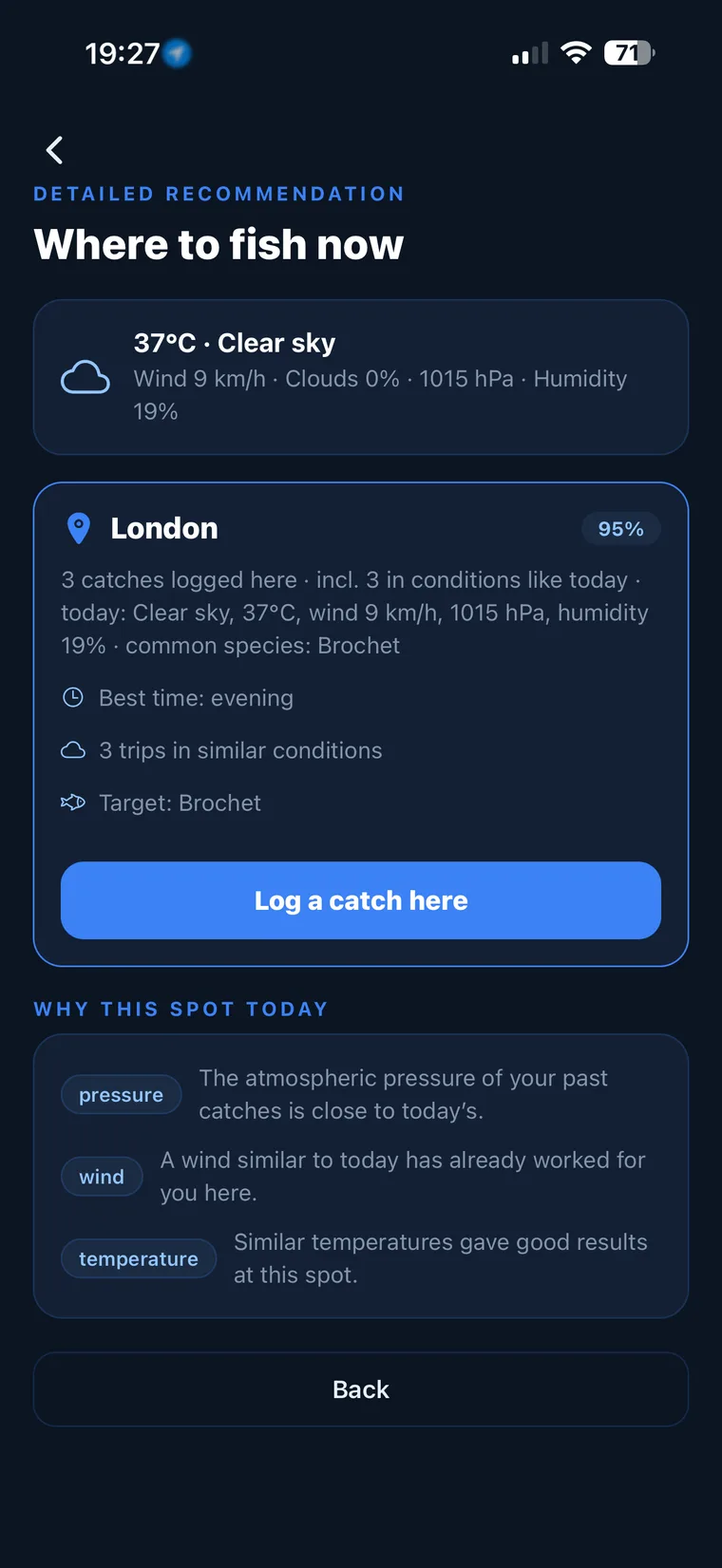
Not sure what to tie on?
Photograph your spot: CarnaFish reads the scene, cross-checks the conditions and gives you the zone, the lure and the retrieve. Free on iOS and Android.
Single hook, catch and release and the hookset
On many stretches, trebles are banned or discouraged. Switching to a single is not just a regulatory constraint, it has concrete effects:
- Fewer snags in gravel bottoms and sunken branches, so more actual fishing time.
- Far quicker, cleaner unhooking for a release, which is the real point in catch and release.
- A slightly lower hook-up rate at first, which you make up for by setting earlier and softer: do not make a big rod sweep, just tighten the line with a flick of the wrist the moment the contact changes.
Fit the single point upwards, with a suitably sized split ring. Too big a single restricts the blade's rotation and kills the action.
Veltic or Aglia Long
The Mepps Aglia Long relies on an elongated blade that turns close to the body and takes strong current without laying over. It is the choice when the main constraint is the power of the flow: high discharge, fast riffles, spring water.
The Veltic plays a different game: a more compact body, a wider speed range at the slow end, and better behaviour on downstream and slow cross-current presentations. On a big river in flood, the Aglia Long holds better. On a medium-river pool where you need to vary three angles on the same fish, the Veltic offers more solutions.
Within the Rublex range, the Rublex Ondex occupies yet another patch, that of deep still water and counted drops on perch shoals. Our guide to river trout fishing covers reading the spots before you even choose a lure. And if you are unsure in what order to attack a pool from the bank, CarnaFish analyses a photo of the spot and answers.
Key takeaways
- A compact body stays on its axis: that is what allows downstream and slow cross-current presentations.
- Work a pool from three angles — upstream, across, downstream — before changing lure.
- Speed is controlled with the rod tip, not the handle.
- Two identical casts per spot maximum: beyond that, you are educating the fish.
- Single hook point up for catch and release: fewer snags, cleaner unhooking, softer hookset.
FAQ
In what order should I fish a pool with a spinner?
Start three-quarters upstream, which is the most discreet pass, then straight across, then three-quarters downstream on a slow retrieve. That way you exhaust three different presentation angles before changing anything on your rig.
What size Veltic for a mid-mountain river?
The medium size, around 5 to 8 g, covers most pools of one to two metres. Drop to the small size on shallow riffles and in clear summer water, and go up to the large size only in high water.
Can it be fished downstream?
Yes, and it is one of its strengths: its compact body stops it laying over and rising to the surface. Wind slowly, keeping just enough rotation, and accept that the fish sees the lure for a long time before making up its mind.
Do I need a swivel?
Yes, a rolling swivel around forty centimetres from the lure. An inline spinner turns the line continuously, and twisted line loses strength, tangles on the cast and transmits bites poorly.
Single or treble?
Single as soon as you practise catch and release or the stretch requires it: fewer snags, quicker unhooking, fish in better shape. Choose one fine enough not to restrict the blade's rotation, and set the hook earlier and softer.
How does it differ from the Aglia Long?
The Aglia Long is built for strong current thanks to its elongated blade. The Veltic offers a wider speed range at the slow end and behaves better on downstream or slow cross-current presentations, which makes it more versatile on a medium-river pool.
The full trout lure guideSeason-by-season strategy: which family of lure, when, and why.Go from theory to fish
CarnaFish reads your spot from a photo and gives you the game plan: zone, lure, retrieve. Free on iOS and Android.