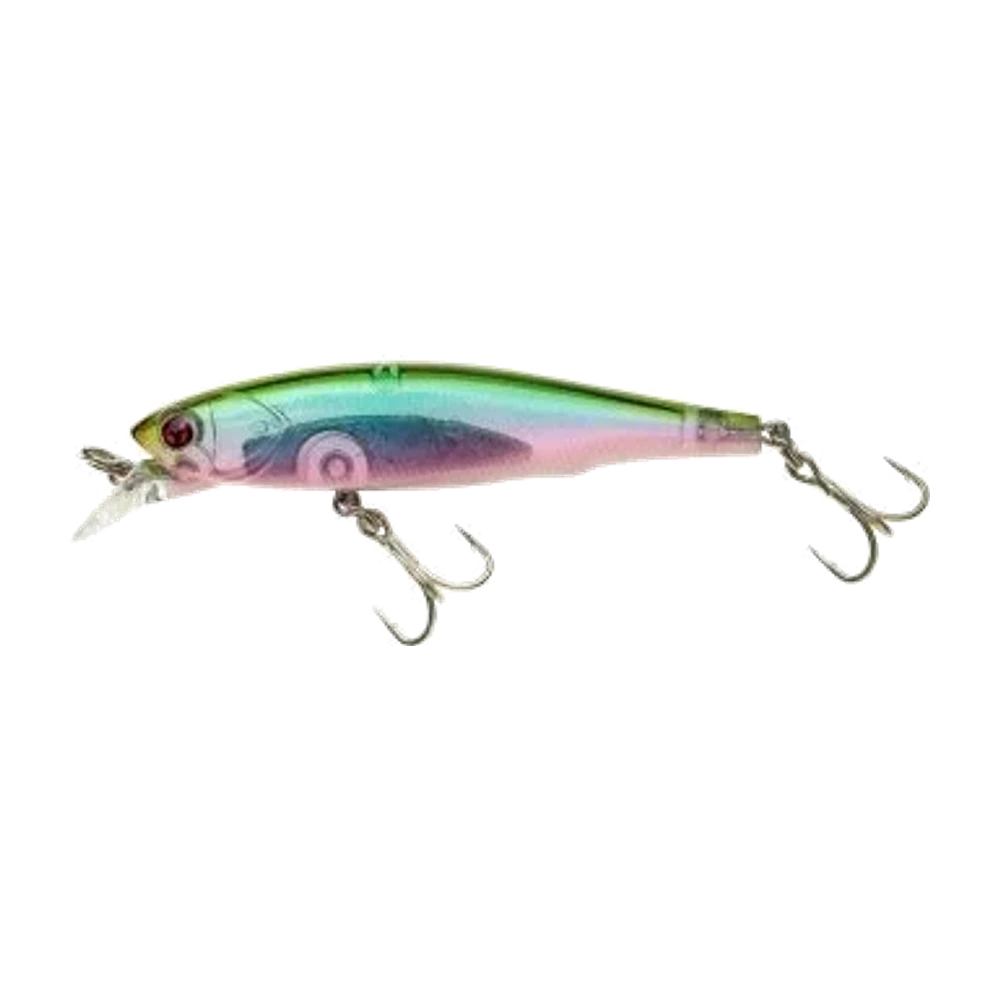
Sakura Majikara Minnow: the minnow that lets the current do the work
One lure, endless conditions. CarnaFish reads your spot from a photo so you are not just guessing.
In a river, the wrong minnow gives itself away in three seconds. You cast across, the current catches the lure's flank, and instead of swimming it rolls over and climbs towards the surface, vibrating uselessly. You feel it in the rod: the vibration turns ragged, then vanishes. The lure has stopped fishing, it is just drifting.
The problem comes from amplitude. A wide-swimming minnow, designed for still water, offers too much lateral surface to the flow. As soon as the pressure passes a certain threshold, it loses its axis.
The Majikara Minnow is tuned the other way: narrow action, high frequency, roll cut to a minimum. It vibrates less hard but it does not let go, and that is exactly what you need when the main flow is pushing. On a zander river, that stability is worth more than any argument about finish.
What "tight action" actually means
The difference between a wide and a tight action is not a catalogue nuance, it shows up in three concrete ways.
- Lateral amplitude. A wide minnow throws its body several centimetres either side of its axis on every beat. The Majikara stays in a narrow band, which reduces the grip the current has on it and lets it hold its line across the flow.
- Frequency. What it loses in amplitude it makes up with a faster beat. The signal it sends is not a big displacement of water but a continuous, high-pitched vibration that zander pick up very well on the lateral line.
- Roll. A lure that rolls on its long axis throws powerful flank flashes — useful in a lake, a penalty in current, because every roll hands the water extra purchase. Here the roll is contained and the lure stays roughly upright.
One important practical consequence follows: this lure will not tolerate being retrieved too fast. A tight action pushed past its range turns into a lifeless tremble. The right speed is the slowest at which you can still feel the vibration in the rod tip.
The retrieve: cast across and follow it round
The standard river approach involves almost no reeling at all.
- Cast at 45 degrees upstream or straight across, never directly downstream to begin with.
- Reel just enough to start the action, two or three turns, then let the current push the lure across while it works downstream.
- Follow the swing with the rod high, keeping constant tension. The lure sweeps the whole flow without you needing to speed up.
- Pause for one or two seconds when the lure arrives over a drop-off or at the tail of the current. On a sinking model it drops slightly; on a suspending one it holds position and the pressure of the current makes it shiver on the spot.
- Finish the swing with three or four slow turns before recasting — a lot of bites come on that last stretch, as the lure works back up against the flow.
On the water: in a river, the bite almost never comes in the fast water itself, but on the seam between the current and the slack. Set your casting angle so the lure travels along that seam for as long as possible, rather than crossing it at right angles. One well-aimed cast is worth ten well-worked retrieves.
Setting size and depth
| Size | Use | Depth reached |
|---|---|---|
| 7 cm | perch in rock piles, small tributaries, low water | 0.8 to 1.2 m |
| 9 cm | general zander and perch use, medium river | 1 to 1.5 m |
| 11 cm | zander in big rivers, strong current, wind | 1.2 to 1.8 m |
Three levers let you reach a little deeper without changing model. Thin fluorocarbon, 0.22 mm rather than 0.28, gains you a few tens of centimetres. So does a rod held low, tip near the water. And a longer cast mechanically increases the cruising depth over the middle section of the retrieve.
Conversely, if you need to fish deeper than two metres, do not force it: this lure is not built for that. Switch to a shad on a jig head, which will get down to the fish without argument.
For the connection, tie straight to the fluorocarbon with a loop knot on the small sizes — a knot cinched tight on the split ring restricts an action that is already narrow. On the 9 and 11 cm sizes, a small fine clip stays acceptable and saves time when you swap models on the same spot.
Its home ground, and its limits
- Zander rivers, along current edges, bridge outflows and the tails of riffles, from spring to autumn.
- Current perch, in the 7 cm, along rip-rap and pillars.
- Big canals and backwaters, on a very slow straight retrieve, when the fish are high in the water column.
- Lightly stained water, where the continuous vibration makes up for reduced visibility.
It is poorly suited to three situations, though. Deep water, beyond two metres, where it simply will not go down. Fast searching of big lake expanses, where a wide-swimming lure calls from far further away. And hard winter conditions, when you need ten-second pauses: a sinking tight-action minnow has nothing to offer during a long stop, unlike a suspending jerkbait built for it.
Not sure what to tie on?
Photograph your spot: CarnaFish reads the scene, cross-checks the conditions and gives you the zone, the lure and the retrieve. Free on iOS and Android.
Majikara Minnow or a jerkbait for pauses
The distinction is sharp and worth stating, because the two lures look alike on the shelf.
A suspending jerkbait such as the Lucky Craft Pointer 78 is built to be twitched with long pauses: it darts sideways, stops dead, and waits. That is still-water fishing, cold and clear, where the dead time is the main argument.
The Majikara Minnow works continuously. Its value lies in an action sustained under pressure, not in stillness. In a river you almost never have the option of a real pause anyway: the current carries the lure away. For a slightly wider action and a flashier finish in still water, the Illex Squad Minnow 95 SP sits at the other end of the spectrum.
Our beginner's guide to lure fishing for zander covers the times of day when fish move up the water column and become reachable with a minnow. And if you are unsure what casting angle to take on facing a seam of current, CarnaFish analyses a photo of the spot and answers.
Colours
- Clear water, lowland river: roach, bleak, green or blue back. You copy what is already drifting down the flow.
- Coloured water after rain: dark back and fire belly, or a strongly contrasting solid tone. Silhouette wins.
- Low evening light: a holographic finish, which bounces the low light off the water and stretches the feeding window.
Key takeaways
- Narrow, fast action with limited roll: built to hold its axis in the current.
- Fish it across, rod high, letting the current sweep the flow for you.
- The right speed is the slowest at which you still feel the rod tip working.
- Depth capped around 1.8 m: beyond that, switch to a shad on a jig head.
- Aim at the seam between current and slack, not the fast water itself.
FAQ
How deep does the Sakura Majikara Minnow swim?
Between 0.8 and 1.8 m depending on size and the line used. Thin fluorocarbon and a rod held low gain a few tens of centimetres, but this lure is not designed to go below two metres.
How do I fish it in a river?
Cast across or slightly upstream, give two or three turns to start the action, then follow the swing with the rod high, keeping the line tight. The current sweeps the lure across the whole flow without you having to speed up.
What size should I pick for zander?
The 9 cm covers most situations on a medium river. Move up to 11 cm on a big river, in strong current or in wind, when you need casting distance and a little more depth.
Should I use a clip?
On the 9 and 11 cm sizes, a small fine clip is acceptable. On the 7 cm, tie straight with a loop knot: a knot cinched on the ring restricts an action that is narrow by design.
Does it work in cold water with long pauses?
Hardly. A tight-action minnow has nothing to offer during a ten-second stop. In winter, a suspending jerkbait built for the long pause makes more sense.
Why does my vibration disappear during the retrieve?
Because you are retrieving too fast, or the current is too strong for the size you are using. Slow down until you find the beat in the rod tip again, and if that is not enough, go up a size or change your casting angle to reduce the lateral pressure.
The full zander lure guideSeason-by-season strategy: which family of lure, when, and why.Go from theory to fish
CarnaFish reads your spot from a photo and gives you the game plan: zone, lure, retrieve. Free on iOS and Android.