Bassday Mogul Minnow: in a river, reel speed is not what matters
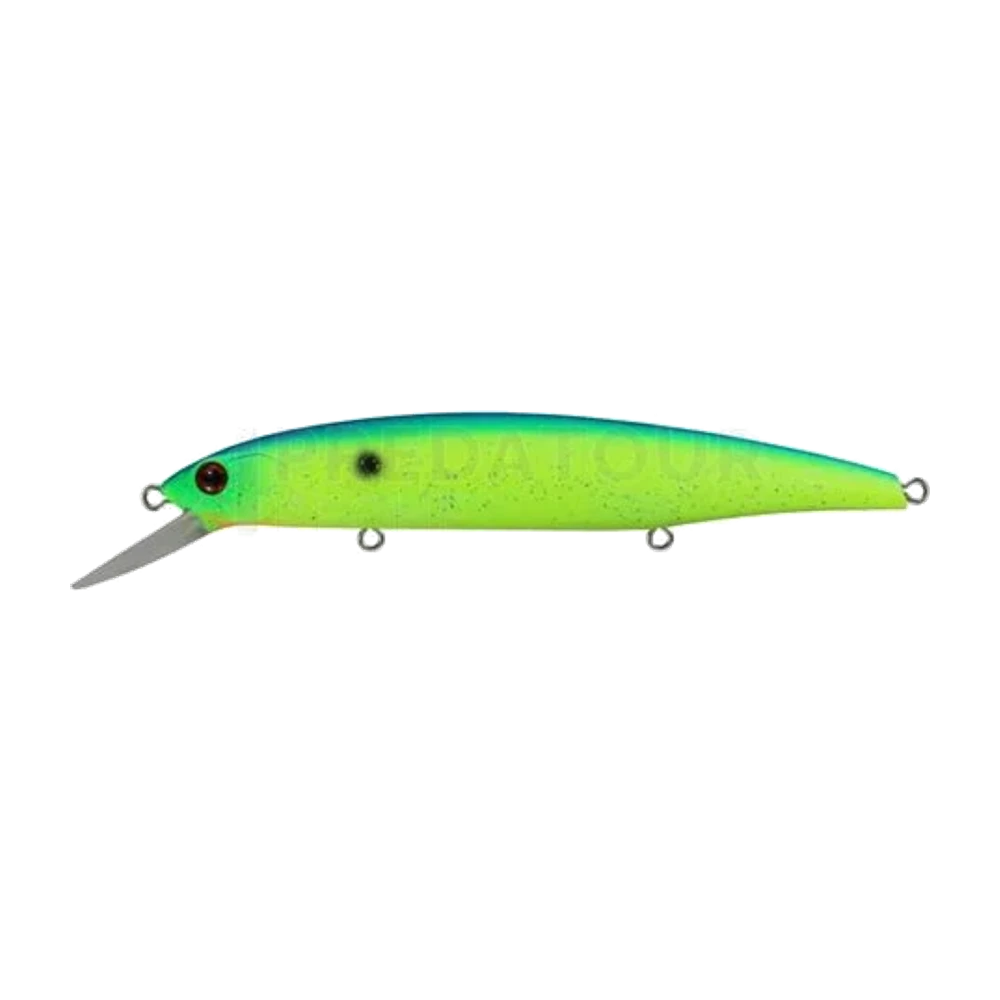
Before tying this one on, it helps to know if the spot actually calls for it. CarnaFish reads the scene from a photo.
You cast your minnow upstream, reel fast to pick up the slack, and the lure comes back to you doing nothing. You slow down and it drifts back like a stick. You speed up and it blows out of the water. After ten casts you decide this lure does not work in a river.
The lure is not the problem. The problem is that in moving water, the speed that makes a minnow swim is not your retrieve speed: it is the speed of the water passing over its lip. And those two numbers have almost nothing to do with each other.
A minnow cast upstream into a one-metre-per-second current and retrieved at one metre per second comes back to you at an apparent two metres per second — but it feels no flow at all, so it does not swim. The same lure cast downstream and held still on the line feels a full metre per second of flow: it swims at full pace without you turning the handle. Until you have taken that on board, you are fishing blind.
Think in relative speed, not handle turns
The practical consequence comes down to three situations you need to tell apart on every spot.
Casting upstream. The lure comes back with the current. To make it swim you have to retrieve noticeably faster than the water. That feels wrong to anyone used to still water, and it is the mistake made most often. The upside: you present the lure before you show yourself to the fish, which is decisive on trout in clear water.
Casting across. The lure crosses and drifts at the same time. The retrieve can stay moderate because the current supplies part of the flow. This is the most forgiving setting, and the right starting point on a spot you do not know.
Casting downstream. The current does everything. You retrieve very slowly, or not at all, and the lure swims while holding station. Handy for working a spot in front of an obstruction for a long time — but the fish sees you coming, so it is not the first pass to make.
The logical order on any spot is therefore upstream first, across next, downstream last.
A sinking minnow: count the drop
Sinking density is not a detail in this style of fishing. It gives you two things a floater cannot.
The cast. A five-centimetre lure weighing five or six grams flies twice as far as a floater of the same size, and above all it cuts under the wind. In a steep valley with wind coming up it, that difference decides the day.
The countdown. In a two-metre pool you can land the lure, count three, five or eight seconds, and start at whatever layer you want. That layered search is impossible with a floater, which stays glued under the surface.
In exchange, a sinker snags faster in shallow riffles and needs a firm start after the cast. In less than fifty centimetres of water, start retrieving the moment it lands.
On the water: in a pool, do not drop straight to the deepest layer. Make three casts counting to two, then three counting to four, then three counting to six. You find the active layer in ten casts instead of dragging the bottom for twenty minutes. And once you have found it, keep exactly that count for the rest of the river: trout in the same stretch almost always sit in the same band of water on the same day.
The retrieve: straight winding and sharp kicks
- Stand downstream and cast upstream, slightly across, past the spot you are targeting.
- Start immediately, faster than the current, to get the lure swimming and pick up slack at the same time.
- Give two sharp wrist twitches as the lure reaches the spot — in front of the boulder, at the head of the seam, along the foam line. The lure kicks out briefly then returns to its line.
- Go back to a straight retrieve for a second, then repeat the twitches a little further down.
- Do not lift the lure out too early. The end of the drift, as the lure climbs back towards you near the bank, produces bites regularly.
When a fish follows without taking, the most effective fix is not to slow down: it is to add a half-second stop between two twitches. A sinker drops slightly at that moment, and that is enough to trigger.
Sizes, weights and line
| Situation | Size | Line |
|---|---|---|
| Small stream, very clear water | 5 cm, 3 to 4 g | 0.12-0.14 mm fluorocarbon |
| Medium river, general use | 6 cm, 5 g | 0.14-0.16 mm nylon or fluorocarbon |
| Wide river or coloured water | 7 cm, 6 to 7 g | 0.16-0.18 mm |
| Perch in still water | 5 to 6 cm | 0.16-0.18 mm fluorocarbon |
An ultralight to light rod, 1.8 to 2.1 m on a tight river. Fluorocarbon is the better choice in clear water for its low visibility, and it sinks slightly, which helps hold the layer. On wild trout, crushing the barbs or switching to singles cuts damage sharply without costing much in hook-up rate.
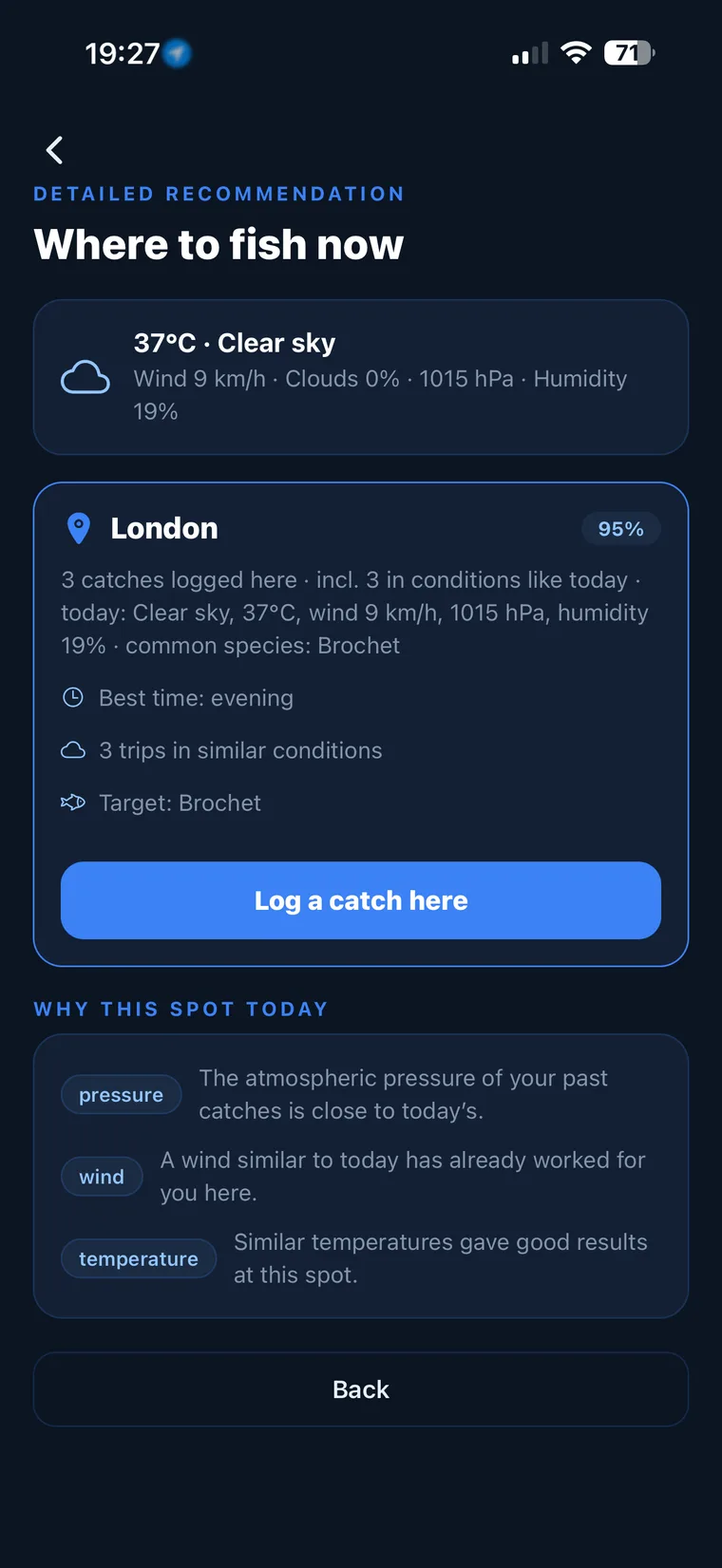
Not sure what to tie on?
Photograph your spot: CarnaFish reads the scene, cross-checks the conditions and gives you the zone, the lure and the retrieve. Free on iOS and Android.
Perch: same lure, different logic
In still water — a canal, a harbour, a lake margin — this compact size works very well on perch, but the current reasoning no longer applies. Here you supply all the flow yourself.
The sequence that works is simple: a slow straight retrieve broken by double twitches, with a one to two second stop. During that stop the lure sinks level, and the bite almost always comes as you start again. Along a quay wall or around a piling, three or four passes at different counts are enough to know whether the fish are there.
Where it is no use: in very dirty water, because a compact minnow trades on silhouette and flash, and a high-vibration lure carries far better in those conditions. Same on big deep rivers, where five grams will never reach the useful layer.
Mogul Minnow or D-Contact
The Smith D-Contact is the historic benchmark for the river sinking minnow, and the two lures cover the same ground. The useful difference is in how they behave on the twitch: the D-Contact is known for a very pronounced kick, almost a break-away, that snaps the lure clean off its line. A compact minnow like the Mogul stays closer to its axis, with shorter kicks and a more sustained swim between twitches.
In practice that means the first suits you better when you want to force an aggressive reaction in a fast seam, and the second when you want to keep working a straight retrieve in clear, calm water without overplaying the action.
Against a micro spoon like the Molix Nano Spoon, the logic is flatly opposite: the spoon works by letting the current do the job while you barely retrieve, whereas the minnow needs you to generate relative speed. Having both in the box lets you cover fast and slow spots with the same tackle.
Our guide to river trout fishing covers reading seams and where to stand. And if you are unsure about the casting angle when you reach the bank, CarnaFish reads a photo of the spot and answers.
Key takeaways
- What makes the lure swim is flow over the lip, not the speed of your retrieve.
- Upstream, retrieve clearly faster than the current; downstream, barely at all.
- Work every spot in this order: upstream, across, downstream.
- In a pool, search with counts of two, four then six seconds.
- On a following fish, add a half-second stop rather than slowing down.
FAQ
Why does my minnow not swim when I cast upstream?
Because the lure is coming back with the current: if you retrieve at current speed, no flow passes over the lip. You have to retrieve clearly faster than the water to get it swimming, which feels far too fast if you come from still-water fishing.
Sinking or floating minnow in a river?
A sinker brings two decisive advantages: it casts much further for the same size and it lets you search pools by countdown. The floater keeps the edge on riffles under fifty centimetres, where a sinker snags.
In what order should I fish a spot?
Upstream first, then across, then downstream. The first casts present the lure before the fish spots you, which counts enormously on trout in clear water. The downstream cast, where the fish sees you coming, is saved for last.
What size should I choose?
5 cm on a small very clear stream, 6 cm for general use, 7 cm on a wide river or coloured water. Weight matters as much as length: it governs casting distance and the layer you can reach.
Does it work for perch?
Yes, in still water — canals, harbours, lake margins. The useful sequence is a slow straight retrieve broken by double twitches and a one to two second stop, the bite almost always coming as you start again after the stop.
How does it differ from a micro spoon?
A spoon works by letting the current create the wobble, with almost no retrieve. A minnow needs the opposite: you create the relative speed. The two cover different spots and complement each other more than they replace each other.
The full trout lure guideSeason-by-season strategy: which family of lure, when, and why.Go from theory to fish
CarnaFish reads your spot from a photo and gives you the game plan: zone, lure, retrieve. Free on iOS and Android.