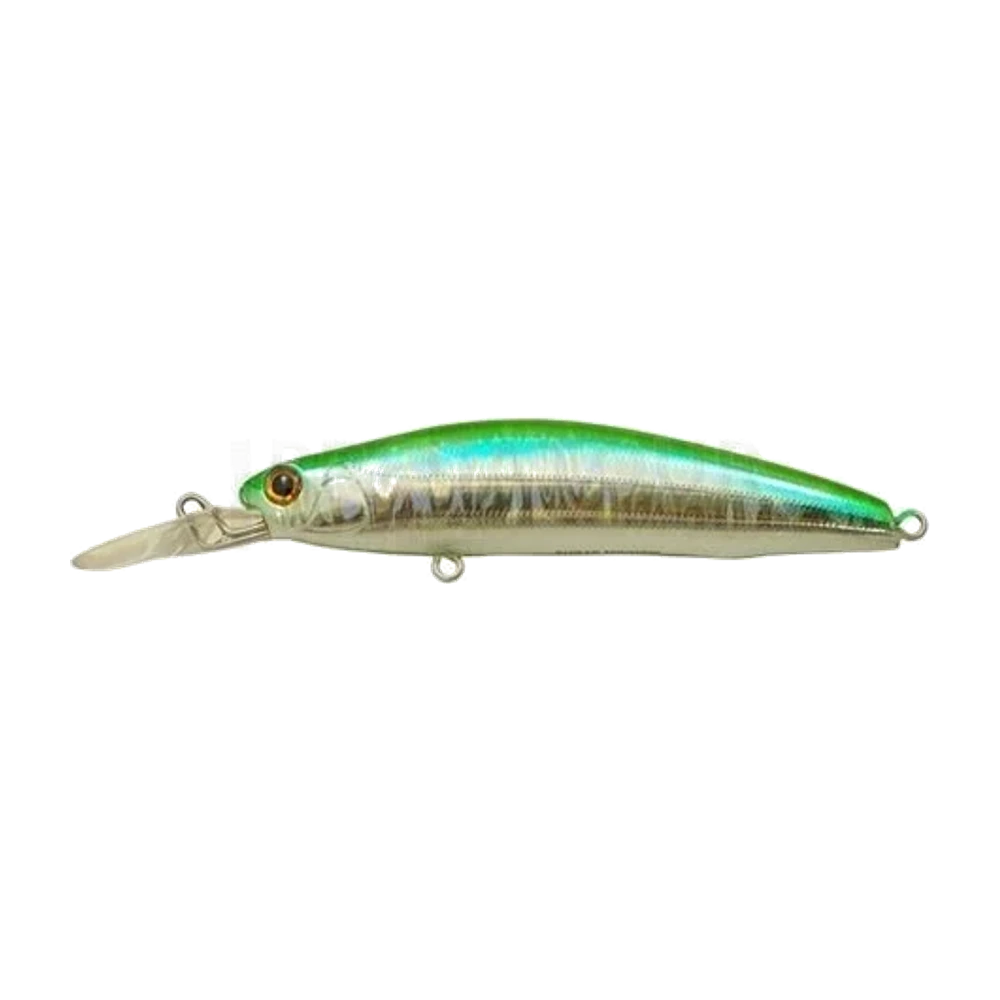
Bassday Sugar Minnow: the tight action that gets through the chop
Before tying this one on, it helps to know if the spot actually calls for it. CarnaFish reads the scene from a photo.
There is one situation everyone on the coast recognises: the bass are feeding, you can see them, and they refuse everything you throw. Often the problem is neither colour nor size. It is the amplitude of the action. In water already churned by wind and swell, a minnow that sweeps widely sends an incoherent signal — it moves too much, inside a mass of water that is already moving.
The Sugar Minnow takes the problem the other way round. Its action is deliberately tiny in amplitude but very fast in frequency. The slim body shivers on the spot rather than swinging its hips. In broken water that is exactly the kind of signal that stands out: a continuous, regular shimmer that does not blend into the surrounding mess.
It is a finesse lure in a brutal environment, which is rarer than it sounds.
Why such a slim profile changes the behaviour
The Sugar Minnow is built around a narrow body, almost blade-like seen from above. Three direct consequences on the water.
It offers little resistance to side current. A fat-bellied minnow catches the flow like a sail: it lies over, comes off line, and rises to the surface as soon as the push increases. The Sugar's slim profile crosses the current without being swept away, which lets you keep a readable path even across a tidal flow.
It holds its action at slow speed. Many saltwater minnows need a firm retrieve before they start vibrating. This one starts almost immediately, which counts enormously when the bass are on small bait and refusing fast retrieves.
It imitates a precise profile. Sandeel, sand smelt, small garfish: long, slim prey dominate much of the year along the coast. A lure of the same build asks the fish for no interpretation at all.
The retrieve: straight, but never constant
This lure is not fished in twitches. It is fished on a continuous retrieve, which does not mean a mechanical one.
- Cast across or slightly up-current, not downstream. You want the lure to cross the flow, not to climb it.
- Start the retrieve on impact, without letting the lure sink if you are fishing a floating version over rock.
- Wind steadily, around one handle turn per second, keeping the rod tip low to limit wind on the line.
- Slow down by a third for two or three seconds every five or six turns, without ever stopping completely. The lure rises very slightly and its vibration changes frequency.
- Pick the original rhythm back up. Most bites come on that pick-up.
- Fish the cast out: a following bass often decides in the last three metres, right at your feet.
On the water: in broken water, do not try to feel the action in the rod. If you feel it strongly, you are retrieving too fast. The right speed is the one where you sense a faint vibration, almost on the edge of disappearing — that is where the Sugar stays in the right layer and keeps its own frequency.
Choosing size and density
Sugar Minnows come in several lengths and in floating or sinking versions. The choice is made on the depth of the mark and on the wind, not on the size of the fish you are after.
| Situation | Size | Density | Target layer |
|---|---|---|---|
| Rock plateau, 30-80 cm of water | 7 cm | Floating | 20 to 40 cm |
| Beach edge, headwind | 9 cm | Sinking | 40 to 80 cm |
| Tidal current across | 8-9 cm | Sinking | 60 cm to 1 m |
| Very clear water, visible fish | 7 cm | Floating | Just under the surface |
The sinking version is not only there to go deeper: above all it lets you cast into the wind. On an exposed coast, the extra distance from the weighted version is often what puts you within range of the feeding zone.
Where it excels, and where not to use it
The Sugar Minnow is made for hard, shallow ground, right next to structure.
- Drying rock plateaus late on the flood, when 40 cm of water covers the rock and the bass come in to forage.
- Breakwater edges and rock armour, fished parallel to the structure rather than at right angles to it.
- Creek mouths and tidal races, across the flow.
- Clear water and educated fish, where a wide-action lure gets refused.
Conversely, it is wrong as soon as you have to search a volume of water at depth. Beyond a metre and a half it has nothing to offer: no mass to get down fast, no low-frequency vibration to call from a distance. On a deep mark or fish sitting on the bottom, a soft plastic on a jig head or a blade bait covers infinitely better. It is also disappointing on a dead-flat oily sea in full daylight: its discretion then turns into invisibility.
Not sure what to tie on?
Photograph your spot: CarnaFish reads the scene, cross-checks the conditions and gives you the zone, the lure and the retrieve. Free on iOS and Android.
Sugar Minnow or Sugapen: two answers to the same fish
The same brand makes a very well-known topwater stickbait, and that is the most useful comparison to draw. The Bassday Sugapen works on the surface, leaving a wake and throwing spray: it calls, it brings fish up, it produces spectacular visual takes. It needs a reasonably readable sea and fish willing to come up.
The Sugar Minnow works just below, in the top 20 to 80 centimetres, and does not call: it gets accepted. When the bass refuse to come up — cold water, full light, fishing pressure — switching from the Sugapen to the Sugar Minnow on the same mark often changes the day.
To cover a deeper layer still, a Duo Tide Minnow Slim runs a little lower with a comparable profile. Our guide to sea bass lure fishing covers how to work these three levels through one tide. And if you are unsure which layer to attack when you arrive in front of a rock plateau, CarnaFish reads a photo of the spot and answers.
Rigging and care in salt water
Tie it straight to 0.25 to 0.30 mm fluorocarbon, or to a leader of that diameter if you fish braid. A snap is acceptable as long as it stays small and light: on a slim lure, any weight added up front flattens the frequency of the action.
The stock trebles are fine wire, which helps the action but corrodes quickly. Rinse in fresh water after every session as a matter of course, and replace the trebles as soon as a point catches on a nail without biting. If you fit heavier hooks for bigger fish, compensate by retrieving slightly faster, or the lure works too deep and hits the rock.
Key takeaways
- Very low amplitude, high frequency: a signal that stands out in water that is already moving.
- Slim profile that crosses current without lying over, and starts working at slow speed.
- Straight retrieve, with a one-third slowdown every five or six handle turns.
- The sinking version is mostly useful for casting into the wind, not just for going deeper.
- No use beyond a metre and a half: this is not a deep-searching lure.
FAQ
How deep does the Sugar Minnow swim?
Between 20 and 40 cm for the floating versions, and down to 80 cm or a metre for the sinking versions retrieved slowly. Speeding the retrieve up brings it higher; slowing down takes the weighted models slightly deeper.
Floating or sinking for shore fishing?
Floating over shallow-covered rock plateaus, where you have to stay above the rock. Sinking as soon as there is a headwind, current, or more than a metre of water: the extra casting distance is often decisive.
What retrieve speed should I use?
Around one handle turn per second, with slowdowns. The reference point is tactile: you should sense a faint vibration rather than a firm swimming action in the rod. If it pulls hard, you are going too fast.
Does the Sugar Minnow work in fresh water?
Yes, on perch and small pike along the edge, especially in clear reservoirs. Its window there is narrower than in salt water, because freshwater predators often respond better to a wider action or a lower-frequency vibration.
Can it be used with a snap?
Yes if it is small and light. On a lure this slim, a bulky snap adds weight up front and flattens the frequency of the action, which is precisely what you are buying it for.
What colour should I choose in broken water?
A dark or pearl back with silver flanks. In churned water it is the contrast of the back and the flash off the flanks that carry, not the exact shade. Translucent finishes are for clear, calm water.
The full sea bass lure guideSeason-by-season strategy: which family of lure, when, and why.Go from theory to fish
CarnaFish reads your spot from a photo and gives you the game plan: zone, lure, retrieve. Free on iOS and Android.