Sakura Naja: the short crankbait that rises the moment you stop
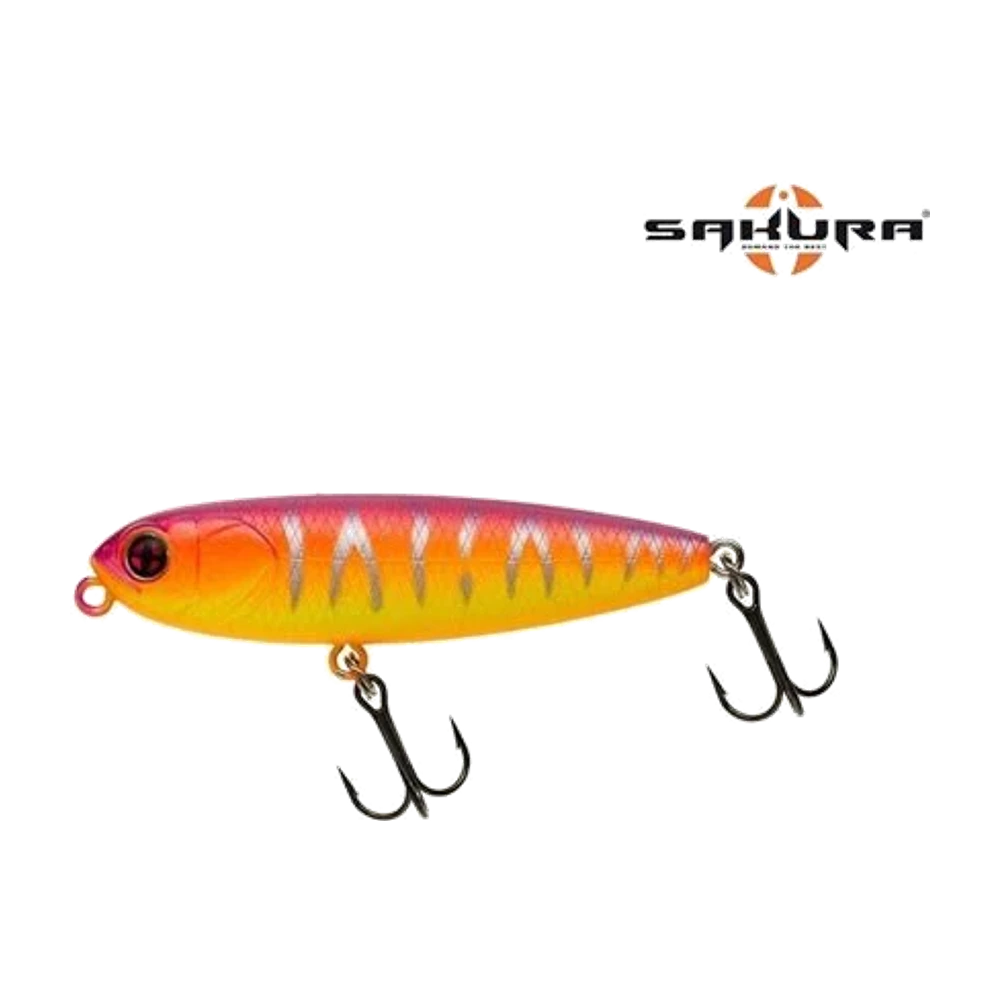
The right lure in the wrong spot still catches nothing. CarnaFish spots the zone that works, from a single photo.
Contact with the bottom is what produces bites in cranking. Everyone knows that. What gets said less often is what happens two seconds later: the lure is wedged between two rocks, or hooked in a sunken branch, and you spend the next five minutes trying to get it back. On a river with a cobble bottom or a bank cluttered with wood, a crankbait that will not free itself is a crankbait you no longer dare cast where it counts.
The Naja answers that problem with one distinctive feature: strong buoyancy. Not neutral, not slow — strong. The moment you stop reeling it rises clearly, nose up, and backs itself out of the obstacle. That is what lets you deliberately fish it in places where you would not send a slow-floating crankbait.
That rise is not just an anti-snag system. It is a retrieve in its own right, and it is where most of the bites come from.
A short profile that forgives trajectory errors
The Naja is a compact crankbait with a stubby body. That short, deep format has three direct consequences.
It rolls far more than it wags. A short body pivots around its long axis on every beat, producing alternating flash off both flanks. On a perch hunting by sight in medium visibility, that flash carries further than a tight vibration.
It changes direction easily. On contact with a rock, a long body goes sideways and stays sideways. A short body deflects, then realigns within two turns of the handle. That is what makes trajectory deflections usable rather than a loss of control.
It gets inhaled effortlessly. A 25 cm perch can take a 5 to 6 cm lure whole. That is precisely the point of a short crankbait for this species: you keep a visible volume and a powerful action without going over mouth size.
The lip, depending on the version, puts the swim between a metre and a half and three metres. The right way to choose is not "how deep is my spot" but "what depth puts me in contact" — more on that below.
The retrieve: hitting the obstacles on purpose
- Pick the lip version that makes the lure touch. Swimming depth should be slightly greater than the depth of the spot. If you are fishing two metres, take the version that runs at two metres fifty.
- Cast well beyond the zone and retrieve at medium speed to bring the lure to its maximum depth before it reaches the spot.
- Keep contact — rocks, branches, gravel. You should feel regular knocks in the rod. If you feel nothing, you are fishing too high.
- The moment the lure jams or snags properly, stop everything. Semi-slack line, do not pull. The lure rises and backs itself free.
- Count one to two seconds during that rise. This is the window: the fish sees a prey that has just struck the bottom and is escaping upwards.
- Restart with one fast turn of the handle to make the lure dive hard again, then go back to medium speed.
That sequence — contact, stop, rise, sharp restart — is the complete retrieve. It turns a fault, the lure snagging, into a trigger.
On the water: when you are stuck, whatever you do, do not pull towards you. Move two or three steps towards the lure, or drop the rod to give slack, and wait three seconds doing nothing. The buoyancy does the job on its own. Almost every crankbait that gets lost is lost because the angler pulled instead of waiting.
Setting depth without changing lure
| Adjustment | Effect on depth | Side effect |
|---|---|---|
| 0.22 mm fluorocarbon instead of 0.28 mm | + 20 to 30 cm | Slightly freer action |
| Rod held high (tip at 11 o'clock) | − 30 to 50 cm | Less bottom contact |
| Rod pointed at the water | + 20 to 40 cm | Softer hookset |
| Longer cast | + up to 50 cm | More time at maximum depth |
| Fast retrieve | + 10 to 20 cm, then it plateaus | Roll harder to read |
Remember the first two rows above all: line diameter and rod position are the two real depth controls in cranking. You can cover a whole metre-wide range with a single lure by playing with them, which saves changing model every fifteen minutes.
The Naja tolerates a small clip: it does not noticeably degrade the action of such a short body, and it saves time on a spot where you are alternating depths.
Not sure what to tie on?
Photograph your spot: CarnaFish reads the scene, cross-checks the conditions and gives you the zone, the lure and the retrieve. Free on iOS and Android.
Perch and zander: two different windows
For perch, this is a shoal lure. You look for rocks, boulder tops and shallow shelves along the edge of a hole, generally between one and three metres. The best period is late summer and autumn, when grouped perch are actively hunting fry on the flats.
For zander, it is more counter-intuitive and more situational. Zander are not a crankbait fish in the classic sense, but they respond very well to a crankbait brought back in contact with a hard bottom in a river, along rip-rap or over a cobble flat, especially at dusk or in stained water. The key is speed: markedly slower than for perch, with longer stops.
It is unsuited in two cases. Over deep soft silt, where contact produces neither a knock nor a usable cloud and the lip just buries itself. And on fish holding in very clear, calm water, where a crankbait this noisy puts everyone on alert: there, a discreet soft plastic will pay better.
Naja or a bigger American crankbait
Against a Strike King 3XD, the Naja plays the reduced-format and fast-rise card. The 3XD is a bass crankbait, bulkier, with a wider and more powerful action — excellent for covering big areas quickly at two or three metres, less right for river perch that refuse a large volume. If you want to get significantly deeper, the Strike King 5XD is the one to look at: the whole principle of cranking in contact is covered there in full, no need to rewrite it here.
At the other end, the Illex Diving Chubby 38 reaches the same depth range in a much smaller package: that is the choice when perch are on two-centimetre fry and refuse anything over four centimetres. The Naja sits between the two, and that is what makes it a good first-choice lure.
Our guide to lure fishing for perch covers reading cobble flats. And if you are unsure which lip depth to fit in front of an unfamiliar bank, CarnaFish analyses a photo of the spot and answers.
Key takeaways
- Strong buoyancy: the lure rises nose-up the moment you stop and backs out of obstacles.
- Pick the lip that dives a little deeper than the spot, to guarantee contact.
- Contact, stop, a one to two second rise, fast restart: that is the complete retrieve.
- Stuck? Give slack and wait. Pulling is what loses crankbaits.
- Line and rod position set depth as effectively as changing model.
FAQ
How deep does the Sakura Naja swim?
Between a metre and a half and three metres depending on the lip version, with standard fluorocarbon. Thinner line and a long cast add twenty to thirty centimetres, a rod held high takes the same amount off.
What do I do when the crankbait jams in a branch?
Stop reeling, give slack and wait two or three seconds. The lure's strong buoyancy makes it rise and back off, which frees it on its own. Pulling towards you is what drives the trebles permanently into the wood.
Is the Naja really effective on zander?
Yes, in one specific case: brought back slowly in contact with a hard bottom, over rip-rap or a cobble flat, preferably at dusk or in stained water. It is not a universal use, but it is a good complement to soft plastics on those spots.
What retrieve speed should I hold?
Medium and steady for perch, markedly slower for zander, with stops after every contact. The right speed is the one that lets you feel the bottom without the lure jamming every metre.
Can I use it with a clip?
Yes. On a body this short with an action this wide, a small light clip does not degrade the action and lets you switch lip depths quickly on the same spot.
Why is the lure ineffective over silt?
Because the contact produces nothing usable: no clean knock, no deflection, and the lip buries itself without raising a readable cloud. Over soft silt, a soft plastic or a lipless passing just above will be more productive.
The full perch lure guideSeason-by-season strategy: which family of lure, when, and why.Go from theory to fish
CarnaFish reads your spot from a photo and gives you the game plan: zone, lure, retrieve. Free on iOS and Android.