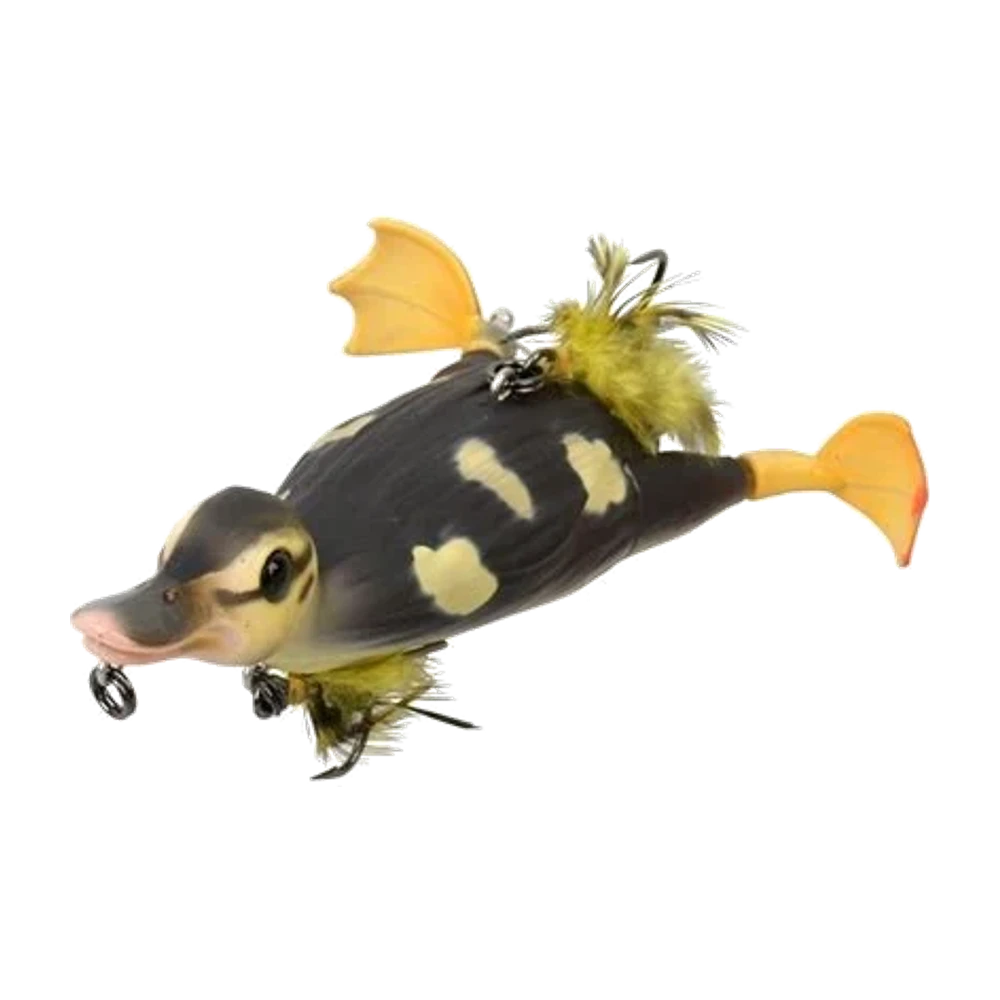
Savage Gear 3D Suicide Duck: the duckling that brings big pike out
The right lure in the wrong spot still catches nothing. CarnaFish spots the zone that works, from a single photo.
Late July, three in the afternoon, a lily pad edge on a lowland pond. The water is at 24 °C, you have spent the morning winding soft plastics back without a bite, and you know there are big fish sitting under the vegetation. The problem is not finding the pike: it is giving it a reason to come out.
At that time of year, margin pike see frogs, moorhens and ducklings go past. These are prey that move slowly, on the surface, making plenty of noise — and that represent a substantial meal for very little energy spent. The Suicide Duck imitates exactly that, large, slow and loud.
It is a lure of few bites and big bites. You have to approach it knowing that.
Why the feet do all the work
The silhouette counts, but it is not what triggers. Under the body, two feet mounted on an axle turn as soon as you start reeling. They produce three distinct signals:
- A steady surface lapping, audible from several tens of metres, very different from the sharp plop of a popper or the silent sliding of a stickbait.
- Turbulence under the body, visible from below as a patch of disturbed water. That is what a pike sitting in two metres of water sees.
- A sideways waddle: with the feet turning in opposition, the body rocks slightly from right to left even on a straight retrieve. The lure does not run straight as a rail.
Another detail that changes things: the body is very buoyant and fairly wide. It slides over vegetation instead of sinking into it, which lets you cross a mat of lily pads or filamentous algae, where no lure with exposed trebles survives.
The retrieve: slow, steady, and above all patient
There is not much to invent, but the rhythm is not intuitive.
- Cast to the edge of the vegetation, never into open water for its own sake. The lure should track along a margin, a mat or a fallen tree.
- Retrieve slowly and steadily, just fast enough for the feet to turn continuously. You should hear the lapping, not see a spray.
- Make stops of 3 to 8 seconds every two or three metres, particularly as you pass the corner of an obstacle. The lure sits there, perfectly still.
- Start again gently after the pause: that restart is what draws the most attacks.
- If you get a boil with no contact, do not cast back into the same place straight away. Leave the lure motionless for five seconds, then move off again. A pike that has missed often comes back within ten seconds.
- If nothing follows, change the rhythm completely on the next pass: faster, without stops. Alternating slow and fast beats alternating lures.
On the water: with this lure, never strike at what you see. The boil is spectacular and makes you react half a second too early, when the pike has often only pushed the lure. Strike when you feel the weight in the rod, not before. Count "and one" to yourself between the explosion and the hookset: that is the only way to convert these takes.
Choosing the size: it defines the fish, not the spot
| Size | Indicative weight | Real use |
|---|---|---|
| 10.5 cm | around 28 g | Pike of 50 to 80 cm, ponds and small gravel pits, medium-heavy rod |
| 15 cm | around 70 g | The reference format for targeting pike over a metre |
| 20 cm | around 150 g | Summer catfish on shallow ground, very big pike, heavy tackle essential |
The 15 cm already calls for a rod rated to 100 g and braid of at least 0.40 mm. The 20 cm falls outside the scope of standard predator tackle: without a heavy casting rod, you will have broken it or hurt yourself before the first bite.
For catfish, the 20 cm format comes into its own on shallow summer margins, at dusk, when the fish move up to hunt. The principle stays the same — slow, loud, along the edge — but the hookset demands even more restraint.
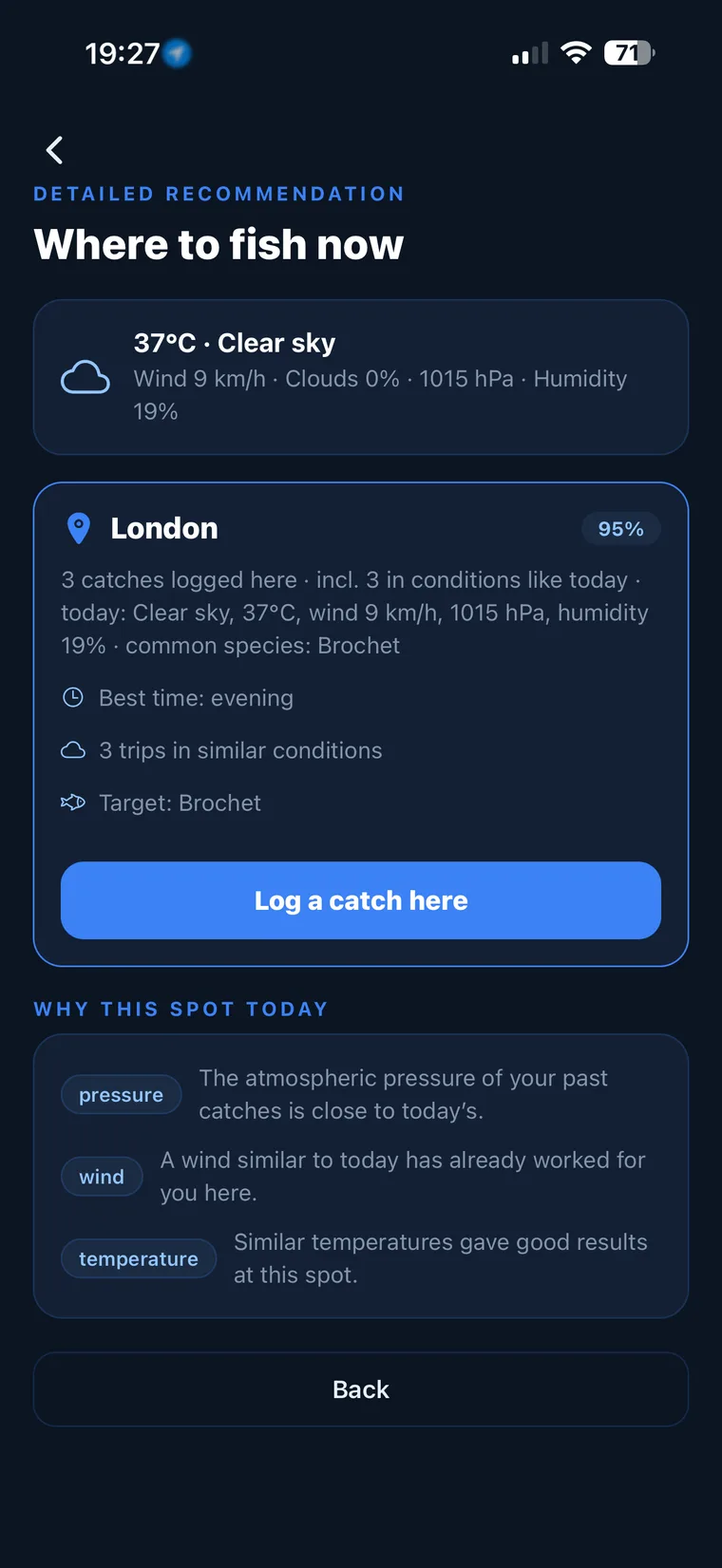
Not sure what to tie on?
Photograph your spot: CarnaFish reads the scene, cross-checks the conditions and gives you the zone, the lure and the retrieve. Free on iOS and Android.
Where it produces fish, and where it is no use
Its windows are narrow but clear-cut:
- Warm water, above 18 °C. That is the main condition.
- Shallow water, from 50 cm to 2.5 m, with vegetation or wood.
- Low light: dawn, dusk, and the first hour of darkness. The middle of the day also works over heavily weeded water.
- A calm to lightly rippled surface. A small ripple actually helps, it masks the flaws in the imitation.
Conversely, forget it in four cases. In cold water below 14 °C, where pike no longer come up to feed on the surface. In deep water with no structure, where nothing justifies a fish rising eight metres. In heavy chop, where the lapping of the feet disappears entirely. And for searching wide: this is a slow lure, you cover little ground, and it should be brought out on spots you have already identified.
One last practical point: the trebles are mounted under the body and stay exposed. The lure clears floating vegetation, but not submerged branches.
Suicide Duck or 3D Rad Rat
Both are surface imitations of land prey, and yet they are fished differently.
The Savage Gear 3D Rad Rat has a low, elongated silhouette, it glides with a soft tail undulating behind it, and it takes well to walking the dog: it is a travelling lure, effective at night along the banks, that can be brought back over long distances. It also fits better where you need to be discreet.
The Suicide Duck sits higher on the water, is bulkier and louder. It does not imitate an animal crossing: it imitates an animal in trouble that is barely moving. It is a spot lure, cast at a precise point and worked slowly along the edge. Over a lily pad mat in high summer, it beats the rat. On a bare bank at night, it is the other way round.
If you want a loud surface signal that searches faster, a Whopper Plopper 130 covers far more ground per hour. Our guide to choosing a pike lure places these three families relative to one another. And if you are unsure what size to fit in front of a cluttered margin, CarnaFish analyses a photo of the spot and answers.
Key takeaways
- The rotating feet produce continuous lapping and turbulence under the body: that is the real signal.
- A slow, steady retrieve, with stops of 3 to 8 seconds at the corners of obstacles.
- Strike on the weight you feel, never on the boil you see. That is the mistake that costs the most fish.
- The 15 cm targets big pike; the 20 cm calls for heavy tackle and aims at catfish and exceptional fish.
- Water above 18 °C, shallow, with vegetation. No use in cold water, out in open water, or in heavy chop.
FAQ
What time of year should I use the Suicide Duck?
From late spring to early autumn, as soon as the water goes above 18 °C. Below 14 °C, pike stop coming up for surface prey and the lure becomes useless.
Why am I missing the takes?
Because you are striking too early. The visible explosion often comes before the actual take: the pike pushes the lure first. Wait until you feel the weight in the rod — half a second of restraint is enough to change the conversion rate.
What size should I choose for pike?
The 15 cm is the reference format for targeting fish over a metre. The 10.5 cm suits ponds and pike of 50 to 80 cm better, with lighter tackle.
What tackle do I need to work it?
A rod rated around 100 g for the 15 cm, braid of 0.40 to 0.50 mm, and a wire or heavy fluorocarbon leader. The 20 cm format falls outside the scope of standard predator tackle.
Does it clear lily pads?
It slides well over a mat of floating vegetation thanks to its very buoyant body, but its trebles stay exposed: it will not get through submerged branches. Aim at the edges rather than the heart of dense weed.
What is the difference with the 3D Rad Rat?
The Rad Rat is lower, more discreet and built to travel, including walking the dog at night. The Suicide Duck is bulkier and louder, and is worked very slowly on a precise spot in high summer.
The full pike lure guideSeason-by-season strategy: which family of lure, when, and why.Go from theory to fish
CarnaFish reads your spot from a photo and gives you the game plan: zone, lure, retrieve. Free on iOS and Android.