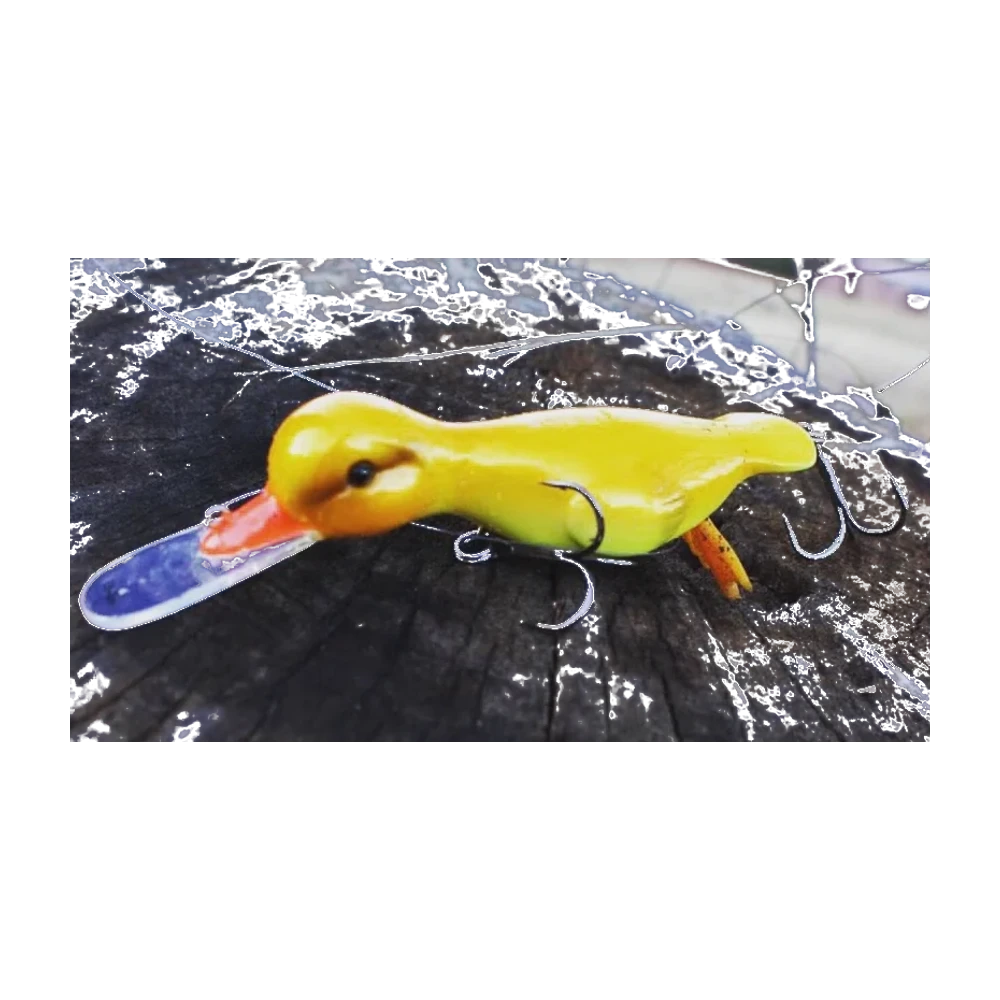
Westin Billy the Mallard: the duckling you fish in the June window
One lure, endless conditions. CarnaFish reads your spot from a photo so you are not just guessing.
There is a period of the year, a few weeks at most, when the big pike in a water eat birds. Not occasionally: regularly. Mallard broods are out on the water, ducklings cross in single file along the reed beds, and an eighty-centimetre pike never gets access to prey that calorific and that poorly defended.
The rest of the year, that same pike never sees one. That is what makes duckling lures peculiar: they are not versatile, they are seasonal. Throwing one in November is a waste of time; throwing one in mid-June along a reed-lined bank is one of the few ways to provoke a big-fish attack in broad daylight.
The Billy the Mallard is built for that window. It is a good-sized duckling imitation, heavy, fished as a towed wake rather than as an animated lure.
A duckling is not a rat
Plenty of anglers file both under "surface animal lure". On the water they do completely different things.
- The silhouette seen from below is wider and shorter. A rat is an elongated spindle; a duckling is a round, compact mass. That is what the pike sees on the way up, and it triggers a different kind of attack, often more frontal and more violent.
- The soft legs produce a low-frequency signal under the surface, a slow, irregular kicking, very different from the tail-whip of a rat. They are the only submerged part of the lure: they give the rising fish its reference point.
- The body sits high and stable. The Billy does not get rolled by chop the way a slim body does, which lets you fish it in light wind without it going over on its side.
- The time slot is daytime. Ducklings cross in daylight. The rat is nocturnal prey, and is logically fished at nightfall.
The retrieve: a wake, nothing else
This is fishing with no technical difficulty in the hands, but heavy demands on the trajectory.
- Cast parallel to the bank, not perpendicular. A duckling does not head out into open water, it runs along the edge.
- Start retrieving immediately, before the lure stops. A duckling sitting inert looks like nothing; the movement is what makes the imitation.
- Constant, slow speed, just enough to hold a clean, steady V behind the body. You should see the wake forming over three or four metres.
- Every five to ten seconds, accelerate hard for two turns of the handle, then return to the original speed. This imitates a duckling panicking for a second — the main trigger.
- Do not strike at the sound. Wait to feel the weight in the rod, then set the hook sideways, hard, pulling to the side.
Point 5 is what costs the most fish on this kind of lure. A pike often misses its first rise; if there is no longer a lure on the water because you struck at nothing, there is no second chance.
On the water: when an attack fails, whatever you do, do not wind in and recast. Stop everything, leave the lure perfectly still for five seconds, then restart very slowly. A duckling that has just escaped a predator freezes before bolting again — and the second attack almost always comes on that restart, more committed than the first.
Tackle: do not go lighter
A 70 to 90 g lure demands a setup of its own, and hanging it on a standard pike rod will end badly.
| Item | Specification |
|---|---|
| Rod | 2.40 to 2.70 m, 100 to 150 g casting weight |
| Reel | casting 300 to 400, or spinning 5000 to 6000 |
| Braid | 0.50 to 0.60 mm, no stretch tolerable |
| Leader | coated steel or titanium, 40 cm minimum, 40 kg |
| Snap | heavy, welded eye, never a stock snap |
The long leader is not just protection against teeth. On a surface attack the fish often turns on the lure and rolls: it is the body of the line, not the tip, that rubs against the teeth.
Not sure what to tie on?
Photograph your spot: CarnaFish reads the scene, cross-checks the conditions and gives you the zone, the lure and the retrieve. Free on iOS and Android.
Where and when it works
- Mid-May to late August, peaking when broods are visible on the water. Look at the water before choosing this lure: if you see ducks with young, you are in the right window.
- Along reed beds, lily pads and wooded banks, over 1 to 3 m of water. The fish has to be able to come up fast.
- On catfish at dusk, on the edge of deep water. The low-frequency signal from the legs is exactly what a catfish's lateral line picks up best, and the attack often comes with no warning at all.
It is wrong in cold water, where no fish will rise three metres for prey that size. It is also wrong on rough water: the wake, which is the bulk of the signal, disappears in chop. And it is not a search lure — over a big featureless expanse you are casting into the void.
Billy the Mallard or Rad Rat
The Savage Gear 3D Rad Rat is smaller, slimmer, and is mainly fished at nightfall or after dark, often across a weed bed. It produces a more discreet wake and a constant tail-whip. It is the better choice when you want a surface animal lure usable throughout the warm season and on a less extreme setup.
The Billy the Mallard aims at something else: a short calendar window, a far bulkier profile, and a big-fish attack in the middle of the day. The 3D Suicide Duck shares the same imitation family in a more compact, more manageable format, to be kept for waters where mid-sized pike dominate.
If you want a big surface profile without the imitative angle, the Westin Mike the Pike covers the same class of fish with a conventional prey shape. Our guide to choosing a pike lure places these options across a full season. And if you are unsure whether a duckling lure makes sense for the bank in front of you, CarnaFish analyses a photo of the spot and answers.
Key takeaways
- A seasonal lure: mid-May to late August, when broods are genuinely out on the water.
- The V wake and the kicking legs do all the work, not the retrieve.
- A brief burst every five to ten seconds to force the decision.
- Strike on felt weight, never on the sound of the attack.
- 0.50-0.60 mm braid and a 40 cm steel or titanium leader, no exceptions.
FAQ
When should you use a duckling lure?
From mid-May to late August, peaking when mallard broods are visible on the water. Outside that window, pike no longer have that prey in their repertoire and the lure loses almost all of its interest.
How do you work the Westin Billy the Mallard?
A slow, constant retrieve to hold a V wake, broken by a brief two-turn burst every five to ten seconds. No rod work is needed at all.
What tackle do you need for an 80 g lure?
A rod rated 100 to 150 g, a 300 to 400 casting reel, 0.50 to 0.60 mm braid and a 40 cm steel or titanium leader. A standard pike setup is undersized and will break.
Why do you miss so many surface attacks?
Because you strike at the sound. You have to wait until you feel the weight of the fish in the rod before setting the hook, and set it sideways. An early hookset drags the lure out of the zone and removes the second chance.
Does the Billy the Mallard catch catfish?
Yes, mainly at dusk on the edge of a hole. The low-frequency kicking of the legs is picked up well by a catfish's lateral line, and attacks often come with no visible sign before impact.
How does it differ from a surface rat lure?
The rat is slimmer, quieter, nocturnal, and usable throughout the warm season. The duckling is bulkier, diurnal, and tied to a short part of the year. They do not replace each other.
The full pike lure guideSeason-by-season strategy: which family of lure, when, and why.Go from theory to fish
CarnaFish reads your spot from a photo and gives you the game plan: zone, lure, retrieve. Free on iOS and Android.