Megabass Dark Sleeper: the weighted goby that crawls without snagging
Before tying this one on, it helps to know if the spot actually calls for it. CarnaFish reads the scene from a photo.
Fish glued to the bottom are the hardest to reach. Not because they refuse to eat, but because most lures pass thirty centimetres above them, in a layer where nothing is happening. Getting down to their level means a lure that will accept scraping, bumping into rock and crossing dead wood without staying there. The Megabass Dark Sleeper is built entirely around that constraint.
A low weight, and everything follows from it
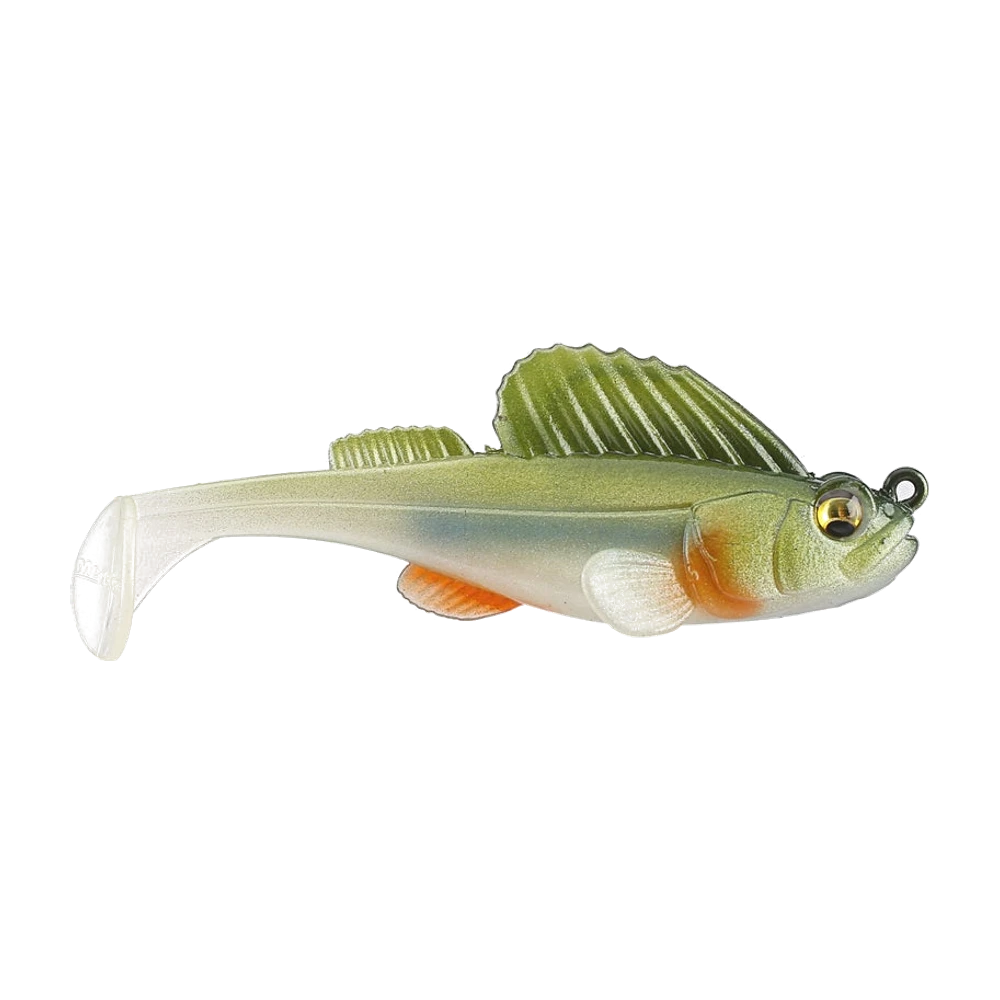
Megabass describes a weight set low in the body, which gives the bait a stable attitude and the stealthy presentation of a bottom-bouncing swimbait. That is the structuring choice: a weight placed low, under the axis of the body, systematically brings the bait back into the right position after every obstacle instead of letting it topple onto its flank.
The profile follows the same logic. The Dark Sleeper imitates a goby, that is, a bottom fish that does not swim in open water and moves in short hops between stones. Broad head, high back, large dorsal, flat belly: this is not a baitfish fleeing, it is a settled prey item caught out. That changes how you work it completely.
And it has to be said straight away what the description does not say: neither length, nor weight, nor the exact number of sizes is published. The maker mentions a low weight without giving its value. Several references coexist at different prices, but no measurement appears in this text — check the packaging before buying if you are targeting a precise depth.
The fin that hides the hook
This is the bait's real signature. The large dorsal fin is not decoration: it is moulded from a soft material entirely around the top hook, which it covers completely. In the photo, no point shows at all.
Two consequences, both claimed by Megabass. First, snag resistance: that solid dorsal protects the point and slides the bait through dead wood, branches and rock where a bare hook would hang up. Second, hook sets: at the moment of the strike the fin collapses instantly under the pressure of the jaws and frees the point. Many weedless rigs fail on exactly that second part, because the body material is too thick to compress quickly.
Check the condition of the dorsal every ten or fifteen fish. A fin that has lost its elasticity still protects the point but no longer collapses fast enough: you keep the snag resistance and lose the hook sets, which is the worst of both worlds.
A tail that works at crawling speed
The other technical point highlighted is the suppleness of the paddle tail. Megabass states a plastic that is both extremely tough and very soft, allowing a natural kicking action even at very slow retrieve speeds, close to a crawl.
That is fundamental on a bottom lure. A stiff paddle needs speed to start up; slow down to stay in contact and it stops working, leaving you dragging an inert lump of plastic. Here you can retrieve slowly enough to feel every stone and still keep a continuous signal going. That is exactly the speed at which a zander sitting behind a break will agree to move.
Three retrieves that cover the ground
The simplest is the crawling straight retrieve: wind slowly enough to feel the bottom the whole way, never lifting off. Over gravel or stone, that is often all it takes.
The second is pull and pause, with a full stop of one to three seconds after each short move. The low weight sets the bait back down on the bottom in its natural posture, and the bite very often comes as you restart.
The third, the most effective in wood, is to bump the obstacle deliberately, release tension for half a second, then move on. The bait crosses the branch sliding on its dorsal and drops down the other side: for a fish sitting underneath, that is prey throwing itself into its mouth.
Not sure what to tie on?
Photograph your spot: CarnaFish reads the scene, cross-checks the conditions and gives you the zone, the lure and the retrieve. Free on iOS and Android.
Where it makes the difference
The Dark Sleeper is a contact bait, not a search bait. It comes into its own over hard, cluttered bottoms: rip-rap, dock edges, submerged treetops, gravel flats. Over uniform silt it remains usable but loses its main advantage, since there is nothing to cross.
In Europe the goby profile matches a prey item that zander and perch know very well, especially in big rivers and reservoirs where gobies have established themselves. That is one reason this type of lure, originally conceived for bass, found an audience among European predator anglers. For a bulkier bottom approach, the Megabass Sleeper Gill plays the same game with a sunfish profile; to cover water faster at mid depth, a Megabass Spark Shad makes more sense.
Colours by water and bottom
Megabass states airbrushed finishes unique to this model but does not publish the colour list in this description. Here is the logic that applies to a bottom lure.
- Clear water over a light bottom: the pattern shown here, speckled olive-green back, bluish flanks and white belly with orange pectorals. A credible goby imitation from the side as well as from above.
- Dark bottom or deep water: a genuinely dark tone that blends with the substrate rather than standing out against it — a goby that shows up too well is not natural.
- Stained water: a higher-contrast finish that keeps a readable silhouette when light no longer reaches the bottom.
Finding the hard, cluttered ground before you send a contact bait down is half the job. That is what CarnaFish simplifies: a photo of the spot, and the AI suggests the zone, the depth and the lure type that fit the day. To build a method around this fish, our guide to getting started on zander with lures details the spots and the rhythms.
What to remember
- The description gives neither length nor weight: check the reference on the packaging if you are targeting a precise depth.
- The low weight holds the attitude and rights the bait after every obstacle.
- The soft dorsal fin entirely encloses the hook: it protects the point and collapses on the strike to free it.
- The tail works from crawling speed, which lets you stay in contact with the bottom without losing the signal.
FAQ
What size and weight is the Dark Sleeper?
The maker's description gives neither. It mentions only a low-set weight, with no figure, and several references exist. If you need a specific sink rate or depth, take that information from the packaging rather than the product text.
Is the hook genuinely snag resistant?
It is entirely enclosed in the soft dorsal fin, which covers the point. Megabass claims passage through weed and gnarly cover. The fin collapses under the pressure of the jaws at the moment of the strike, which frees the point for the hook set.
How fast should it be retrieved?
Very slowly, down to a pure crawl. That is precisely the bait's argument: the paddle tail keeps a natural kick even at a speed where a stiff paddle would stop working. Stay in contact with the bottom and let the ground do the rest.
Does the Dark Sleeper suit zander?
The maker names no species, but the goby profile and the bottom-hugging swim match exactly what zander look for over the hard bottoms of big rivers and reservoirs. It is one of the commonest uses of this kind of lure in Europe.
Should you strike hard?
Strike firmly, but only once you have felt the weight. The time it takes for the fin to collapse and the point to emerge is a fraction of a second: an early strike pulls the lure away before the hook is clear.
Does the body survive teeth?
Megabass states a plastic that is both very tough and very soft, meant to absorb a great deal of abuse. In practice, the area to watch is the base of the dorsal fin, since that is what gets crushed on every fish.
The full bass lure guideSeason-by-season strategy: which family of lure, when, and why.Go from theory to fish
CarnaFish reads your spot from a photo and gives you the game plan: zone, lure, retrieve. Free on iOS and Android.