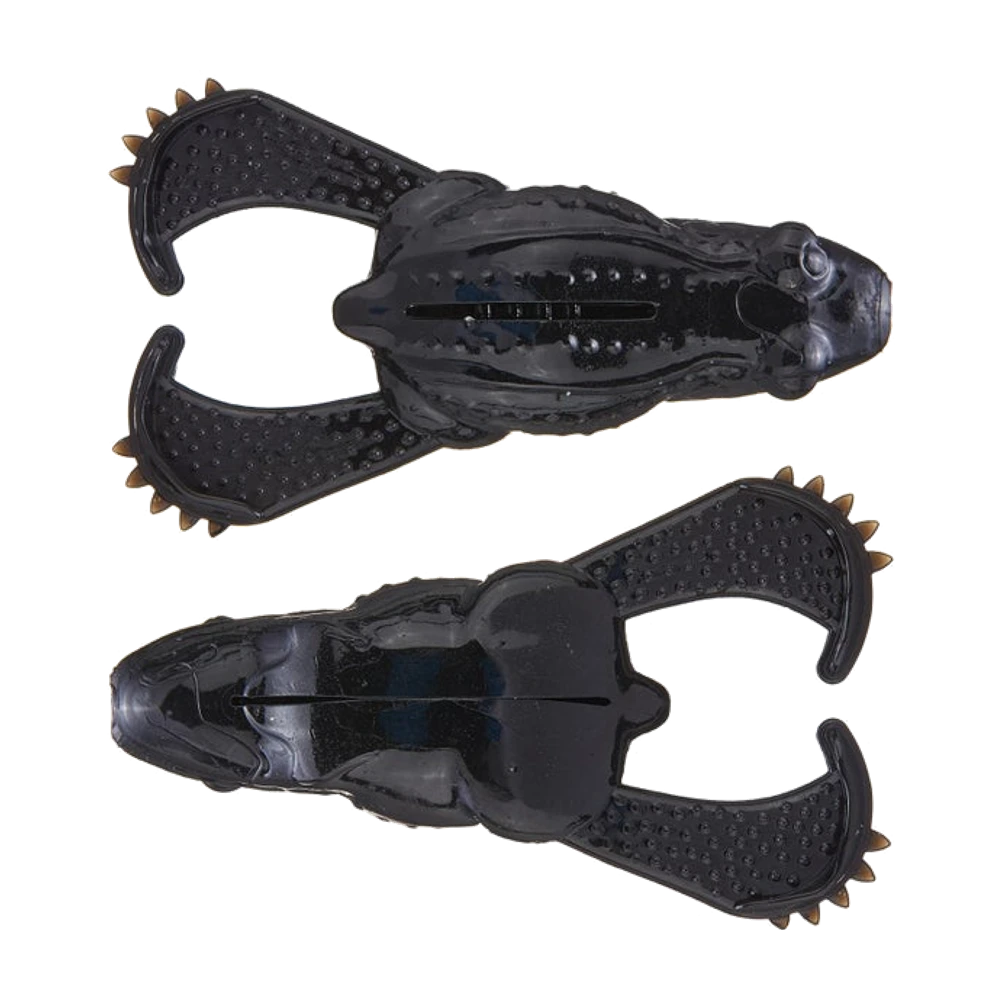
Savage Gear Tough Toad: the toad that floats with no retrieve at all
One lure, endless conditions. CarnaFish reads your spot from a photo so you are not just guessing.
A toad is judged on ten seconds: the ones where you stop reeling. Most soft plastic toads sink the instant the retrieve stops, and you lose the pause — exactly the moment a bass that followed without committing makes up its mind. The Savage Gear Tough Toad is built around that detail: the maker claims a TPE buoyant enough to keep the lure on the surface even when it is completely still.
A plastic chosen to float, not just to last
Savage Gear names the material TPE Duratech 12X Tough and puts forward two properties: high buoyancy and resistance to jaws. The size table in the description confirms the first one outright, because it carries a class column and both sizes are listed there as Floating. That is not our deduction and not a shelf label: it is written down.
The difference shows up in the retrieve. With a toad that sinks, you are forced to keep permanent tension just to hold it up; you cannot hesitate at the edge of a pad, nor let the lure drift for a second over a hole of open water. With this one, the pause becomes a tool. You bring it to the edge of a mat, you stop, the lure stays put, and that is often when the mouth opens underneath it.
Two sizes, and above all two buying decisions
The description publishes a real table, and it has to be read in full because one column changes everything:
- 8.9 cm / 3.5 in, 21 g / 0.75 oz, floating, sold in packs of 3, un-rigged.
- 10.2 cm / 4 in, about 34 g / 1.2 oz, floating, sold in packs of 2, pre-rigged.
The maker spells it out: the 4 in version arrives already rigged, the 3.5 in version arrives with no hook. That changes the real price per lure, and it changes what you need to carry in the box. Pick the small size and you need suitable wide-gap worm hooks; pick the big one and you can fish it straight out of the bag.
One word on the weight of the large model: the maker lists it as 1-1/5 oz. That fraction does not exist in normal American usage, which counts in eighths and quarters; it betrays a conversion from a round metric figure. Read it as an order of magnitude around 34 g rather than a gram-accurate weighing. It is still very heavy for a soft topwater, and it dictates the rod.
The retrieve: straight winding, and nothing else
Both legs are curved paddles. The moment the lure moves forward they kick — hard, and audibly through the rod. There is almost nothing to do: a steady straight retrieve is enough to produce the wake and the surface noise. No need to twitch the rod tip the way you would on a stickbait; you would only break the rhythm of the legs.
Setting the speed
Start slow, just fast enough to get the legs turning. If strikes are missed or fish follow without committing, speed up decisively: on a toad, acceleration works better than slowing down, because it stops the bass inspecting the prey. In cold water or on a listless fish, the pause takes over instead — and that is where the stated buoyancy pays.
The hookset
This is where most fish are lost. When the bass blows up on it, do not set on the sound. Wait until you feel the weight load the rod, then sweep low and long. On a body this thick, the hookset has to travel through the plastic before it reaches the jaw: a soft rod or stretchy mono takes that margin away. Braid and a heavy rod, no argument.
The detail that changes everything along a pad edge: never bring the toad in perpendicular to the edge. Run it parallel, ten centimetres off the vegetation. The bass sit under the lip of the mat looking outwards; a lure that travels past them along its whole length is in view three times as long as one that crosses it.
The second use: oversized jig trailer
The maker mentions a second use few anglers exploit: rigging the Tough Toad as a jig trailer to produce a bulk that fish are not used to seeing. It is a genuine late-season tool, when every jig on the lake wears the same craw trailer. Behind a swim jig it turns a shoreline lure into a block of silhouette that shifts a lot of water and fishes just under the surface.
One caution, though: at 21 or 34 g of plastic you are adding a trailer heavier than most jigs. Pair it with a jig of at least 10 g so the whole thing keeps a sensible attitude, and accept that the fall becomes much slower.
The classic mistake
Treating the Tough Toad like a hollow body frog. They are not the same family. A hollow frog such as the Booyah Pad Crasher collapses on the hookset to free a double hook and crosses the thickest mats; a solid toad is Texas-rigged on a single hook and belongs along grass edges, in sparse vegetation and on the open water next to it. Throw a toad into the middle of a dense mat and it comes back wearing salad after three metres.
Not sure what to tie on?
Photograph your spot: CarnaFish reads the scene, cross-checks the conditions and gives you the zone, the lure and the retrieve. Free on iOS and Android.
Colours by light and bottom
- Dirty water, overcast sky, dawn and dusk: black, the one in the photo. On the surface the fish sees the lure backlit: only the silhouette counts, and black cuts the cleanest shape.
- Living grass, green-tinted water: a natural green frog pattern, which blends into the scenery and reassures a fish that has already been worked over.
- Bright sun on clear water: a lighter pattern with a pale belly, closer to what a real amphibian shows from underneath.
Knowing when a topwater belongs on the line
A toad is a window lure: it needs warm water, fish high in the column and usable vegetation. The rest of the time it produces nothing. That is exactly what CarnaFish helps you settle: a photo of the spot, and the AI tells you whether the layout suits a surface strike or whether you should drop a level. For the seasonal and structural basics, our guide to getting started on bass sets the frame. And if you want to compare against a dense-mat approach, the Deps Slither K plays a very different game.
Key takeaways
- The maker's table lists both sizes in the floating class: the surface pause is published data, not an assumption.
- The 10.2 cm comes pre-rigged in packs of 2, the 8.9 cm comes bare in packs of 3: check what you are ordering.
- The paddle legs work on a straight retrieve; rod twitches only break their rhythm.
- The stated 1-1/5 oz for the big model is a conversion: read it as roughly 34 g, not as an exact weighing.
FAQ
Does the Tough Toad really float at rest?
Yes, and it is in the maker's size table: both sizes are listed in the floating class, and the description states the lure holds on the surface even when standing completely still. That is the property that makes the pause along a grass edge worth using.
Which size should you start with?
The 8.9 cm covers most situations and takes a standard wide-gap worm hook. The 10.2 cm targets big fish and arrives already rigged, but its roughly 34 g demands a heavy rod and braid: it is not a trial size.
Do you need to buy hooks separately?
For the 8.9 cm, yes: the maker states it ships un-rigged, three to a pack. The 10.2 cm ships pre-rigged, two to a pack, and fishes as it comes.
Can it be fished in very dense vegetation mats?
That is not its ground. A solid Texas-rigged toad travels well through sparse vegetation and along edges, but on a thick mat a hollow body frog stays better suited because it collapses and picks up less salad.
How do you set the hook on a surface strike?
Wait until you feel the weight of the fish load the rod before setting, not at the sound of the blow-up. Then sweep low and long, with braid: on a thick soft body the hookset has to pass through the plastic before it reaches the jaw.
What is the point of rigging it as a jig trailer?
The maker lists it as a second use: behind a jig, the Tough Toad adds an unusual bulk that stands apart from the craw trailers fish see all season. Count on a jig of at least 10 g to balance the weight of the toad.
The full bass lure guideSeason-by-season strategy: which family of lure, when, and why.Go from theory to fish
CarnaFish reads your spot from a photo and gives you the game plan: zone, lure, retrieve. Free on iOS and Android.