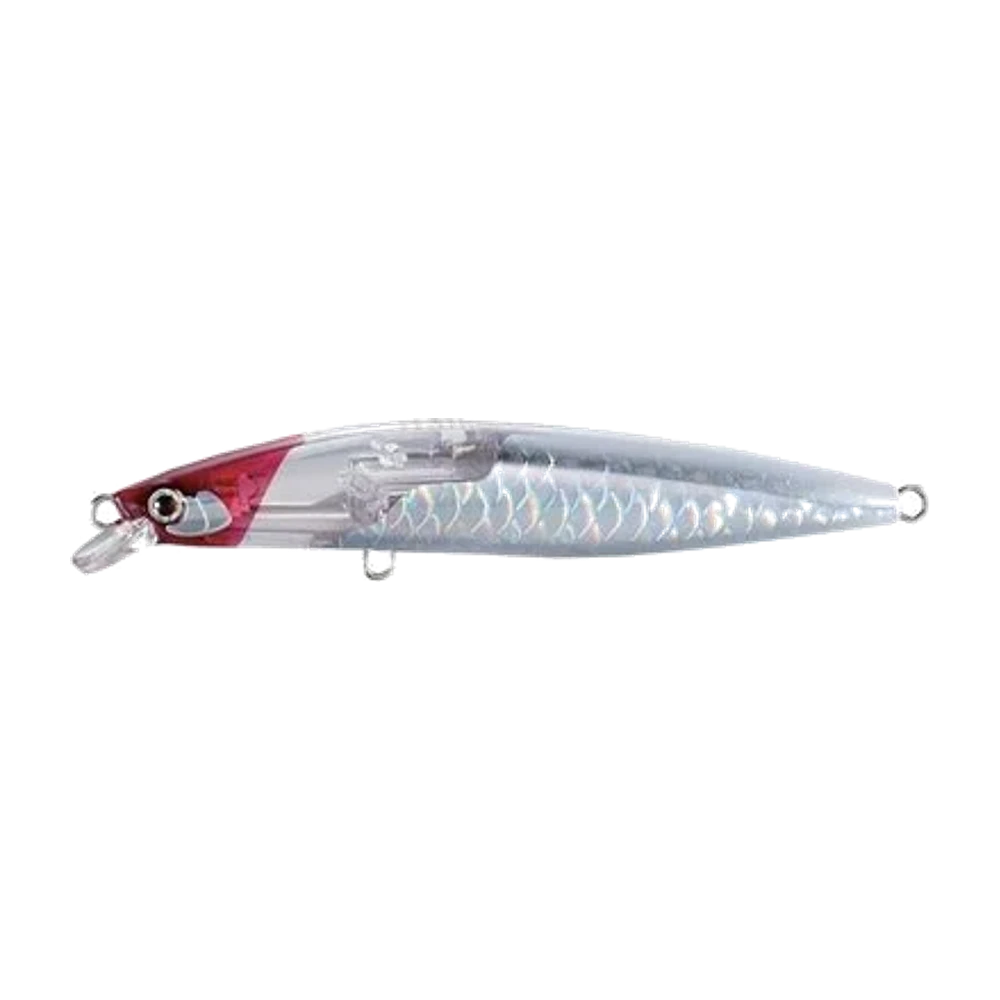
Shimano Exsence Strong Assassin: the version that does not fold in heavy weather
One lure, endless conditions. CarnaFish reads your spot from a photo so you are not just guessing.
There are two ways to lose a big sea bass. The first is never to reach it: the headwind is blowing thirty knots, your lure lands at twenty metres, and the fish is feeding at forty. The second is to reach it and lose it anyway, because a treble opened up or a split ring let go in a wave.
The Strong Assassin is Shimano's answer to both problems at once. It is not a different lure from the Exsence Silent Assassin: it is the same family in a heavier, denser version built to take punishment.
If you fish fair weather on calm water, this page is not for you and the Silent Assassin will do better. If you fish when everyone else goes home, it is.
Three concrete differences from the silent version
These are not finishing details, they are three choices that change how the lure is used.
- Mass. Several grams more at a comparable size. That translates directly into casting distance into a headwind, exactly where a lighter model loses control of its trajectory.
- Density and body strength. The build is designed to survive the loads of a fight with a fish of size and constant rinsing in the foam. A thin body that cracks around the line-tie eyelet is a classic failure in hard sea bass fishing.
- The hardware. Split rings and trebles of a clearly higher grade, matched to thick braid and a firm hookset at forty metres. On the light version, those parts are sized for finesse, not for load.
There is a swimming consequence on top of that: being denser, the lure holds its line better in churned water and does not climb to the surface when you speed up to keep contact in current. That is exactly what a light minnow lacks in a fast run of water.
Working it in heavy weather
Unlike finesse fishing, there is not much to invent here. The job is to keep contact and depth despite the elements.
- Cast low and flat, pushing the rod forward at the end of the stroke. A lofted cast into a headwind loses half its distance.
- Close the bail by hand as soon as the lure lands and take up the slack immediately: in current, two seconds of loose line is enough to lose the zone.
- Retrieve steadily, medium to brisk. You should feel the action at all times. If it disappears, speed up: either the lure has lost its action or you have dropped out of the run.
- On a current line, cast upstream at forty-five degrees and let the lure swing across. The moment it arrives downstream, loaded up against the flow, is the most productive.
- Mark a one-second stop every ten turns or so, and nothing more. This lure works continuously, not in twitches.
On the water: in a quartering tailwind, do not chase maximum distance, chase the shortest line between you and the lure. A belly of line pushed by the wind forms an arc that costs you both running depth and bite detection. Move ten metres along the breakwater to cast into the wind rather than gaining twenty metres downwind with an unmanageable bow in the line.
The tackle to make it work
| Item | Choice | Why |
|---|---|---|
| Rod | 2.70 to 3.10 m, 15-50 g | You need length to hold the line above the foam |
| Braid | 0.20 to 0.25 mm | A finer diameter will not take casting a 30 g lure all session |
| Leader | 0.45 to 0.60 mm fluorocarbon, 1 to 1.5 m | Abrasion on rock and shells |
| Connection knot | FG or equivalent, pulled down tight | A bulky knot slaps through the guides on the cast |
A word on the line tie: with thick fluorocarbon, a direct knot is safer than a snap. If you want a snap for quick changes, pick a stainless model rated for the real pull of the fish, not for the weight of the lure.
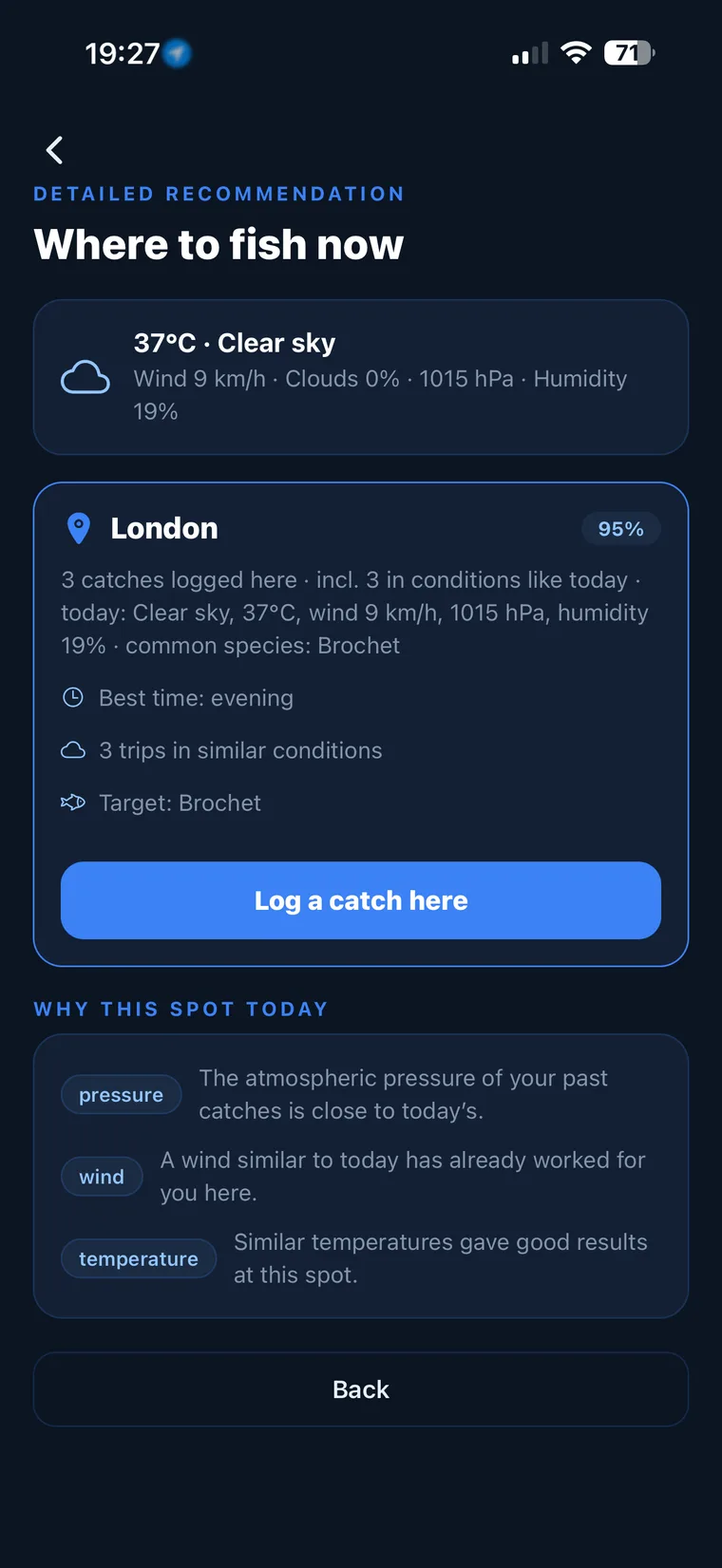
Not sure what to tie on?
Photograph your spot: CarnaFish reads the scene, cross-checks the conditions and gives you the zone, the lure and the retrieve. Free on iOS and Android.
When it is essential, and when it is too much
It is essential in the conditions that send most anglers home:
- A hard headwind, when distance decides everything.
- Strong current: channels, river mouths, headlands on a full tide, harbour entrances.
- Rough sea and foam, where the turbulence makes a light lure's action unreadable.
- Big-fish ground, where losing a fish to an opened split ring is a realistic scenario.
It is too much in the opposite cases, and that needs saying plainly. On flat water at night, in very clear calm water, on a pressured spot where the bass are wary, a heavy lure with heavy hardware is overkill: the silhouette is more pronounced, the whole package less discreet, and the oversized trebles disturb the action at low speed. In those conditions the Silent Assassin takes the lead without argument.
Strong Assassin or Silent Assassin: how to choose
The choice is not about the target fish but about the conditions. Both lures are aimed at the same sea bass, on the same spots, at different moments.
Take the Silent Assassin when the sea is calm, when you are fishing at night, or when the spot is worn out: it is a lure of discretion, built not to announce itself. Take the Strong Assassin when the conditions are taking control away from you: wind, current, swell, and fish big enough to expose standard hardware.
A simple rule: if you are hesitating while looking at the sea, you are in the zone where the Silent Assassin is enough. The Strong Assassin comes out when there is no hesitation. On intermediate water, stirred up but no more, a Duo Realis Pencil 130SW on the surface often covers the ground better.
Our guide to lure fishing for sea bass covers which tide and weather windows to favour. And if you are unsure between the fine version and the reinforced one as you reach the breakwater, CarnaFish analyses a photo of the spot and answers.
Key takeaways
- Heavier, denser, better armed: three differences that only pay off in heavy weather.
- The extra mass converts into real distance into a headwind.
- It holds its action in current without climbing when you speed up.
- 0.20-0.25 mm braid, 0.45-0.60 mm fluorocarbon leader, a direct knot rather than a snap.
- In calm water, at night or on a worn-out spot it is too heavy-handed: go back to the Silent Assassin.
FAQ
What is the difference between the Strong Assassin and the Silent Assassin?
The Strong Assassin is heavier, built denser and fitted with clearly stronger split rings and trebles. It is meant for wind, hard current and big fish, where the silent version prioritises discretion in calm water.
Should I change the stock hooks?
Not in most cases: that is precisely the point of this version, the hardware is already sized for the job. Just check the points after every session in the rocks and replace like for like when they dull.
What leader should I use?
Fluorocarbon of 0.45 to 0.60 mm over one to one and a half metres, joined to braid of 0.20 to 0.25 mm. That diameter is there as much against abrasion on rock and shells as against the pull of the fish.
How deep does it run?
Between 0.5 and 1.5 m depending on the version and line tension. Its density lets it hold that layer even when you speed up in current, which a light minnow does not do.
Is it useful on a calm sea?
Hardly. Its more pronounced silhouette and heavy hardware become drawbacks on flat water, at night or on a heavily fished spot. In those conditions a finer, silent version catches more.
How do I cast well into a headwind?
Cast low, almost parallel to the surface, pushing the rod forward at the end of the stroke rather than looking for a high trajectory. Close the bail by hand as soon as the lure lands so the wind cannot put an arc in your line.
The full sea bass lure guideSeason-by-season strategy: which family of lure, when, and why.Go from theory to fish
CarnaFish reads your spot from a photo and gives you the game plan: zone, lure, retrieve. Free on iOS and Android.