Snag Proof Zoo Kick: the legged frog that makes noise at slow speed
The right lure in the wrong spot still catches nothing. CarnaFish spots the zone that works, from a single photo.
There are mornings when bass refuse everything that moves fast. The water is warm, the weed mat is closed over, and the buzzbait you are burning across it triggers nothing because it crosses the zone in four seconds. The Zoo Kick answers exactly that problem: it makes a churning noise comparable to a buzzbait, but it makes it at a speed where the fish has time to come up.
Noise at slow speed, and that is the whole point
Snag Proof presents the Zoo Kick as an evolution of its Wobbletron, to which the brand added more aggressive kicking legs for a faster and louder surface churn. The wording is marketing, but the principle holds up: it is the legs, not the body, that produce the signal.
The result is a bait that does not need speed to speak. A conventional buzzbait has to keep a blade turning, so it has a minimum pace below which it sinks and goes quiet. Here the two soft legs kick as soon as the bait moves, and the gurgle sets in on the first turn of the handle. You can retrieve at a speed where a buzzbait would already be on the bottom, and the noise keeps going.
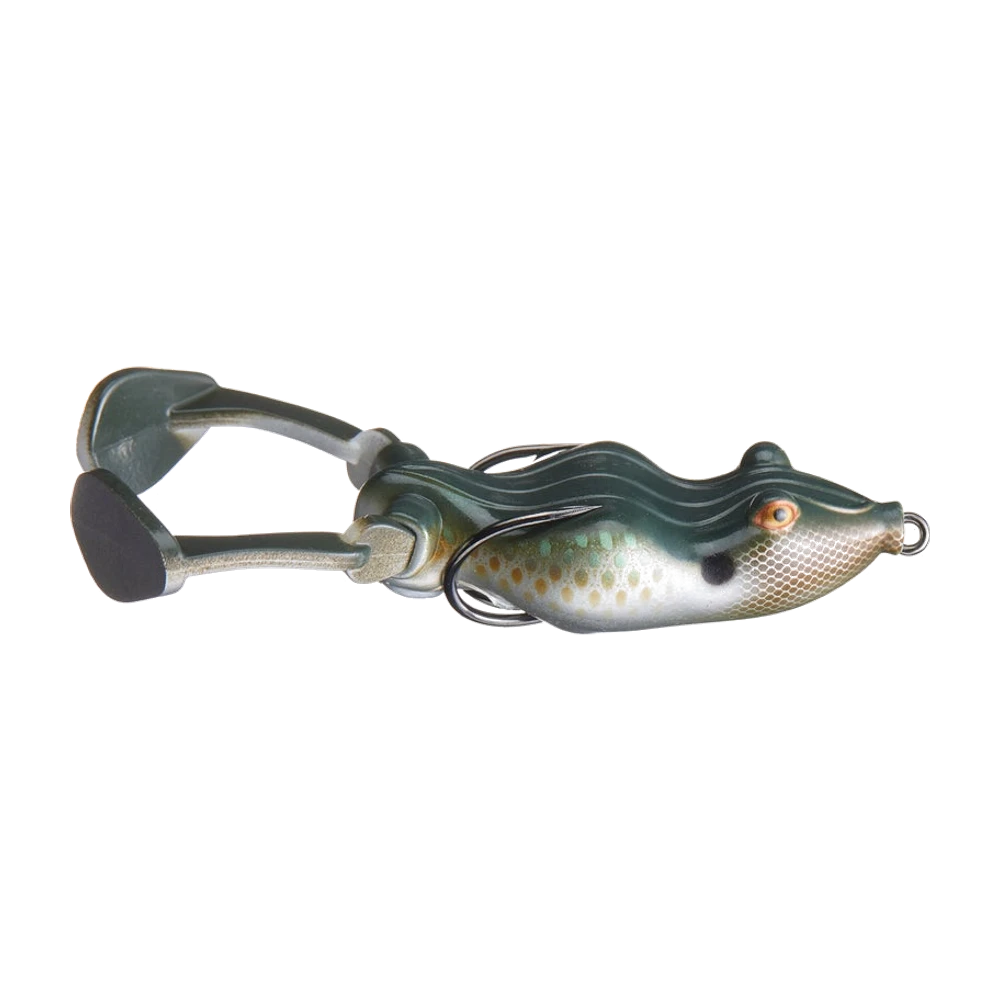
The product photo shows two flat, fairly thick legs, each ending in a wide oval paddle, and a double hook lying along the back with the points up. The body is a hollow shell with a rippled back, an orange-ringed eye and a dark spot on the flank. These are observations from a product photo, not specifications: the description gives neither the length of the legs nor the hook size.
If the legs are not making noise, it is almost always because you are reeling too slowly — but the instinct to speed up is the wrong one. Give a sharp half-turn of the handle first to start the kick, then settle back into your slow rhythm: the legs stay in motion once they are going, whereas they will not start by themselves from a dead stop.
The slow retrieve, and nothing else
The manufacturer's description is clear on this: the bait is built for a slow, steady retrieve that creates a permanent commotion. It is rare for a brand to narrow the use of its own product like that, and it deserves to be taken seriously.
Finding the right pace
Look for the slowest speed at which both paddles keep kicking without stalling. In practice that is very slow: a handle turning without jerks, the rod tip at mid-height, and the bait leaving a continuous trail of bubbles behind it. If you lose the noise you are one notch too slow; if the bait starts skating across the surface you are too fast.
Pauses, to be handled carefully
The bait is listed as floating by the manufacturer, so a pause will not sink it. But the legs stop instantly, and restarting them takes that sharp half-turn mentioned above. Save pauses for the precise moments when you cross a hole in the weed mat, not as a basic rhythm.
It always lands belly down
The manufacturer claims a weighting worked out both for long-distance casting and for an upright landing posture on every cast. That is a real issue on this kind of bait: a legged frog that lands on its back means a wasted cast, or at best a correction that alerts the fish. Here the brand's claim fits what you would expect from a heavy hollow-body bait, and 17.7 g clearly helps it carry.
That weight has a direct consequence for tackle: 17.7 g over 8.9 cm is dense. A light rod will not load properly on the cast and, more importantly, will not pull a fish out of a closed mat.
Its ground is the mat, not open water
The Zoo Kick is described with a body shape designed to resist snagging in thick mats and lily pads, and that is exactly where it should be cast. Filamentous algae mats, compact floating weed, pad fields, flooded reed edges: anywhere the surface is closed over, it slides across making noise, and the fish locates it by sound before seeing it.
On open water it loses its advantage. A bladed bait or a Booyah Buzz will cover more water per unit of time, and a treble-hooked stickbait will hook better. The Zoo Kick is only worth it where conventional hooks cannot go.
In Europe, late-summer pad ponds are pike water too, and a noisy slow-retrieve bait works there. Plan on a heavy fluorocarbon leader: without steel you break off; with line that is too fine you lose the bait and the fish swims away with it.
Not sure what to tie on?
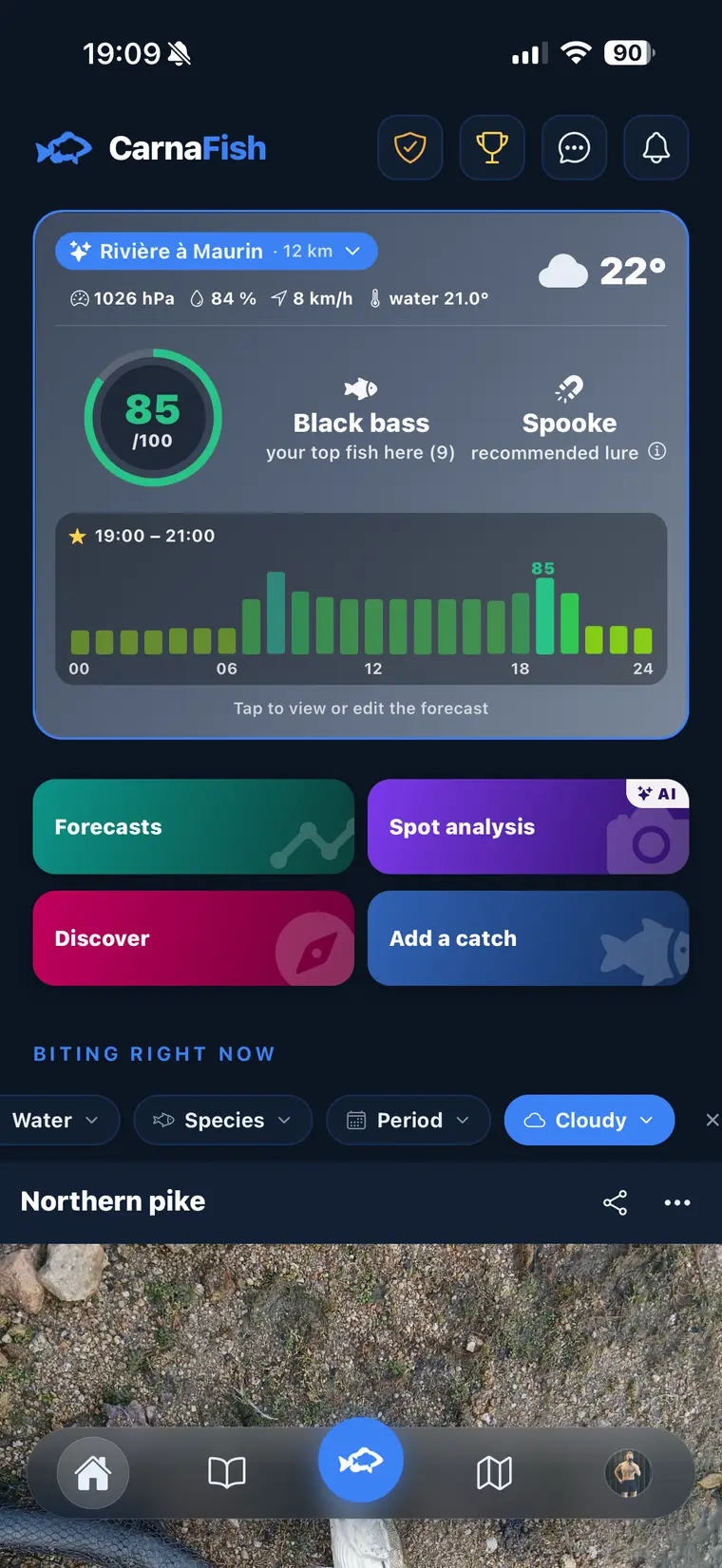
Photograph your spot: CarnaFish reads the scene, cross-checks the conditions and gives you the zone, the lure and the retrieve. Free on iOS and Android.
Rigging, rod, and the moment of the hookset
Braid, 40 to 50 pound test, tied straight on or through a strong snap. No discreet leader here: the fish strikes at the noise in closed water, discretion is not the issue, the ability to extract the fish is.
The description mentions a dedicated sharpened double frog hook built to hold in heavy cover. What matters most, though, is your reaction to the strike. The hollow body has to collapse before the two points come clear, and that is not instant.
The classic mistake
Setting the hook on the noise. A bass hitting a loud frog is spectacular, and the reflex is to lift immediately — except at that moment the fish often has nothing but water and a bit of plastic in its mouth. Wait until you feel the weight load the rod, then set wide and hard. Second common mistake: speeding up after a missed fish. Do the opposite, slow down further and come back over the same spot, those fish often return on a second cast. If you want to change the signal without changing the ground, a Snag Proof Zoo Wake produces a different kind of wake with the same type of hook.
Colours by light and water
Snag Proof advertises several colours meant to mimic the prey bass feed on, without publishing a detailed chart for this model. So we reason in families of tones.
- Weedy water, closed mat: a green frog imitation, dark back and pale flanks, like the one in the product photo. That is the obvious register over a field of pads.
- Backlight, sunrise and sunset: a frankly dark or black back. Seen from below, the fish reads a silhouette, not a colour.
- Clear water, strong light: pale speckled flanks, which break up the outline and avoid a uniform block when visibility carries a long way.
You still need to know whether that mat is worth fishing or whether it is just scenery with nothing underneath. That is the kind of reading CarnaFish makes easier: a photo of the spot, and the AI suggests the zone, the depth and the lure family that fit the day's conditions. To get better at reading a water before you even pick a lure, our guide to reading a fishing spot sets out the basics.
Key takeaways
- The legs make the noise from slow speed on: that is what separates the Zoo Kick from a buzzbait, which has to move fast to spin its blade.
- Specs confirmed by the manufacturer: 8.9 cm / 3.5 in, 17.7 g / 5/8 oz, listed as floating.
- Reserved for closed cover — mats, pads, floating weed. On open water other baits do it better.
- Set the hook on the weight, never on the noise: the hollow body needs a moment to collapse and free the points.
FAQ
Does the Zoo Kick float?
Yes, and that is not a deduction: the manufacturer's spec table carries a Class column reading Floating for this model, beside 3.5 in and 5/8 oz. A pause will not sink it, even though it stops the legs kicking.
What is the difference with a buzzbait?
A buzzbait needs speed to spin its blade, otherwise it sinks and goes quiet. The Zoo Kick produces its churn through two soft legs that kick as soon as the bait moves, which allows a far slower retrieve. In exchange, it covers less water per hour.
Why are my legs not kicking?
Most often because the retrieve starts from a dead stop with no impulse. Give a sharp half-turn of the handle to start the movement, then come back to your slow pace. Check too that the legs have not folded against the body after a cast into the weed.
Do you need a steel leader for pike?
In Europe, on pike water, heavy fluorocarbon is the usual compromise: it survives the teeth of a fish hooked properly in the mouth and stays supple. Steel is safer where big pike are present, at the cost of a slightly less free action.
What rod for this bait?
A powerful rod, able to cast 17.7 g and above all to drag a fish out of a weed mat. What matters is the reserve of power in the butt, not the stiffness of the tip: a slightly progressive tip gives the hollow body time to collapse on the hookset.
Is it a good first topwater bait?
Not really. It calls for fine speed control and a delayed hookset, two reflexes that have to be learned. A popper or a treble-hooked walking bait over clear water, such as the Heddon Zara Spook, forgives beginner mistakes far more readily.
The full bass lure guideSeason-by-season strategy: which family of lure, when, and why.Go from theory to fish
CarnaFish reads your spot from a photo and gives you the game plan: zone, lure, retrieve. Free on iOS and Android.