SPRO Little John 50: the silent crank with a circuit-board lip
Not sure this lure fits YOUR spot today? CarnaFish tells you in 10 seconds, from a photo.
There are days when everyone on the lake is throwing a rattling crank. Three boats have already run the drop-off, the fish have heard the same knock twenty times in two hours, and nothing comes up any more. That's exactly the problem John Crews set out to solve when he designed the Little John for SPRO: a crankbait that works the same band of water as the others, but makes no sound at all.
A circuit-board lip, and what that changes
The Little John doesn't use a moulded polycarbonate bill but a circuit board lip — a thin, rigid laminate cut from sheet. SPRO puts forward two consequences: high durability and better sensitivity. Both are credible and easy to understand.
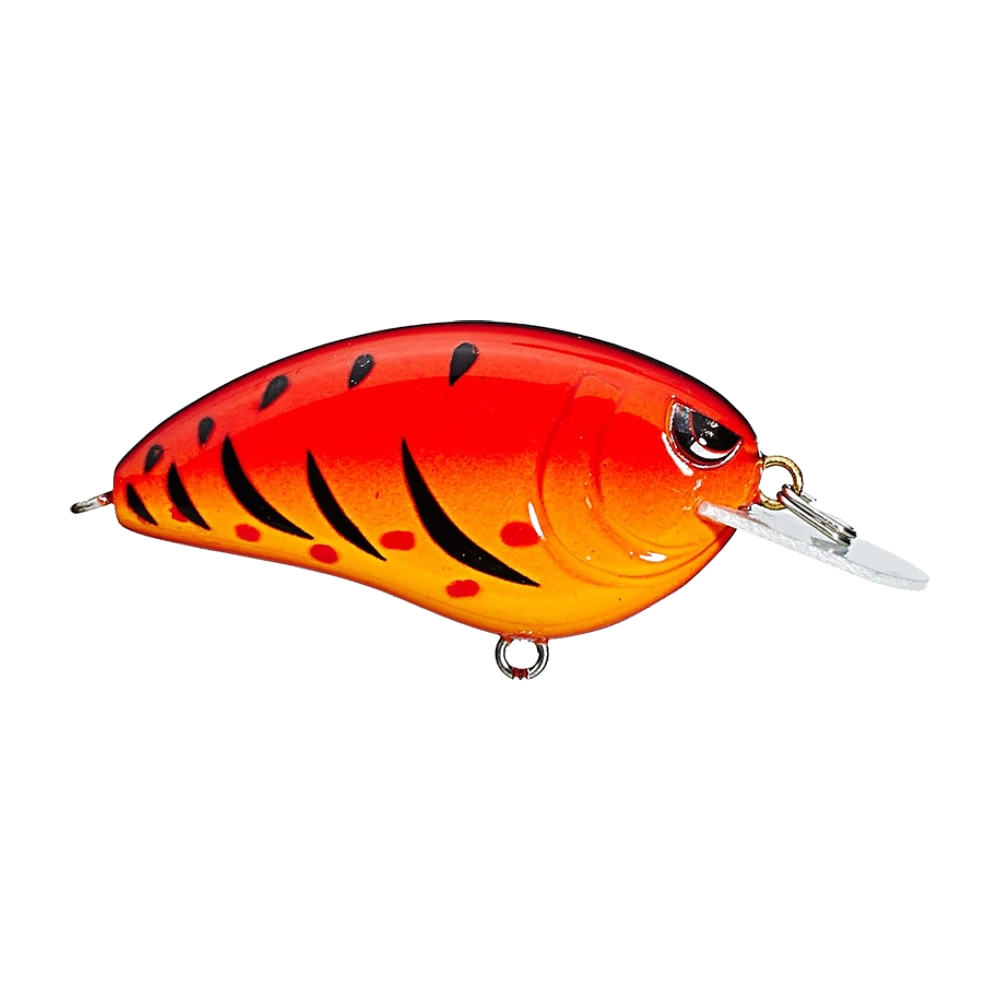
Durability, because a thin laminate doesn't snap cleanly the way plastic does when it hits a rock edge: it flexes little and takes the hit. Sensitivity, because a thin plate transmits vibration to the line instead of absorbing it in its own thickness. In practice you read the bottom under the lip — gravel, silt, wood — far more clearly than with a thick-billed crank. In the product photo the lip does appear white and opaque with the fibrous edge typical of that material, and the line tie is a brass wire passing through the plate, fitted with a split ring. That's an observation from a product photo, not a specification.
The spec table, read line by line
The maker's table has four columns here — length, weight, class and depth — and the first cell of the row carries the model name, not a measurement. So it reads: 2-1/2 in, which is 6.3 cm; half an ounce, roughly 14 g; floating class; and a depth of 3-5 ft, meaning 0.9-1.5 m.
That class column is valuable, and it's rare. Here there's no interpreting to do: this crankbait floats. You can lean on that to clear cover, letting off for a second the moment the lip stalls and allowing the bait to rise a few centimetres before you start again.
A word on the name. The 50 does not correspond to the length: the table says 6.3 cm, not 50 mm. The maker nowhere explains its numbering, so don't make the name say what the table doesn't. Trust the dimensions.
Silence as a technical argument
The Little John's weight transfer system is tungsten and, in an important detail from the maker, it is silent. A transfer system normally sends a heavy ball to the tail on the cast then brings it forward again to balance the swim. Most such systems produce an audible knock; this one is built not to.
That's the bait's main point, and it's a precise niche. On lightly fished water a noisy crank often does better because it pulls fish from further away. On a reservoir worked every weekend, on a tournament lake, or late in the season when the fish have seen it all, silence becomes the advantage. It's the exact mirror of the SPRO Essential Hunter 65, which fishes the same band but with a wide swim and a loud rattle: two opposite answers at the same depth, picked according to fishing pressure.
Keep both in the same box and test them in this order on fresh water: the noisy one first, to see whether fish will come from a distance. If nothing happens in four or five casts, run the same line again with the silent, tight-wobbling bait. It's often the second pass that produces, and it costs two minutes.
A tight wobble, not a wide-search crank
SPRO describes a lip design that produces a tight wobble while keeping enough action to help the bait deflect off cover. That balance is worth understanding before you buy.
A tight wobble puts out a fine, discreet signal, very close to what a small baitfish swimming normally produces. It works in clear water, in cold water, and on fish that refuse anything too demonstrative. It also lets you retrieve fast without the bait rolling onto its side: the maker stresses that the Little John was built to cover the 0.9-1.5 m band quickly, and that is precisely what a tight wobble is for.
The trade-off is reach. In dirty water or over a very wide flat, a wider-swimming crank will bring you more bites. Here you're fishing precisely: tracing a drop-off, shaving a riprap bank, running a line of dock pilings.
The classic mistake
Fishing this bait like a squarebill, deliberately banging it into everything that sticks out. A round lip doesn't deflect as decisively as a square one; it helps deflection, which is not the same thing. In thick timber you'll hang up more often than with a Strike King KVD Squarebill. Save the Little John for hard margins and light contact, and bring out the squarebill when the cover gets genuinely messy.
Not sure what to tie on?
Photograph your spot: CarnaFish reads the scene, cross-checks the conditions and gives you the zone, the lure and the retrieve. Free on iOS and Android.
Rigging and hooks
SPRO states Gamakatsu trebles in size 5. The maker itself flags a transition on this point: depending on the unit, the bait may carry Gamakatsu Black Nickel trebles or Gamakatsu Nano Alpha coated trebles. That's useful to know before you grumble about a difference between two packets — and a rare piece of honesty in a product description. In the product photo the bait is shown bare, with no trebles fitted, a split ring in place on the line-tie eye and a belly hanger visible.
A rod of 1.95-2.10 m, medium, moderate action: a tight-wobbling crank is fished on a forgiving blank, because the signal is already fine and a stiff rod adds nothing while costing you hooked fish. Fluorocarbon of 0.25-0.30 mm, which runs the bait slightly deeper and passes on what the circuit-board lip is sending up. Loop knot or small snap so the lip isn't choked, as on any fine-swimming crankbait.
Colour by water clarity
- Spring, warming water: the craw pattern photographed here, red-orange flanks turning yellow towards the belly with black bars and red spots. Crayfish are the prey of the moment once the water passes 14 °C and bass start working hard bottom.
- Clear water, wary fish: a roach or silver shiner pattern with a grey-green back. This is where the tight wobble and the silence work together at full effect.
- Stained water: blue-back chartreuse. You lose the benefit of silence, which matters less when visibility is short, but you gain silhouette.
A silent crank is useless if you don't know whether the spot is pressured or untouched, and that's a reading of the water before it's a lure choice. CarnaFish answers exactly that question: a photo of the spot, and the app suggests a zone, a depth and a lure family that fit the conditions. To build the tackle and spot fundamentals, our beginner's guide to bass fishing remains the right starting point.
Key takeaways
- 6.3 cm for roughly 14 g, a floating class confirmed in the table, a stated depth of 0.9-1.5 m.
- Silent tungsten weight transfer: the niche is pressured fish, not wide searching.
- A circuit-board lip: durable, and above all far more talkative about what the bottom is made of.
- Gamakatsu size 5 trebles, in Black Nickel or Nano Alpha coating depending on the unit, as the maker itself states.
FAQ
Does the SPRO Little John 50 float?
Yes, and you don't have to guess: the maker's spec table includes a class column and it reads floating. You can therefore use it to clear cover by letting off the retrieve.
Why choose a silent crankbait?
Because a noisy bait loses its edge as soon as fish have heard it several times. On heavily fished water, late in the season or in clear water, a silent tight-wobbling crank gets bites where a rattling model gets refusals.
What does the 50 in the name mean?
Not the length: the table says 2-1/2 in, which is 6.3 cm. SPRO doesn't explain its numbering in the description, so the only reliable figure is the one in the spec table.
How does it differ from a squarebill?
The Little John has a round lip: it helps deflection but doesn't bounce off cover as decisively as a square lip. In thick timber a Strike King KVD Squarebill hangs up far less. Keep the Little John for hard margins and light contact.
Which hooks come fitted?
Gamakatsu trebles in size 5. SPRO says it is mid-transition between two references, Black Nickel and Nano Alpha coating, so two baits bought six months apart may differ without that being a fault.
Is it a good perch bait?
Yes, within its depth band and along hard margins. A 6.3 cm profile and a tight swim match a perch hunting small baitfish well, and the lack of a rattle doesn't bother it — what brings it up is the tight vibration delivered at short range.
The full bass lure guideSeason-by-season strategy: which family of lure, when, and why.Go from theory to fish
CarnaFish reads your spot from a photo and gives you the game plan: zone, lure, retrieve. Free on iOS and Android.