SPRO Little John Micro DD 45: 4.4 cm that reach 3 m down
Rather not fish it blind? Photograph your spot — CarnaFish cross-checks the conditions and points you the right way.
Mid-March, a reservoir at 9 °C, fish pinned to a drop-off between two and three metres, and water so clear you can see the bottom at two. Anything that makes noise gets refused, and so does anything big. Very few tools can reach three metres with a tiny profile and a discreet signal — and the Little John Micro DD 45 is one of the rare ones that does exactly that.
A very small body with a very large lip
SPRO's table fits in three columns: 1-3/4 in, which is 4.4 cm; 5/16 oz, roughly 8.9 g; and a depth of 8-10 ft, so 2.4-3 m. The 45 in the name does match the length in millimetres.
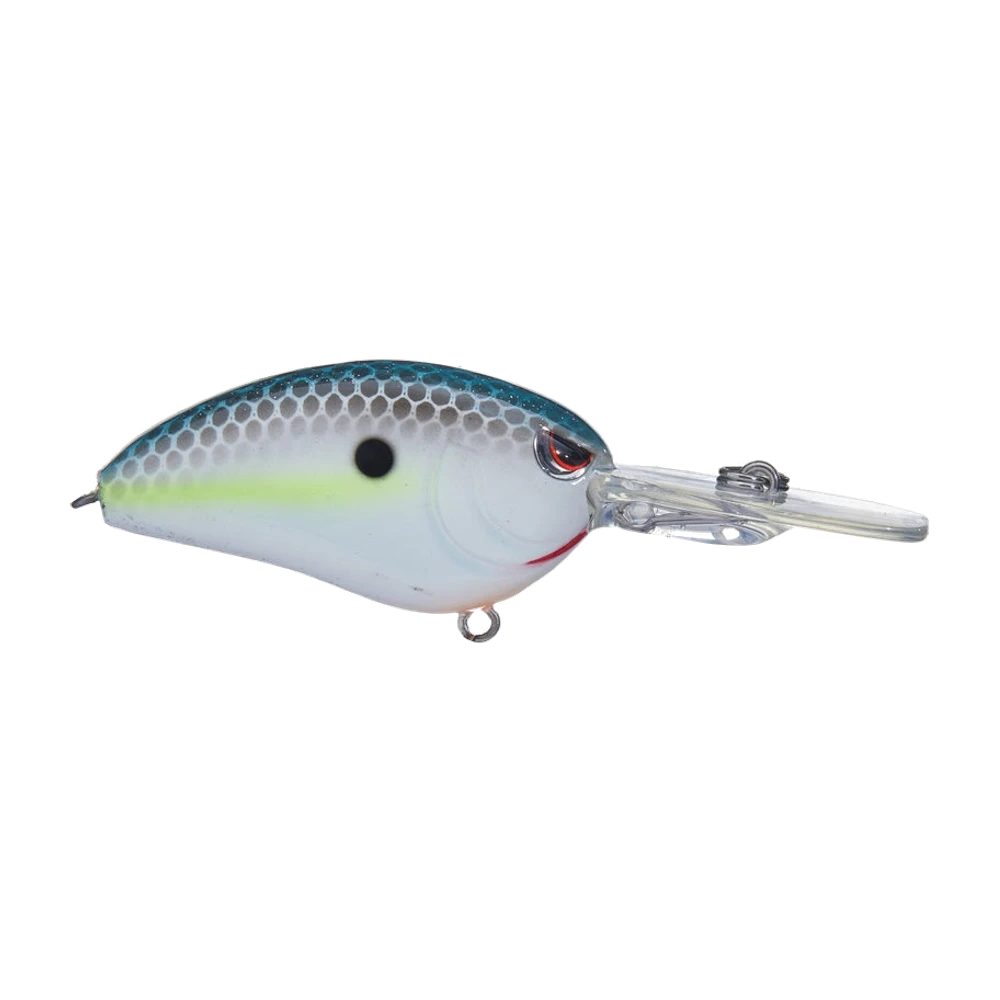
Take a second to weigh what that means. Nearly nine grams on four and a half centimetres is a very high density: the bait is heavy for its size. And three metres of depth on a 4.4 cm body is far from common — most cranks that size top out around a metre and a half. The two facts go together and are explained by the lip: SPRO claims a DD bill shape that takes the bait deeper than other finesse flat-sides on the market and deflects off cover better. That's the maker's claim, but the lip's length, visible in the product photo, makes it entirely plausible. In that photo the lip is clear polycarbonate with a rounded tip, and the line tie sits on it, well back from the nose, with a split ring in place — an observation from a product photo, not a specification.
Flat sides, tight vibration: the cold-water register
A flat-sided body doesn't roll like a round one: it wiggles. The signal is short, nervous, high-frequency, and it stays discreet. That's precisely what SPRO highlights for this model — a tight wiggling action and subtle vibration — presenting it as the right answer in cold water and on heavily fished fish.
That's the logic of the whole flat-sided family, from the Berkley Frittside to the Micro DD: you trade calling power for close-range credibility. It should be added that this bait is completely silent. No ball, no rattle, and a fixed internal weight system — nothing mobile. A fixed weight never knocks, and the maker draws a second argument from it: a weight that doesn't move leaves the bait balanced the same way every time, so it runs true at any speed.
The adjustment that counts in cold water: drop your fluorocarbon to 0.20 or 0.22 mm. On an 8.9 g bait expected to reach three metres, every tenth of a millimetre of diameter you shed gives back a good twenty centimetres of depth and a few metres of casting distance. On this kind of small deep-diver it's by far the most effective lever, well ahead of colour choice.
The slow rise, and what the table doesn't say
This model's spec table has no class column. The maker's prose, however, explicitly states that the bait provides a slow float on the pause and is deadly on lethargic fish. So we can lean on that, bearing in mind it's prose and not a measurement: a slow rise, yes, but no rate is published.
In practice that's exactly the behaviour you want in cold water. You retrieve until you touch the drop-off, stop, and the bait stays almost on the spot, barely rising. A sluggish fish that has followed from two metres away has time to make up its mind. With a strongly buoyant crank, the bait climbs out from under its nose and leaves the strike window; with a sinking one, it falls into the rocks.
Not sure what to tie on?
Photograph your spot: CarnaFish reads the scene, cross-checks the conditions and gives you the zone, the lure and the retrieve. Free on iOS and Android.
Where and how to fish it
The spots are drop-offs, rocky plateaus in two to three metres, dam walls, gravel slopes. In Europe it's also a size perfectly calibrated for perch along a hard bank, at a season when most baits look too big.
The basic retrieve is slow and steady until the bait touches bottom, then a two- to three-second pause, then on again. The second rhythm worth knowing is a long stop-and-go: six turns of the handle, five full seconds of stop. Below 12 °C it's often the long pause that triggers, not the movement.
The rod should be light. A 1.85-2.00 m blank in light to medium-light power, moderate action, with a spinning reel loaded with 0.20-0.25 mm fluorocarbon, or fine braid plus a metre of fluorocarbon leader. At 8.9 g, the cast also works on light baitcasting gear — SPRO stresses the casting distance its fixed weight allows, which remains a maker's claim.
The classic mistake
Trying to fish it fast to cover water. The Micro DD is not a search tool: its tiny profile and subtle vibration don't call from a distance. If you want to cover water at the same depth, take a bigger, wider-swimming crank. This bait comes out when you already know where the fish are and everything else is getting refused — it's a second-pass bait, not a first-pass one.
What it doesn't do
It doesn't go through thick timber. SPRO claims it deflects better than other finesse flat-sides, which is a relative comparison, not a promise of snag resistance: with bare trebles and a long lip, a logjam is still a logjam. For banging real cover, the SPRO Little John 50 and its short lip are better placed, even if they don't get as deep.
Rigging, hooks and colours
The bait is stated to come with Gamakatsu round bend trebles. The maker gives neither their size nor their number; in the product photo the bait is shown bare, with no trebles fitted and a belly hanger visible. A round bend suits the job: on a small crank fished on fine line and a soft rod, it holds better in the mouth of a head-shaking fish than an inward-point bend.
On colour, three choices cover the ground:
- Clear, cold water: the shad pattern photographed here, blue-green honeycombed back, pearl white flanks, chartreuse stripe and a red gill slash. The reference dress when fish are feeding on small baitfish.
- Spring, water warming over hard bottom: a brown or dark red craw, matching what bass are rooting out of the rocks at that time.
- Stained water: black-back chartreuse. You lose the discretion advantage, but at short visibility it's silhouette that counts.
Knowing you need a three-metre finesse crank already assumes you've identified the drop-off and the layer the fish are holding in. That's exactly what CarnaFish gives you from one photo of the spot: the zone to work, the depth, and a lure family consistent with the conditions. For perch, the second natural customer for this size in Europe, our guide to perch fishing with lures covers the spots and the rigs.
Key takeaways
- 4.4 cm for roughly 8.9 g, listed at 2.4-3 m: an unusual depth for such a small body, down to the long DD lip.
- Completely silent, fixed internal weight, flat sides: the register is cold water and pressured fish.
- The slow rise on the pause comes from the maker's prose, not from a class column — that's wording, not a measurement.
- It isn't a search bait. Bring it out on the second pass, when you already know where the fish are.
FAQ
Can a 4.4 cm crankbait really reach 3 m?
That's what the maker's table states, 8-10 ft. It comes down to the DD lip, very long relative to the body, and a high density of 8.9 g on 4.4 cm. To reach the deep end of that range, fish it on fine line and cast long.
Does the Micro DD 45 float?
The table has no class column, but the maker's prose says it provides a slow float on the pause. So we record a slow buoyancy stated in prose, with no published figure to characterise it.
When should I use this rather than a standard crank?
In cold water, in clear water, and on a spot that's already been fished. Its tight vibration and total silence get through where a rattling crank gets refused. The trade-off is that it calls from less far: it isn't a search bait.
What's the difference with the Little John 50?
The SPRO Little John 50 is bigger, short-lipped, and fishes 0.9-1.5 m with a floating class confirmed in the table. The Micro DD is half the size, runs twice as deep and aims at a finer presentation.
What line should I use?
Fluorocarbon of 0.20-0.25 mm, or fine braid with a metre of fluorocarbon leader. The finer the diameter, the closer the bait gets to the deep end of its stated range.
Is it suitable for perch?
Yes, and it's one of its best uses in Europe. A 4.4 cm body with a tight vibration, fished slowly along a two- to three-metre drop-off, is exactly what a perch is looking for in cold water.
The full bass lure guideSeason-by-season strategy: which family of lure, when, and why.Go from theory to fish
CarnaFish reads your spot from a photo and gives you the game plan: zone, lure, retrieve. Free on iOS and Android.