SPRO RK Crawler: the crankbait built to bang into rock
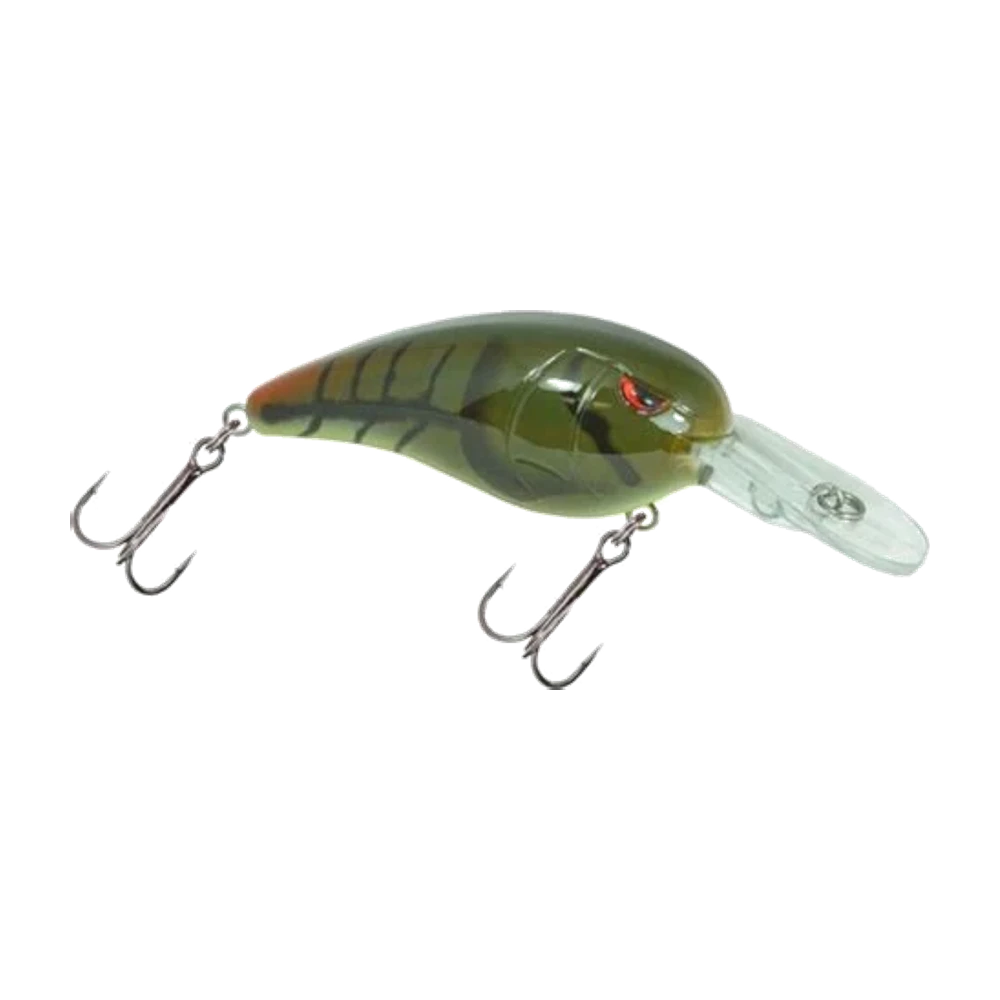
This lure shines under specific conditions. CarnaFish tells you in 10 seconds if today is one of them.
A dam wall of rip-rap, a line of blocks along a canal, a bank of big stones at the foot of a bridge: these are among the best bass spots there are, and they are also the ones most anglers cross in ten minutes before moving on to something else. The reason is simple: you lose lures there.
So people fish these spots from a distance, parallel to them, without ever really touching the rock. And that is precisely the opposite of what you should do, because on this type of structure the fish does not react to the lure going past: it reacts to the lure that hits something and kicks sideways.
The RK Crawler is built around that single principle. It is not a crankbait you fish in open water; it is a crankbait you fish in the hard stuff, and its whole geometry is designed to get back out of it.
The lip: wide, not long
That is the difference you see at first glance. Where a deep crankbait carries a long, narrow lip, the RK Crawler carries a wide, almost square lip with softened corners.
That geometry produces three effects:
- It acts as a bumper. The lip hits the obstacle before the hooks do, across a wide surface, and pivots the lure to one side instead of wedging it into the gap between two blocks.
- It generates a clean kick out. On contact, the lure shoots violently sideways before coming back on line. That break is what triggers the bite.
- It keeps a wide action at low speed. A wide lip moves more water than a narrow one at the same speed, which lets you slow down without the lure losing its roll.
The trade-off is that it does not go deep. Depending on version, reckon on a working band between 1 and 2.5 m. Beyond that, it is no longer the tool.
The retrieve: force the knock, then do nothing
The sequence is short, but every step has a function.
- Cast parallel to the rip-rap, not at right angles to it. You want the lure running along the structure for its whole path, not crossing it in three metres.
- Three or four fast turns as soon as it hits the water to drive the lure down to its working depth.
- A steady, medium retrieve, until the first contact. You have to feel the lure touching: if you feel nothing for ten seconds, shorten your cast or move closer to the structure.
- At the moment of the knock, ease off half a turn or stop completely for half a second. The lure floats, rises slightly, clears the block and picks its action back up. That is the bite window.
- Resume the retrieve and look for the next contact.
- Do not set the hook on the knock. A crankbait hits a stone twenty times a cast; setting every time will cost you time and lures.
On the water: on rip-rap, the right working depth is not the one where you pass above the stones, it is the one where you touch one every two or three turns of the handle. If you never knock into anything, you are fishing too high; if you keep getting stuck, you are fishing too deep. You adjust that by changing version or line diameter, not by changing speed.
Setting depth with the line
On a crankbait, line diameter is a depth setting, not a rigging detail. Thick fluorocarbon acts as a brake in the water and stops the lure going down; fine line lets it reach its maximum depth.
| Fluorocarbon | Effect on depth | Context |
|---|---|---|
| 0.40 mm | About 30 cm higher | Shallow rock, big fish, very abrasive structure |
| 0.35 mm | Neutral setting | Standard use on rip-rap |
| 0.30 mm | About 30 cm lower | When you need to reach the foot of the bank |
Three remarks that go with that:
- Fluorocarbon, not braid. Braid has no stretch at all: a fish that hits a crankbait at full speed comes off because nothing absorbs the head shakes.
- A rod with a parabolic action. Same logic. A stiff rod rips the trebles out of the mouth.
- No heavy clip. A small round clip is fine, but a chunky model weighs the nose down and changes the attitude on deflection.
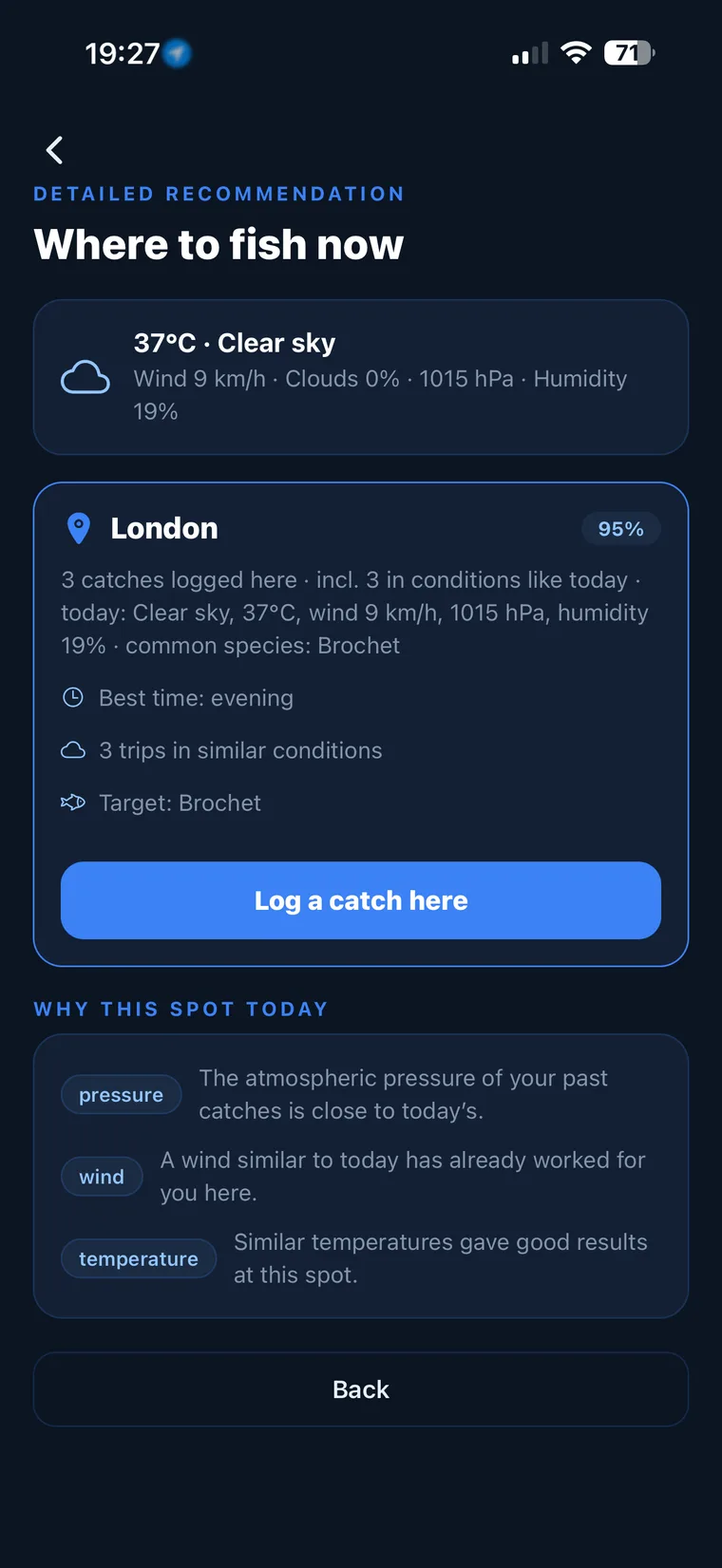
Not sure what to tie on?
Photograph your spot: CarnaFish reads the scene, cross-checks the conditions and gives you the zone, the lure and the retrieve. Free on iOS and Android.
Where it excels, where it is beside the point
Its windows:
- Rip-rap and block walls, fished parallel. That is its whole reason for existing.
- Shallow cobble and gravel bottoms, where the lure ploughs and kicks up clouds of particles.
- Stumps and scattered dead wood, provided it is occasional: the wide lip bounces well off a trunk, less well in a tangle of branches.
- Spring and early autumn, when bass come to hunt crayfish over the rock. Our beginner's guide to bass fishing covers those windows.
Where it has nothing to do:
- Open water with no structure. With nothing to hit, it loses 80% of its point and a deeper crankbait will cover the ground better.
- Dense weed. The lip does not push vegetation aside, it collects it.
- Depths beyond 3 m. It does not go down, full stop.
- Very cold water below 8 to 10 °C. A fast crankbait is no longer the right register.
RK Crawler or a classic squarebill
The natural comparison is the Strike King KVD Squarebill, which rests on the same deflection logic. The difference lies in how each one rebounds: the classic squarebill, with its sharp corners, produces a short, abrupt deflection, very effective on dead wood and stumps. The softened lip of the RK Crawler tends instead to slide the lure along the block before sending it off to the side, which snags far less in the gaps of a rip-rap wall. On a stone wall, that is a real saving in lures.
In the same range, the SPRO Fat Papa answers a completely different question: round body, long lip, it is built to go deep and to search open water over deep flats. The two never meet on the same spot — one works rock shallower than 2.5 m, the other open bottom below that.
And if you are unsure what working depth to aim for when you reach the bank, CarnaFish analyses a photo of the spot and answers.
Key takeaways
- The wide lip acts as a bumper: it pivots the lure off the block instead of wedging it.
- The whole game is to force the knock, then ease off for half a second to let the lure clear itself.
- One contact every two or three turns of the handle is the right benchmark for depth.
- Fluorocarbon diameter sets the depth: 0.40 mm to lift it, 0.30 mm to drop it.
- Fluorocarbon and a parabolic rod are compulsory; braid and a stiff rod lose fish.
FAQ
How deep does the RK Crawler run?
Between 1 and 2.5 m depending on the version and the line diameter used. It is a shallow-water crankbait: beyond 3 m you need to switch to a long-lipped model.
Should I set the hook when the lure bangs into a stone?
No. On rip-rap the lure hits rock dozens of times per cast. Wait until you feel a weight that resists and pulls, which feels nothing like a sharp knock followed by the action resuming.
How do I avoid losing the lure in the blocks?
Fish parallel to the structure rather than at right angles to it, and ease off half a turn of the handle as soon as you feel contact. The buoyant lure rises slightly and frees itself in the vast majority of cases.
Braid or fluorocarbon?
Fluorocarbon, without hesitation. Braid does not absorb the head shakes of a fish hooked at full speed on a lure with trebles, and the drop-off rate climbs sharply. Fluorocarbon also sets the running depth through its diameter.
What colour on rip-rap?
Craw, red-brown and orange tones are a logical starting point in spring, when bass are hunting crayfish over the rock. In clear water and in summer, a natural baitfish pattern often takes over.
How does it differ from a classic squarebill?
The sharp-cornered squarebill produces an abrupt deflection, perfect on dead wood and stumps. The RK Crawler, with its wide, softened lip, slides more along the blocks and snags less in the gaps of a rip-rap wall.
The full bass lure guideSeason-by-season strategy: which family of lure, when, and why.Go from theory to fish
CarnaFish reads your spot from a photo and gives you the game plan: zone, lure, retrieve. Free on iOS and Android.