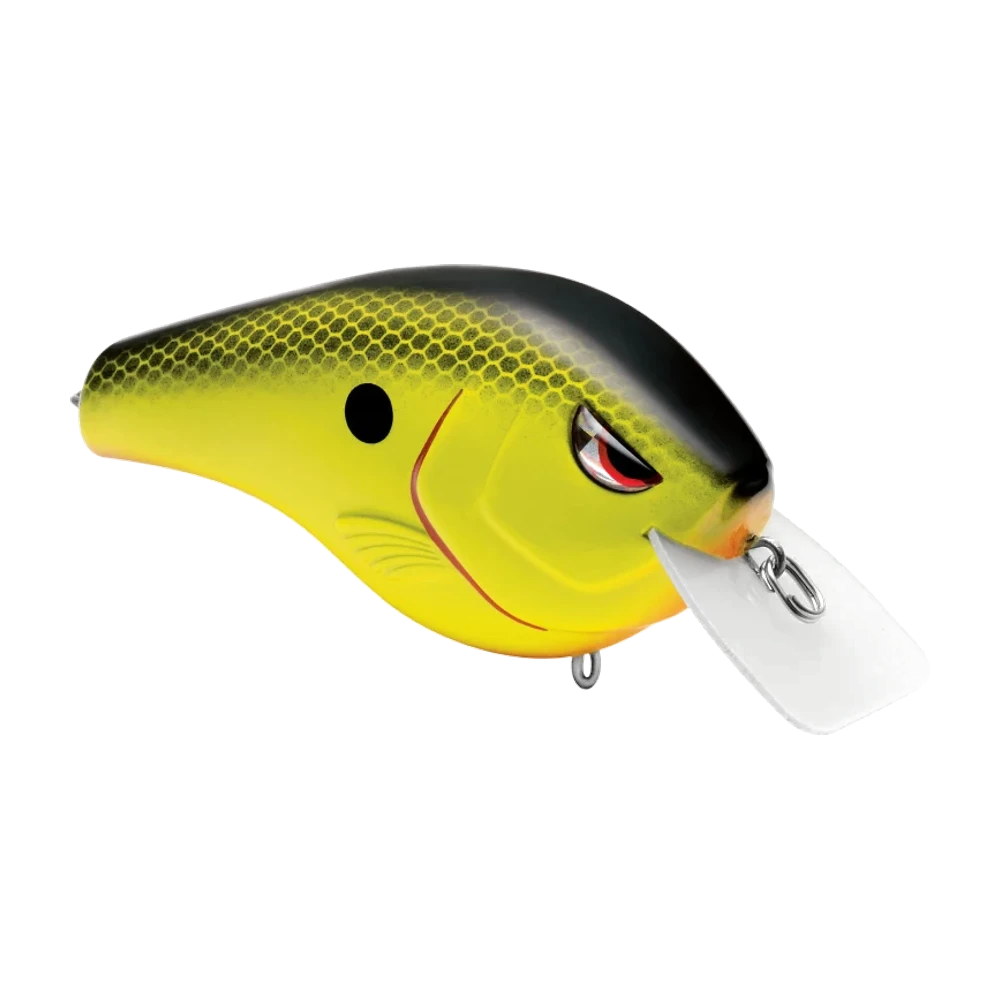
SPRO Fat Papa: the round crankbait you fish by casting distance
One lure, endless conditions. CarnaFish reads your spot from a photo so you are not just guessing.
You tie on a crankbait rated at four metres, you cast twenty metres, you retrieve, and you never once touch the bottom of a flat you sounded at three and a half. You conclude that the stated depth is fantasy.
It is not. It is simply conditional. A deep crankbait does not behave like a lure that sinks: it digs progressively, along a curve, and it only reaches maximum depth after a certain number of metres travelled — often fifteen to twenty. On a twenty-metre cast it spends most of its run going down, touches bottom for three seconds, then climbs back up the slope towards you.
The Fat Papa is a good lure for understanding that, because its round body and long lip make the phenomenon very readable through the rod. And because, once you have grasped the settings, it is one of the most effective tools there is for combing a three-metre gravel flat.
Why a round body and not a flat one
The cross-section of the body determines the nature of the action. A flat, tall body produces a tight, fast, high-frequency vibration. A round, thick body like the Fat Papa's produces the opposite: a wide, slower roll that shifts a lot of water with every oscillation.
In practice that gives three advantages:
- A low-frequency signature the fish picks up on its lateral line long before it sees the lure. That is decisive on a gravel flat in stained water, where visibility does not exceed fifty centimetres.
- Stability at low speed. You can slow right down without the lure rolling over or wandering off line, which is exactly what you need in cool water.
- Strong buoyancy. The moment you stop, it rises. That is useful for getting clear of a stump, and above all it is useful for provoking bites.
The downside: it pulls hard in the water. Over a full day, a thick crankbait dragged at three metres tires the wrist and the shoulder. That is not a comfort detail, it is why people fish badly after two hours.
Casting distance, the first setting
Before you talk about colour or speed, look at this table — it is the logic of this style of fishing.
| Casting distance | What the lure does | Use |
|---|---|---|
| Under 15 m | Sinks without reaching maximum depth | Little point with this type of lure |
| 20 to 30 m | Reaches depth over the middle third of the run | The standard on an even flat |
| Over 30 m | Stays on the bottom for a long stretch | Searching wide, uniform flats |
Two further levers complete the setting:
- Fluorocarbon diameter. 0.30 mm lets the lure go to its maximum. 0.35 mm lifts it by about twenty centimetres. Above 0.35 mm you lose real depth and distance.
- Rod position. Tip pointed at the water, almost in it, and you gain depth. Rod held high and you lift the lure by 40 to 60 cm. It is the fastest way to clear an obstacle you have spotted without changing lure.
The retrieve: contact first
- Cast as far as you can. Here, distance is depth, not showmanship.
- Rod tip down as soon as it hits the water, and a steady, sustained retrieve to start the dive.
- Look for the bottom. You should feel the gravel scraping the lip. As long as you feel nothing, you are fishing too high and this lure is doing nothing for you.
- On contact, ease off half a turn without stopping completely. The lure keeps ploughing instead of rising.
- On a solid obstacle — a stump, a big boulder — stop dead for a second. The lure rises, clears itself, and that rise triggers bites.
- Hold the same speed through the whole run. The deep crankbait is fished on consistency: the breaks in rhythm come from bottom contact, not from your hand.
On the water: when you are casting again and again without touching bottom, do not change lure straight away — first put your rod tip in the water and add five metres to your casts. Nine times out of ten the lure was the right one, and it was the geometry of your retrieve stopping it from digging.
The zander use, often overlooked
The deep crankbait is filed away as a bass lure, and that is a shame. On big rivers and reservoirs it covers a job soft plastics do badly: combing a large two-to-four-metre gravel flat quickly to locate scattered zander.
Three points specific to that use:
- Late spring and autumn, when zander move up onto the flats and follow shoals of silver fish. In midwinter, forget it.
- A slower retrieve than for bass, with longer pauses in speed on contact with the gravel.
- Check your trebles. Zander have hard, bony mouths: a point blunted by gravel costs you fish. This style of fishing wears hooks out faster than any other.
Our beginner's guide to zander explains how to spot those flats and which season to attack them in.
Not sure what to tie on?
Photograph your spot: CarnaFish reads the scene, cross-checks the conditions and gives you the zone, the lure and the retrieve. Free on iOS and Android.
Where it excels, where it falls behind
Its windows:
- Gravel and cobble flats between 2 and 4 m, long and even, to be covered fast.
- Stained water, where the wide roll and the low frequency carry far.
- Gentle breaks and progressive slopes, along which the lure ploughs for a long stretch.
- Cool but not cold water, between 10 and 18 °C, where stability at low speed becomes an advantage.
Its limits:
- Cluttered ground. A deep crankbait with two trebles in dense dead wood is a loss waiting to happen.
- Short, precise spots. It needs room to work; on a ten-metre spot you have no time to get it down.
- Depths beyond 5 m, out of reach whatever the version.
- Finesse fishing for educated fish in clear water. The signal is massive, and that can work against you.
Fat Papa or a short-lipped crankbait
Against the SPRO RK Crawler, the dividing line is clear and comes down to the structure you are targeting. The RK Crawler works rip-rap and rock shallower than two and a half metres, deflecting off the blocks. The Fat Papa works open bottom, deeper, in continuous contact with gravel or sand. They never compete over the same spot.
Against a Rapala DT10, the difference is subtler: the DT10 favours a quick dive and a very even action on a balsa body. The Fat Papa bets more on volume and water displacement, easier for fish to read in dirty water but more tiring to wind in. On a clear flat the DT10 often comes out ahead; on a murky reservoir, the reverse.
And if you are torn between a deep crankbait and a soft plastic on a flat you do not know, CarnaFish analyses a photo of the spot and answers.
Key takeaways
- A deep crankbait only reaches its depth after about fifteen metres: casting distance is the first setting.
- The round body produces a wide, low-frequency roll, very readable in stained water.
- If you never feel the bottom, drop the rod tip and lengthen the cast before changing lure.
- Excellent on zander for combing a gravel flat in spring and autumn.
- Unsuited to cluttered ground, short spots and depths beyond 5 m.
FAQ
Why doesn't my crankbait reach its stated depth?
Because a crankbait digs progressively and only reaches its maximum after fifteen to twenty metres of retrieve. A short cast, line that is too thick or a rod held high is enough to keep it a metre above the theoretical depth.
What fluorocarbon diameter should I use?
0.30 mm to let the lure go as deep as it can, 0.35 mm to hold it about twenty centimetres higher. Above that, the drag of the line in the water costs you both depth and casting distance.
Should I fish it fast or slow?
A steady, sustained speed for bass, slower for zander and in cool water. What matters is not the absolute speed but the consistency: the breaks in rhythm should come from bottom contact, not from your hand.
Does the Fat Papa work for zander?
Yes, particularly on gravel flats of two to four metres in late spring and autumn. It is an excellent locating tool when fish are scattered and a soft plastic is too slow to cover the water.
How do I free it from a stump?
Stop the retrieve for a second. The buoyant body rises and frees itself in most cases. That rise is also one of the moments when bites most often come, so do not cast again straight away.
Which version should I choose?
The small one for flats of two to three metres and average fish, the big one as soon as you need to reach three and a half metres or more, cast a long way, or fish into the wind. Choose the version by the depth of the flat, not by the size of the fish you are after.
The full bass lure guideSeason-by-season strategy: which family of lure, when, and why.Go from theory to fish
CarnaFish reads your spot from a photo and gives you the game plan: zone, lure, retrieve. Free on iOS and Android.