Strike King Gravel Dawg 8: the medium crankbait built to ricochet off rock
The right lure in the wrong spot still catches nothing. CarnaFish spots the zone that works, from a single photo.
There is a band of water almost nobody fishes properly: the stretch between about one and a half and two metres over hard rock. Too deep for a squarebill, too shallow to justify a big deep diver that will plough and snag. That gap is exactly what the Gravel Dawg 8 targets, a compact crankbait Strike King says was developed with tournament anglers Todd Castledine and Kevin VanDam. The name tells you most of what you need to know: it is meant to work gravel.
The real numbers, and one contradiction worth knowing
The manufacturer's spec table lists a single version: 6.4 cm / 2.5 in for 14 g / 1/2 oz. The body is short and deep-bellied, a stubby silhouette that pushes a lot of water for its size. That same table classes the bait as floating, which is the single most useful line in the whole spec sheet: stop reeling and it rises.
On depth there is a wobble in the brand's own wording. The table column says 1.5-2.1 m / 5-7 ft, while the written blurb mentions a range reaching eight feet, roughly 2.4 m. The table figure is the conservative one, and it is the one to plan your spot around. As for the 8 in the name, it most likely refers to that maximum depth in feet, but the manufacturer never states it outright, so treat it as a range label rather than a specification.
In practice a crankbait this size only reaches its rated depth if you give it the means: a long cast, thin line, rod tip low. With heavy braid and a fifteen-metre lob you will lose a comfortable foot off the whole range.
A bill meant to hit things, not avoid them
Strike King describes a purpose-shaped bill engineered to deflect off cover and cut down on hang-ups. That is the whole point of the model, and it changes how you should fish it. A deflection crankbait only truly works when it collides. While the bill touches nothing you are holding a decent but unremarkable bait; the moment it clips a stone and the lure kicks sideways, you trigger the reflex.
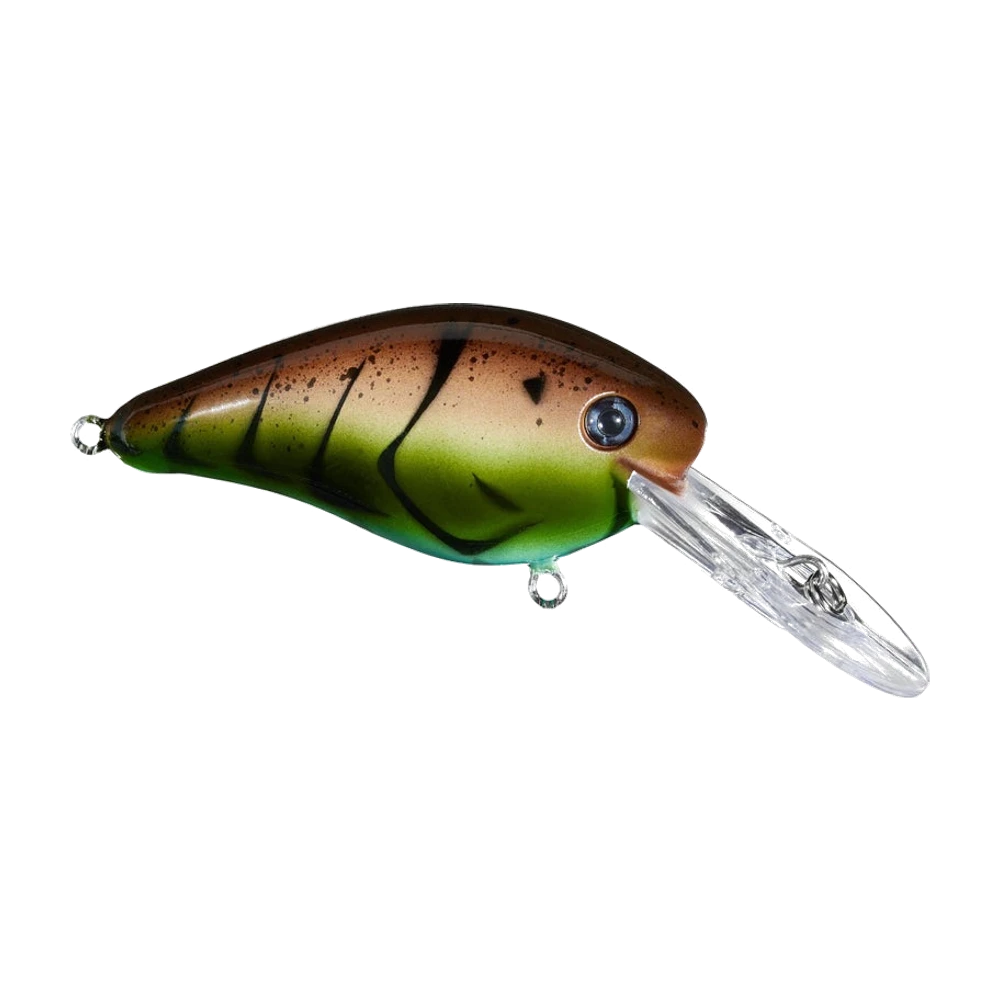
On the product photo the line tie sits not on the nose but inside the bill itself, well away from the body joint. That placement lengthens the lever arm and feeds into the ricochet behaviour — an observation from a product photo rather than a published specification, but one consistent with what the bait does.
The classic mistake: trying to protect the lure
Plenty of anglers slow down the instant they feel gravel, afraid of snagging. Do the opposite. Hold a steady medium retrieve, let the bill strike properly, and give half a second of slack the moment the bait jams. Because the body floats, that micro-pause lifts it a centimetre or two and frees it most of the time without you pulling. Pulling does the reverse: it drives the hook into the crevice.
Where and when to use it
The spots that suit it are those where hard bottom rises: a riprap dam face, a bank slide, a tailrace, a bridge pillar, a rock bar cutting across a flat. Anything that takes the bottom from three metres to a metre and a half in a short horizontal distance.
In spring and early autumn, with water between twelve and eighteen degrees, it is a fast search bait: comb a riprap wall along its full length, casting at an angle so the lure stays in the productive band as long as possible. Through high summer it keeps its value at first light and at dusk, when fish climb onto the rock to feed.
In Europe its size also makes it a very effective perch bait on reservoir riprap. Perch are often the more realistic target than bass on that kind of structure, and the Gravel Dawg fits comfortably in their mouth.
When you work a dam wall, count the contacts per retrieve. Fewer than three or four and you are too far off the bottom: cast further or drop the rod. More than ten and you are ploughing and will eventually lose it: step a metre back. The right setting is when the bait touches constantly but never stays stuck.
Rod, line and hooks
A medium casting cranking rod, parabolic enough not to tear the bait out of a fish's mouth on the strike, matched with a moderate-ratio reel. Fluorocarbon around 0.25-0.30 mm works well: it sinks slightly, helps the lure hold depth, and takes abrasion from rock. Braid is usable but lifts the bait and transmits contacts far too sharply.
Use a loop knot or a small snap. A knot cinched tight against the eye binds the nose and shaves off wobble amplitude, exactly as it does on a Rapala Shad Rap.
Strike King states the bait is fitted with black nickel hooks. On the product photo the lure appears bare, with two empty hook hangers, so do not rely on the image to judge treble size — only the written description counts here. If you fish rock all day the points dull quickly; check them against a fingernail every hour or so.
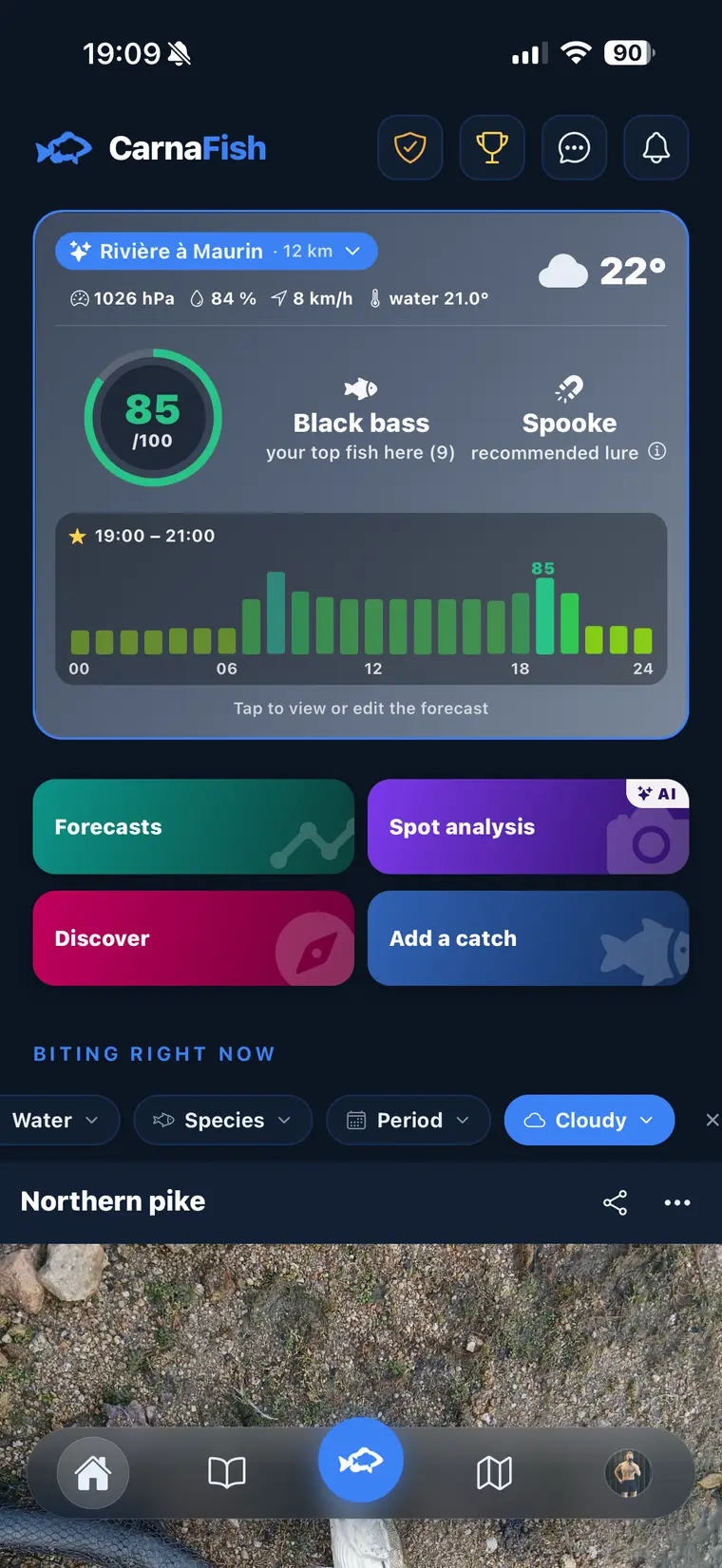
Not sure what to tie on?
Photograph your spot: CarnaFish reads the scene, cross-checks the conditions and gives you the zone, the lure and the retrieve. Free on iOS and Android.
Colours by water clarity
- Clear water: Sexy Shad, the grey-and-white barred pattern that remains the safe bet in the Strike King palette whenever fish can see properly.
- Lightly stained water: Chartreuse Sexy Shad, which adds just enough yellow-green to stay visible without turning gaudy.
- Gravel bottom, neutral water: a crawfish pattern such as Powder Blue Back Craw, which matches what fish actually eat on that substrate. It is also the colour family of the lure photographed here.
Where it sits among the other Strike King cranks
The Gravel Dawg 8 replaces neither of the two cranks you probably already own. Above it, the Strike King KVD 1.5 Squarebill covers the first metre and the wood. Below it, the Strike King 3XD reaches two to two and a half metres with a tighter action. The Gravel Dawg slots between them with a wider wobble, which makes it a slightly-stained-water bait rather than a gin-clear one. And when the target band drops further or the speed needs to climb, a Strike King Red Eyed Shad takes over on the same hard bottom.
Knowing which band of water to fish is half the job — and that is exactly what CarnaFish does: photograph the spot and the AI suggests the zone, the depth and the lure type that fit the day's conditions. To build the groundwork on structure and tackle, our beginner's guide to bass fishing starts from scratch.
What to remember
- A floater of 6.4 cm / 2.5 in and 14 g / 1/2 oz, rated 1.5-2.1 m / 5-7 ft in the spec table — the written blurb mentions up to 2.4 m, so plan on the lower figure.
- The bill is built to collide: with no contact on hard bottom, the bait loses most of its edge.
- Give half a second of slack when it jams; the floating body frees itself, pulling only buries it.
- A size aimed at bass that takes perch very well on European riprap.
FAQ
How deep does the Gravel Dawg 8 actually run?
Strike King's spec table gives 1.5-2.1 m / 5-7 ft, while the written description mentions a slightly wider range up to roughly 2.4 m / 8 ft. On the water you will only reach the top of that bracket with a long cast, thin fluorocarbon and the rod tip low.
Is it floating or sinking?
Floating — it is stated outright in the manufacturer's class column. That buoyancy is what lets you free it from an obstruction by simply dropping tension for half a second.
How does it differ from a squarebill like the KVD 1.5?
The squarebill works the first metre and specialises in wood; the Gravel Dawg runs deeper and its oval bill is designed for rock. The two complement each other across a day rather than replacing one another.
What line should I use with this crankbait?
Fluorocarbon around 0.25-0.30 mm is the best compromise: it helps the bait hold depth and copes with abrasion from gravel. Avoid straight braid, which lifts the lure and makes contacts feel harsh.
Does it catch perch?
Yes, and it is a thoroughly sensible use in Europe on dam riprap and breakwaters. At 6.4 cm / 2.5 in it fits easily inside the mouth of a decent perch.
Should I upgrade the factory hooks?
Not on principle: the manufacturer specifies black nickel hooks. That said, fishing gravel dulls points far faster than open water, so check them regularly and swap them as soon as they stop catching on a fingernail.
The full bass lure guideSeason-by-season strategy: which family of lure, when, and why.Go from theory to fish
CarnaFish reads your spot from a photo and gives you the game plan: zone, lure, retrieve. Free on iOS and Android.